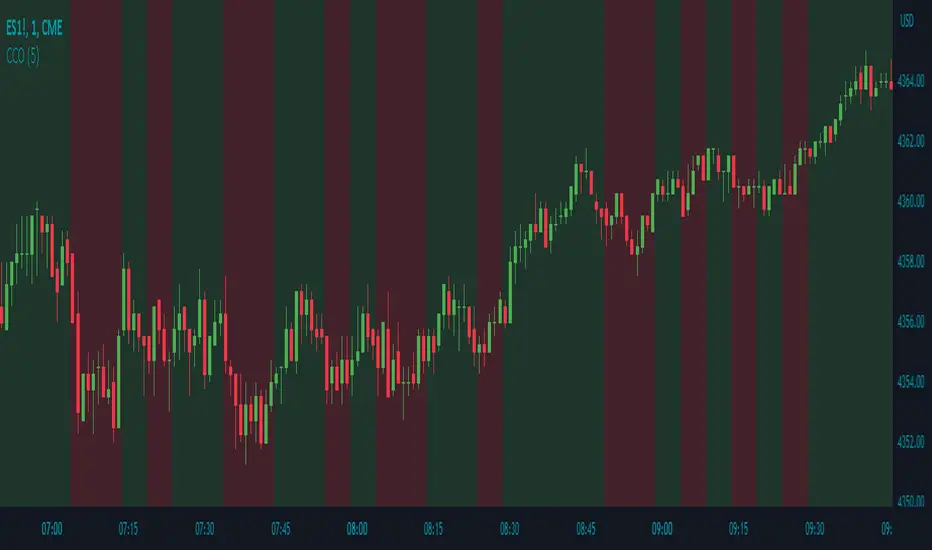
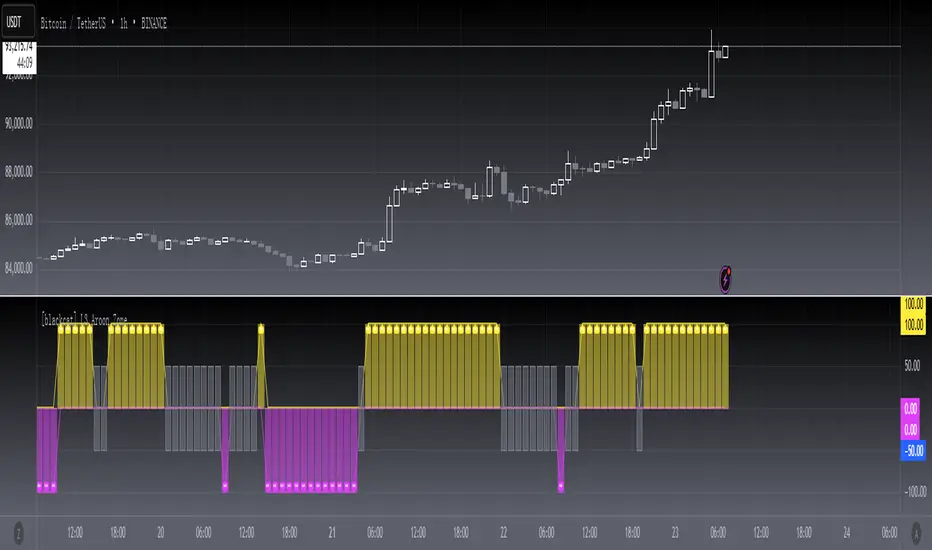
Traders Dynamic Index(TDI) + Momentum Candles[CW_Trades]The Traders Dynamic Index(TDI) is a trend, momentum and volatility indicator. The TDI is comprised of a standard Relative Strength Index(RSI) line, but also includes an RSI signal line, Bollinger Bands of the RSI and adjusted horizontal overbought/oversold levels. This version of the TDI offers the ability to color the RSI line based on RSI momentum. This version colors the horizontal background levels of the RSI depending on whether price is in a bull trend or bear trend. This version also allows you to color the price candles based on RSI momentum.
When reading the TDI the first line you want to look at is the RSI line, which is the line that changes color. The RSI line in this indicator is set to a lookback period of 13 rather than 14 as in the standard RSI indicator.
-The RSI line color is derived from the line's horizontal position(0-100). When the RSI line is between 45-55 the RSI line will be gray which indicates no momentum, or that price is neutral.
-When the RSI line is above 55 the line will be colored shades of green which indicate bullish price momentum:
--55-60 = dark green = weak bullish momentum
--60-70 = green = bullish momentum
--70-80 = light green = strong bullish momentum
--above 80 = bright green = extreme/overbought bullish momentum
---The brighter the shade of green the stronger the bullish momentum.
-When the RSI line is below 45 the line will be colored shades of purple which indicate bearish price momentum:
--45-40 = dark purple = weak bearish momentum
--40-30 = purple = bearish momentum
--30-20 = light purple = strong bearish momentum
--below 20 = bright purple = extreme/oversold bearish momentum
---The brighter the shade of purple the stronger the bearish momentum.
The next line in the TDI is the RSI Signal Line and it is an 8-period average of the RSI. The RSI Signal Line shows short-term trend in momentum. When the RSI line is above the RSI signal line the short-term momentum trend is considered bullish. When the RSI line is below the RSI signal line the short-term momentum trend is considered bullish.
The next set of lines you want to look at after the RSI line are the Bollinger Bands of the RSI, which are preset to the color blue. The RSI Bollinger Bands are read just as standard price Bollinger Bands in that the RSI trending above the middle of the bands is considered bullish and an RSI line trending below the middle of the bands is considered bearish. Breaches above the upper Bollinger Band and breaches below the lower Bollinger Band are considered to be signs of extreme volatility. A breach of the upper band indicates that momentum is extremely volatile to upside and price could potentially reverse, or make a short-term top. When this occurs the RSI line is colored yellow. When the RSI line breaches the lower Bollinger Band it indicates that momentum is extremely volatile to the downside and price could potentially reverse, or make a short-term bottom. When this occurs the RSI line is colored red.
Along with watching where the RSI line is relative to the Bollinger Bands, you also want to watch where the middle Bollinger Band is on the horizontal range(0-100). When the middle Bollinger Band is above 50 it indicates intermediate-term bullish momentum. When the middle Bollinger Band gets near or above 70 it usually marks a short-term top or end of a bull rally. When the middle Bollinger Band is below 50 it indicates intermediate-term bearish momentum. When the middle Bollinger Band gets near or below 30 it usually marks a short-term bottom or end of a bear rally.
When the middle Bollinger Band crosses above and below the horizontal 50 level it changes the color of the TDI background. When the middle band is above 50 the background is colored green and when the middle band is below 50 the background is colored purple. The green background will fill the 40-80 levels and is where you want to see most of the RSI line action during a bull trend in price. When the RSI is mostly trending between 40-80 the overall trend behind price is considered bullish. The purple background will fill the 20-60 levels and is where most of the RSI line action will be during a bear trend in price. When the RSI line is mostly trending between 20-60 the overall trend behind price is considered bearish.
The TDI is a great tool for any trader, especially if you already use the RSI indicator since the TDI is basically and improved/advanced RSI.
스크립트에서 "bear"에 대해 찾기
Fractal Trend Trading System [DW]This is an advanced utility that uses fractal dimension and trend information to generate useful insights about price activity and potential trade signals.
In this script, my Advanced FDI algorithm is used to estimate the fractal dimension of the dataset over a user defined period.
Fractal dimension, unlike spatial or topological dimension, measures how complexity or detail in an "object" changes as its unit of measurement changes, rather than the number of axes it occupies.
Many forms of time series data (seismic data, ECG data, financial data, etc.) have been theoretically shown to have limited fractal properties.
Consequently, we can estimate the fractal dimension from this data to get an approximate measure of how rough or convoluted the data stream is.
Financial data's fractal dimension is limited to between 1 and 2, so it can also be used to roughly approximate the Hurst Exponent by the relationship H = 2 - D.
When D=1.5, data statistically behaves like a random walk. D above 1.5 can be considered more rough or "mean reverting" due to the increase in complexity of the series.
D below 1.5 can be considered more prone to trending due to the decrease in complexity of the series.
In this script, you are given the option to apply my Band Shelf EQ algorithm to the dataset before estimating dimension.
This enables you to transform your data and observe how its newly measured complexity changes the outputs.
Whether you want to give emphasis to some frequencies, isolate specific bands, or completely alter the shape of your waveform, EQ filtration makes for an interesting experience.
The default EQ preset in this script removes the low shelf, then attenuates low end and high end oscillations.
The dominant cyclical components (bands 3 - 5 on default settings) are passed at 100%, keeping emphasis on 8 to 64 sample per cycle oscillations.
The estimated dimension is then used to calculate the High Dimension Zone and the Error Bands.
Both of these components are great for analyzing trends and for estimating support and resistance values.
The High Dimension Zone is composed of a high line, low line, and midline that update their values when D is at or above the user defined zone activation threshold.
The zone is then averaged over a user defined amount of updates and zone width is multiplied by a user defined value.
The Error Bands are composed of a high, low, and middle band that are calculated using an error adjusted adaptive filter algorithm that utilizes dimension as the smoothing constant modulator.
The basis filter for the error bands has two calculation types built in:
-> MA - Calculates the filters as adaptive moving averages modulated by D.
-> WAP - Calculates the filters as adaptive weighted average prices modulated by D.
The WAP starting point can be based on the High Dimension Zone being moved or a user defined interval.
You can also define the WAP's minimum and maximum periods for additional control of the initial and decayed sensitivity states.
The alpha (smoothing constant) modulator can be fine tuned using the designated dimension thresholds.
When D is at or below the low dimension threshold, the filter is most responsive, and vice-versa for the high dimension threshold.
Alpha is then multiplied by a user defined amount for additional control of sensitivity.
Band width is then multiplied by a user defined value.
A Hull transformation can be optionally performed on the zone averaging and band filter algorithms as well, which will alter the frequency and phase responses at the cost of some overshoot.
This transformation is the same as a typical Hull equation, but with custom filters being used instead of WMA.
The calculated outputs are then used to gauge the trend for signal and color scheme calculations.
First, a dominant trend indication is selected from its designated dropdown tab.
The available built in indications to choose from are:
-> Band Trend (Outer) - Detects band breakouts and saves their direction to gauge trend.
-> Band Trend (Median) - Uses disparity between source and the band median to gauge trend.
-> Zone Trend (Expansion) - Detects when the high fractal zone expands and saves its direction to gauge trend.
-> Zone Trend (Outer Levels) - Detects zone breakouts and saves their direction to gauge trend.
-> Zone Trend (Median) - Uses disparity between source and the zone median to gauge trend.
Then the trend output is optionally filtered before triggering signals.
There are multiple trend filtration options built into this script that can be used individually or in unison:
-> Filter Trend With High Fractal Zone - Filters the trend using the specified zone level or combination of levels with either disparity or crossover conditions.
There is a set of options for bullish and bearish trends.
-> Filter Trend With Error Bands - Filters the trend using the specified band level or combination of levels with either disparity or crossover conditions.
There is a set of options for bullish and bearish trends.
-> Filter Trend With Band - Zone Disparity Condition - Filters the trend using the specified band level, zone level, and disparity direction.
There is a set of options for bullish and bearish trends.
-> Filter By Zone That Moves With The Trend - Filters the specified trend by detecting when the high fractal zone’s direction correlates.
-> Filter By Bands That Move With The Trend - Filters the specified trend by detecting when the error bands’ direction correlates.
-> Filter Using Wave Confirmation - Filters the specified trend by detecting when source is in a correlating wave with user defined length.
You can also choose separate lengths for bullish and bearish trends.
-> Filter By Bars With Decreasing Dimension - Filters the specified trend by detecting when fractal dimension is decreasing, suggesting source is approaching more linear movement.
The filtered trend output is then used to generate entry and exit signals.
There are multiple options included to fine tune how these signals behave.
For entries, you have the following options built in:
-> Limit Entry Dimension - Limits the range of dimensional values that are acceptable for entry with user defined thresholds.
This can be incredibly useful for filtering out entries taken when price is moving in a more complex pattern,
or when price is approaching a peak and you’re a little late to the party.
-> Enable Position Increase Signals - Enables more entry signals to fire up to a user defined number of times when a position is active.
This is helpful for those who incrementally increase their positions, or for those who want to see additional signals as reference.
-> Limit Number Of Consecutive Trades - Limits the number of consecutive trades that can be opened in a single direction to a user defined maximum.
This is especially useful for markets that only trend for brief durations.
By limiting the amount of trades you take in one direction, you have more control over your market exposure.
There is a set of these options for both bullish and bearish entries.
For exits, you have the following options built in:
-> Include Exit Signals From High Fractal Zone - Enables exit signals generated from either crossover or disparity conditions between price and a specified zone level.
-> Include Exit Signals From Error Bands - Enables exit signals generated from either crossover or disparity conditions between price and a specified zone level.
-> Include Inactive Trend Output For Exits - Triggers exit signals when the filtered trend output is an inactive value.
-> Dimension Target Exit Method - Triggers exit signals based on fractal dimension hitting a user defined threshold.
You can either choose for the exit to trigger instantly, or after dimension reverts from the target by a user specified amount.
-> Exit At Maximum Entry Dimension - Triggers exit signals when dimension exceeds the maximum entry limit.
-> Number Of Signals Required For 100% Exit - Controls the number of exit signals required to close the position.
You can also choose whether or not to include partial exits.
Enabling them will fire a partial signal when an exit occurs, but the position is not 100% closed.
Of course, there is a set of these options for bullish and bearish exits.
In my opinion, no system is complete without some sort of risk management protocol in place.
So in this script, bullish and bearish trades come equipped with optional protective SL and TP levels with signals.
The levels can be fixed or trailing, and are calculated with a user defined scale.
The available scales for SL and TP distances are ticks, pips, points, % of price, ATR, band range, zone range, or absolute numerical value.
Now what if you have some awesome signals of your own that you’d like to use in conjunction with this script?
Well good news. You can!
In addition to all of the customizable features built into the script, you can integrate your own signals into the system using the external data inputs and linking your script.
This adds a whole new layer of customization to the system.
With external signals, you can use your own custom dominant trend indication, filter the dominant trend, and trigger exits and protective stops using custom signals.
The signal input is an integer format. 1=Bull Signal, -1=Bear Signal, 2=Bull Exit, -2=Bear Exit, 3=Bull SL Hit, -3=Bear SL Hit, 4=Bull TP Hit, -4=Bear TP Hit.
You can also use the external input as a custom source value for either dimension or global sources to further tailor the system to your liking.
The color scheme in this script utilizes two custom gradients that can be chosen for bar and background colors:
-> Trend (Dominant or Filtered) - A polarized gradient that shows green scaled values for bullish trend and red scaled values for bearish trend.
The colors are brighter and more vibrant as perceived trend strength increases.
-> Dimension - A thermal gradient that shows cooler colors when dimension is higher, and hotter colors when dimension is lower.
Both color schemes are dependent on the designated dimension thresholds.
The script comes equipped with alerts for entries, additional entries, exits, partial exits, and protective stops so you can automate more and stare at your charts less.
And lastly, the script comes equipped with additional external outputs to further your analysis:
-> Entry And Exit Signals - Outputs in the same format as the external signal input with these additions: 5=Bull Increase, -5=Bear Increase, 6=Bull Reduce, -6=Bear Reduce.
You can use these to send to other scripts, including strategy types so you can backtest your performance on TV’s engine.
-> Dominant Trend - Outputs 1 for bullish and -1 for bearish. Can be used to send trend signals to another script.
I designed this tool with individuality in mind.
Every trader has a different situation. We trade on different schedules, markets, perspectives, etc.
Analytical systems of basically any type are very seldom (if ever) “one size fits all” and usually require a fair amount of modification to achieve desirable results.
That’s why this system is so freely customizable.
Your system should be flexible enough to be tailored to your analytical style, not the other way around.
When a system is limited in what you can control, it limits your experience, analytical potential, and possibly even profitability.
This is not your typical pre-set system. If you're looking for just another "buy, sell" script that requires minimal thought, look elsewhere.
If you’re ready to dive into a powerful technical system that allows you to tailor the experience to your style, welcome!
-----------------------------------------------------------------------------------------------------------------------------------------------------------------
This is a premium script, and access is granted on an invite-only basis.
To gain access, get a copy of the system overview, or for additional inquiries, send me a direct message.
I look forward to hearing from you!
-----------------------------------------------------------------------------------------------------------------------------------------------------------------
General Disclaimer:
Trading stocks, futures, Forex, options, ETFs, cryptocurrencies or any other financial instrument has large potential rewards, but also large potential risk.
You must be aware of the risks and be willing to accept them in order to invest in stocks, futures, Forex, options, ETFs or cryptocurrencies.
Don’t trade with money you can’t afford to lose.
This is neither a solicitation nor an offer to Buy/Sell stocks, futures, Forex, options, ETFs, cryptocurrencies or any other financial instrument.
No representation is being made that any account will or is likely to achieve profits or losses of any kind.
The past performance of any trading system or methodology is not necessarily indicative of future results.
FiFT Pro---- INTRODUCTION ----
This indicator is to measure the strength of BULL and BEAR.
The formulars are based on Price Change and Volume for period of time.
On top of that, Overbought (OB) and Oversold (OS) signal is included which is based on stochastic calculation.
FiFT is come with BoD signal which indicating Potential Buy on Dip setup.
FiFT Pro is further enhance to detect BULL "is about to rally" on Uptrend chart. It is a potential "further buy" signal.
---- HOW TO READ ----
GREEN BAR = BULL is stronger than BEAR
RED BAR = BEAR is stronger than BULL
BLUE BAR = POTENTIAL BoD Signal
BoD (Buy on Dip)
BOD on GREEN (With Star) = Price is oversold, Fast Turtle Buy in BULLISH environment (Strong Buy)
BOD on RED = Price is oversold, Fast Turtle Buy in BEARISH environment (Risk Buy/Do not buy/Monitor)
OB (Overbought) = Fast Turtle Sell with OverBought condition.
OB on GREEN = Price is overbought, Fast Turtle Sell in BULLISH environment (Cautious/Do not sell/Monitor)
OB on RED = Price is overbought, Fast Turtle Sell in BEARISH environment (Strong Sell)
+ve Sign = Potential BULLISH activities (Can consider further Buy IF it's uptrend EMA20 > EMA50)
-ve Sig n = Potential BEARISH activities (Can consider take profit/Sell)
Note : Best use with " EMA Indicators with BUY sell Signal " indicator
Average Sentiment OscillatorDescription of this indicator from its author:
Average Sentiment Oscillator
Momentum oscillator of averaged bull/bear percentages.
We suggest using it as a relatively accurate way to gauge the sentiment of a given period of candles, as a trend filter or for entry/exit signals.
It’s a combination of two algorithms, both essentially the same but applied in a different way. The first one analyzes the bullish/bearishness of each bar using OHLC prices then averages all percentages in the period group of bars (eg. 10) to give the final % value. The second one treats the period group of bars as one bar and then determines the sentiment percentage with the OHLC points of the group. The first one is noisy but more accurate in respect to intra-bar sentiment, whereas the second gives a smoother result and adds more weight to the range of price movement. They can be used separately as Mode 1 and Mode 2 in the indicator settings, or combined as Mode 0.
Original indicator idea from Benjamin Joshua Nash, converted from MT4 version
Usage:
The blue line is Bulls %, red line is Bears %. As they are both percentages of 100, they mirror each other. The higher line is the dominating sentiment. The lines crossing the 50% centreline mark the shift of power between bulls and bears, and this often provides a good entry or exit signal, i.e. if the blue line closes above 50% on the last bar, Buy or exit Sell, if the red line closes above 50% on the last bar, Sell or exit Buy. These entries are better when average volume is high.
It's also possible to see the relative strength of the swings/trend, i.e. a blue peak is higher than the preceding red one. A clear divergence can be seen in the picture as the second bullish peak registers as a lower strength on the oscillator but moved higher on the price chart. By setting up levels at the 70% and 30% mark the oscillator can also be used for trading overbought/oversold levels similar to a Stochastic or RSI. As is the rule with most indicators, a smaller period gives more leading signals and a larger period gives less false signals.
TradeChartist PowerTracer™TradeChartist PowerTracer is an exceptionally well designed and functional indicator, requiring minimal user input to trace the asset's Bull and Bear Power. The indicator makes it visually engaging with its various color schemes and intelligent positioning of the PowerTracer Bar, tracking not just the current trend, but also the developing trend using a visually easy to understand Power plots.
What does ™TradeChartist PowerTracer do?
1. Tracks Bull and Bear Power and plots the information visually on chart using one of the following 3 Power plot options based on high or low power detection sensitivity.
𝗣𝗼𝘄𝗲𝗿𝗧𝗿𝗮𝗰𝗲𝗿 - Plot of the Bull and Bear Power Oscillator, pivotal to this script that tracks the true Bull and Bear Power along with Bull/Bear oscillator reading, calculated dynamically using a unique and original formula. Values beyond 50 and -50 are quite rare, but theoretically, they can go beyond 80 and -80. 𝗣𝗼𝘄𝗲𝗿𝗧𝗿𝗮𝗰𝗲𝗿's highs and lows are also tracked and updated real-time using labels placed exactly at the Highs and Lows with their readings.
Bar-wise Power Holder - Absolute Bull and Bear power of each bar. It is plotted by calculating the difference between Bull and Bear Power or each bar. The values can swing between -100 and +100 even though values above 90 and below 90 are rare. The bar color on the chart will be painted using this value to visually display the Bull/Bear strength if "Paint Bars on Chart" is enabled from the indicator settings.
Bar-wise Power Fight - Plot of Maximum Bull and Bear Power of every bar that helps visualize the fight between Bulls and Bears in each bar.
2. Visually displays the Balance of Power between the Bulls and the Bears using Opponent Power Gain background fill when it is 50% or over. For example, if the current PowerTracer plot is a Bull zone, enabling this setting with Opponent Power Gain % set at 75, will paint the background when Bear Power increases beyond 75% using the Bear Power Intensity fill based on Color Scheme the user opts from the settings. This option can be enabled or disabled from settings and the Opponent Power gain % (minimum 50%) can also be adjusted to spot the change in price trend early on.
3. Uses an accompanying 𝗣𝗼𝘄𝗲𝗿𝗧𝗿𝗮𝗰𝗲𝗿 bar that helps spot the true bull and bear power using simple linear blocks, displaying the power level using power intensity colors based on the color scheme.
4. Paints price bars and PowerTracer background using Power intensity colors based on Color Scheme from the indicator settings, which helps spot the increase or decrease in Bull and Bear Power.
5. Inverts bar colors, background fill and PowerTracer bar color to help see price using the Opponent's Point of View.
What markets can this indicator be used on?
-- Forex
-- Stocks - works best with 4hr or above and prices calculated taking gaps into account.
-- Commodities
-- Cryptocurrencies
and almost any asset on Trading View
What time-frames can this indicator be used on?
This indicator can be used on all timeframes. If the asset has very little volume/volatility or is far low in comparative value against the base currency, power detection can be choppy, but with most assets, this won't be an issue.
Does this indicator repaint?
-- No. Real-time Power plots can change colors and values based on current bar close as values get calculated dynamically. Once the bar closes, plots and power intensity colors don't repaint.
-- This can be verified using Bar Replay to check if the plots and fills stay in the same bar in real time as the Bar Replay
Does the indicator send alerts when the power shifts from Bull to Bear or from Bear to Bull?
Yes. Users can get alerts when Power gets shifted using Trading View alerts. This can be done by choosing '™TradeChartist PowerTracer' and 'Powershift to Bulls' or 'Powershift to Bears' under Trading View Alert condition and by using 'Once per bar close' as user needs to wait for candle close for Power shift confirmation.
Example Charts
In this split screen chart of Bitcoin, it can be seen how the 30m chart on left is Bearish and 5m chart on right is Bullish based on Power changes. The trend can be spotted on PowerTracer by spotting the Opponent's background fill that started showing when Opponent's power gained by over 75%. This is a good example using the script for scalping/swing trading using 2 timeframes. Note that the chart on the left shows Price bars and PowerTracer bar with inverted colors to show Opponent's point of view.
In this 15m chart of GBP-USD, 100% Power gain for Entries and Exits is used. This is a more conservative approach and is suited for less aggressive traders based on complete change of trend.
In this 2hr chart of Ethereum, all 3 Power plots are used to identify the trend using low sensitivity using 100% Power Gain entries and this shows how a trade can be held longer to maximise gains using entries with Power shift confirmations.
===================================================================================================================
This is not a free to use indicator. Get in touch with me (PM me directly if you would like trial access to test the indicator)
Premium Scripts - Trial access and Information
Trial access offered on all Premium scripts.
PM me directly to request trial access to the scripts or for more information.
===================================================================================================================
Bar Balance [LucF]Bar Balance extracts the number of up, down and neutral intrabars contained in each chart bar, revealing information on the strength of price movement. It can display stacked columns representing raw up/down/neutral intrabar counts, or an up/down balance line which can be calculated and visualized in many different ways.
WARNING: This is an analysis tool that works on historical bars only. It does not show any realtime information, and thus cannot be used to issue alerts or for automated trading. When realtime bars elapse, the indicator will require a browser refresh, a change to its Inputs or to the chart's timeframe/symbol to recalculate and display information on those elapsed bars. Once a trader understands this, the indicator can be used advantageously to make discretionary trading decisions.
Traders used to work with my Delta Volume Columns Pro will feel right at home in this indicator's Inputs . It has lots of options, allowing it to be used in many different ways. If you value the bar balance information this indicator mines, I hope you will find the time required to master the use of Bar Balance well worth the investment.
█ OVERVIEW
The indicator has two modes: Columns and Line .
Columns
• In Columns mode you can display stacked Up/Down/Neutral columns.
• The "Up" section represents the count of intrabars where `close > open`, "Down" where `close < open` and "Neutral" where `close = open`.
• The Up section always appears above the centerline, the Down section below. The Neutral section overlaps the centerline, split halfway above and below it.
The Up and Down sections start where the Neutral section ends, when there is one.
• The Up and Down sections can be colored independently using 7 different methods.
• The signal line plotted in Line mode can also be displayed in Columns mode.
Line
• Displays a single balance line using a zero centerline.
• A variable number of independent methods can be used to calculate the line (6), determine its color (5), and color the fill (5).
You can thus evaluate the state of 3 different components with this single line.
• A "Divergence Levels" feature will use the line to automatically draw expanding levels on divergence events.
Features available in both modes
• The color of all components can be selected from 15 base colors, with 16 gradient levels used for each base color in the indicator's gradients.
• A zero line can show a 6-state aggregate value of the three main volume balance modes.
• The background can be colored using any of 5 different methods.
• Chart bars can be colored using 5 different methods.
• Divergence and large neutral count ratio events can be shown in either Columns or Line mode, calculated in one of 4 different methods.
• Markers on 6 different conditions can be displayed.
█ CONCEPTS
Intrabar inspection
Intrabar inspection means the indicator looks at lower timeframe bars ( intrabars ) making up a given chart bar to gather its information. If your chart is on a 1-hour timeframe and the intrabar resolution determined by the indicator is 5 minutes, then 12 intrabars will be analyzed for each chart bar and the count of up/down/neutral intrabars among those will be tallied.
Bar Balances and calculation methods
The indicator uses a variety of methods to evaluate bar balance and to derive other calculations from them:
1. Balance on Bar : Uses the relative importance of instant Up and Down counts on the bar.
2. Balance Averages : Uses the difference between the EMAs of Up and Down counts.
3. Balance Momentum : Starts by calculating, separately for both Up and Down counts, the difference between the same EMAs used in Balance Averages and an SMA of double the period used for the EMAs. These differences are then aggregated and finally, a bounded momentum of that aggregate is calculated using RSI.
4. Markers Bias : It sums the bull/bear occurrences of the four previous markers over a user-defined period (the default is 14).
5. Combined Balances : This is the aggregate of the instant bull/bear bias of the three main bar balances.
6. Dual Up/Down Averages : This is a display mode showing the EMA calculated for each of the Up and Down counts.
Interpretation of neutral intrabars
What do neutral intrabars mean? When price does not change during a bar, it can be because there is simply no interest in the market, or because of a perfect balance between buyers and sellers. The latter being more improbable, Bar Balance assumes that neutral bars reveal a lack of interest, which entails uncertainty. That is the reason why the option is provided to interpret ratios of neutral intrabars greater than 50% as divergences. It is also the rationale behind the option to dampen signal lines on the inverse ratio of neutral intrabars, so that zero intrabars do not affect the signal, and progressively larger proportions of neutral intrabars will reduce the signal's amplitude, as the balance calcs using the up/down counts lose significance. The impact of the dampening will vary with markets. Weaker markets such as cryptos will often contain greater numbers of neutral intrabars, so dampening the Line in that sector will have a greater impact than in more liquid markets.
█ FEATURES
1 — Columns
• While the size of the Up/Down columns always represents their respective importance on the bar, their coloring mode is independent. The default setup uses a standard coloring mode where the Up/Down columns over/under the zero line are always in the bull/bear color with a higher intensity for the winning side. Six other coloring modes allow you to pack more information in the columns. When choosing to color the top columns using a bull/bear gradient on Balance Averages, for example, you will end up with bull/bear colored tops. In order for the color of the bottom columns to continue to show the instant bar balance, you can then choose the "Up/Down Ratio on Bar — Dual Solid Colors" coloring mode to make those bars the color of the winning side for that bar.
• Line mode shows only the line, but Columns mode allows displaying the line along with it. If the scale of the line is different than that of the scale of the columns, the line will often appear flat. Traders may find even a flat line useful as its bull/bear colors will be easily distinguishable.
2 — Line
• The default setup for Line mode uses a calculation on "Balance Momentum", with a fill on the longer-term "Balance Averages" and a line color based on the "Markers Bias". With the background set on "Line vs Divergence Levels" and the zero line on the hard-coded "Combined Bar Balances", you have access to five distinct sources of information at a glance, to which you can add divergences, divergences levels and chart bar coloring. This provides powerful potential in displaying bar balance information.
• When no columns are displayed, Line mode can show the full scale of whichever line you choose to calculate because the columns' scale no longer interferes with the line's scale.
• Note that when "Balance on Bar" is selected, the Neutral count is also displayed as a ratio of the balance line. This is the only instance where the Neutral count is displayed in Line mode.
• The "Dual Up/Down Averages" is an exception as it displays two lines: one average for the Up counts and another for the Down counts. This mode will be most useful when Columns are also displayed, as it provides a reference for the top and bottom columns.
3 — Zero Line
The zero line can be colored using two methods, both based on the Combined Balances, i.e., the aggregate of the instant bull/bear bias of the three main bar balances.
• In "Six-state Dual Color Gradient" mode, a dot appears on every bar. Its color reflects the bull/bear state of the Combined Balances, and the dot's brightness reflects the tally of balance biases.
• In "Dual Solid Colors (All Bull/All Bear Only)" a dot only appears when all three balances are either bullish or bearish. The resulting pattern is identical to that of Marker 1.
4 — Divergences
• Divergences are displayed as a small circle at the top of the scale. Four different types of divergence events can be detected. Divergences occur whenever the bull/bear bias of the method used diverges with the bar's price direction.
• An option allows you to include in divergence events instances where the count of neutral intrabars exceeds 50% of the total intrabar count.
• The divergence levels are dynamic levels that automatically build from the line's values on divergence events. On consecutive divergences, the levels will expand, creating a channel. This implementation of the divergence levels corresponds to my view that divergences indicate anomalies, hesitations, points of uncertainty if you will. It excludes any association of a pre-determined bullish/bearish bias to divergences. Accordingly, the levels merely take note of divergence events and mark those points in time with levels. Traders then have a reference point from which they can evaluate further movement. The bull/bear/neutral colors used to plot the levels are also congruent with this view in that they are determined by price's position relative to the levels, which is how I think divergences can be put to the most effective use.
5 — Background
• The background can show a bull/bear gradient on four different calculations. You can adjust its brightness to make its visual importance proportional to how you use it in your analysis.
6 — Chart bars
• Chart bars can be colored using five different methods.
• You have the option of emptying the body of bars where volume does not increase, as does my TLD indicator, the idea behind this being that movement on bars where volume does not increase is less relevant.
7 — Intrabar Resolution
You can choose between three modes. Two of them are automatic and one is manual:
a) Fast, Longer history, Auto-Steps (~12 intrabars) : Optimized for speed and deeper history. Uses an average minimum of 12 intrabars.
b) More Precise, Shorter History Auto-Steps (~24 intrabars) : Uses finer intrabar resolution. It is slower and provides less history. Uses an average minimum of 24 intrabars.
c) Fixed : Uses the fixed resolution of your choice.
Auto-Steps calculations vary for 24/7 and conventional markets in order to achieve the proper target of minimum intrabars.
You can choose to view the intrabar resolution currently used to calculate delta volume. It is the default.
The proper selection of the intrabar resolution is important. It must achieve maximal granularity to produce precise results while not unduly slowing down calculations, or worse, causing runtime errors.
8 — Markers
Six markers are available:
1. Combined Balances Agreement : All three Bar Balances are either bullish or bearish.
2. Up or Down % Agrees With Bar : An up marker will appear when the percentage of up intrabars in an up chart bar is greater than the specified percentage. Conditions mirror to down bars.
3. Divergence confirmations By Price : One of the four types of balance calculations can be used to detect divergences with price. Confirmations occur when the bar following the divergence confirms the balance bias. Note that the divergence events used here do not include neutral intrabar events.
4. Balance Transitions : Bull/bear transitions of the selected balance.
5. Markers Bias Transitions : Bull/bear transitions of the Markers Bias.
6. Divergence Confirmations By Line : Marks points where the line first breaches a divergence level.
Markers appear when the condition is detected, without delay. Since nothing is plotted in realtime, markers do not appear on the realtime bar.
9 — Settings
• Two modes can be selected to dampen the line on the ratio of neutral intrabars.
• A distinct weight can be attributed to the count of the latter half of intrabars, on the assumption that later intrabars may be more important in determining the outcome of chart bars.
• Allows control over the periods of the different moving averages used in calculations.
• The default periods used for the various calculations define the following hierarchy from slow to fast:
Balance Averages: 50,
Balance Momentum: 20,
Dual Up/Down Averages: 20,
Marker Bias: 10.
█ LIMITATIONS
• This script uses a special characteristic of the `security()` function allowing the inspection of intrabars—which is not officially supported by TradingView.
• The method used does not work on the realtime bar—only on historical bars.
• The indicator only works on some chart resolutions: 3, 5, 10, 15 and 30 minutes, 1, 2, 4, 6, and 12 hours, 1 day, 1 week and 1 month. The script’s code can be modified to run on other resolutions, but chart resolutions must be divisible by the lower resolution used for intrabars and the stepping mechanism could require adaptation.
• When using the "Line vs Divergence Levels — Dual Color Gradient" color mode to fill the line, background or chart bars, keep in mind that a line calculation mode must be defined for it to work, as it determines gradients on the movement of the line relative to divergence levels. If the line is hidden, it will not work.
• When the difference between the chart’s resolution and the intrabar resolution is too great, runtime errors will occur. The Auto-Steps selection mechanisms should avoid this.
• Alerts do not work reliably when `security()` is used at intrabar resolutions. Accordingly, no alerts are configured in the indicator.
• The color model used in the indicator provides for fancy visuals that come at a price; when you change values in Inputs , it can take 20 seconds for the changes to materialize. Luckily, once your color setup is complete, the color model does not have a large performance impact, as in normal operation the `security()` calls will become the most important factor in determining response time. Also, once in a while a runtime error will occur when you change inputs. Just making another change will usually bring the indicator back up.
█ RAMBLINGS
Is this thing useful?
I'll let you decide. Bar Balance acts somewhat like an X-Ray on bars. The intrabars it analyzes are no secret; one can simply change the chart's resolution to see the same intrabars the indicator uses. What the indicator brings to traders is the precise count of up/down/neutral intrabars and, more importantly, the calculations it derives from them to present the information in a way that can make it easier to use in trading decisions.
How reliable is Bar Balance information?
By the same token that an up bar does not guarantee that more up bars will follow, future price movements cannot be inferred from the mere count of up/down/neutral intrabars. Price movement during any chart bar for which, let's say, 12 intrabars are analyzed, could be due to only one of those intrabars. One can thus easily see how only relying on bar balance information could be very misleading. The rationale behind Bar Balance is that when the information mined for multiple chart bars is aggregated, it can provide insight into the history behind chart bars, and thus some bias as to the strength of movements. An up chart bar where 11/12 intrabars are also up is assumed to be stronger than the same up bar where only 2/12 intrabars are up. This logic is not bulletproof, and sometimes Bar Balance will stray. Also, keep in mind that balance lines do not represent price momentum as RSI would. Bar Balance calculations have no idea where price is. Their perspective, like that of any historian, is very limited, constrained that it is to the narrow universe of up/down/neutral intrabar counts. You will thus see instances where price is moving up while Balance Momentum, for example, is moving down. When Bar Balance performs as intended, this indicates that the rally is weakening, which does necessarily imply that price will reverse. Occasionally, price will merrily continue to advance on weakening strength.
Divergences
Most of the divergence detection methods used here rely on a difference between the bias of a calculation involving a multi-bar average and a given bar's price direction. When using "Bar Balance on Bar" however, only the bar's balance and price movement are used. This is the default mode.
As usual, divergences are points of interest because they reveal imbalances, which may or may not become turning points. I do not share the overwhelming enthusiasm traders have for the purported ability of bullish/bearish divergences to indicate imminent reversals.
Superfluity
In "The Bed of Procrustes", Nassim Nicholas Taleb writes: To bankrupt a fool, give him information . Bar Balance can display lots of information. While learning to use a new indicator inevitably requires an adaptation period where we put it through its paces and try out all its options, once you have become used to Bar Balance and decide to adopt it, rigorously eliminate the components you don't use and configure the remaining ones so their visual prominence reflects their relative importance in your analysis. I tried to provide flexible options for traders to control this indicator's visuals for that exact reason—not for window dressing.
█ NOTES
For traders
• To avoid misleading traders who don't read script descriptions, the indicator shows nothing in the realtime bar.
• The Data Window shows key values for the indicator.
• All gradients used in this indicator determine their brightness intensities using advances/declines in the signal—not their relative position in a fixed scale.
• Note that because of the way gradients are optimized internally, changing their brightness will sometimes require bringing down the value a few steps before you see an impact.
• Because this indicator does not use volume, it will work on all markets.
For coders
• For those interested in gradients, this script uses an advanced version of the Advance/Decline gradient function from the PineCoders Color Gradient (16 colors) Framework . It allows more precise control over the range, steps and min/max values of the gradients.
• I use the PineCoders Coding Conventions for Pine to write my scripts.
• I used functions modified from the PineCoders MTF Selection Framework for the selection of timeframes.
█ THANKS TO:
— alexgrover who helped me think through the dampening method used to attenuate signal lines on high ratios of neutral intrabars.
— A guy called Kuan who commented on a Backtest Rookies presentation of their Volume Profile indicator . The technique I use to inspect intrabars is derived from Kuan's code.
— theheirophant , my partner in the exploration of the sometimes weird abysses of `security()`’s behavior at intrabar resolutions.
— midtownsk8rguy , my brilliant companion in mining the depths of Pine graphics. He is also the co-author of the PineCoders Color Gradient Frameworks .
Ichimoku Score by KingThiesiScore, is an Ichimoku-based scoring system, in which individual Ichimoku events are measured by their impact, and then counted towards a greater score, leaning either bullish or bearish. The score tends to be between -3 and 3 for 99% of occurrences. Scores above or below this range are abnormal to say the least.
How the Score is Calculated
Bearish events are negative points. When the score is below zero, bears have control of the given TF. In theory, when the iScore is falling, the market is in downtrend. Note the divergences on reversals. iScore tends to lead price.
Bullish events are positive points. When the score is above zero, bulls have control of the given TF. In theory, when the iScore is rising, the market is in uptrend. Note the divergences on reversals. iScore tends to lead price.
Bullish Events Measured: TK Bull Cross, PK Bull Cross, Lagline Bull Cross, and Leadline Bull Cross
Bearish Events Measured: TK Bear Cross, PK Bear Cross, Lagline Bear Cross & LeadLine Bear Cross
The location of the events are also a factor in the scoring system. Locations include above the kumo, inside the kumo, and below the kumo, and are then prioritized in their own respects, based on the standard rules interpretation of Ichimoku signals, which users can read more into if interested. Links are provided below with further reading.
iScore can be applied to any ticker by any trader, and is not limited to any specific TF. Its programmed in Pine version 4 and uses Heikin Ashi inputs for OHLC, although traders are able to use with any chart type.
Links for Further Reading
Fidelity Ichimoku Summary
Investopedia Intro to Ichimoku Clouds
Cheers!
KT
888 BOT #alerts█ 888 BOT #alerts
This is an Expert Advisor 'EA' or Automated trading script for ‘longs’ and ‘shorts’, which uses only a Take Profit or, in the worst case, a Stop Loss to close the trade.
It's a much improved version of the previous ‘Repanocha’. It doesn`t use 'Trailing Stop' or 'security ()' functions (although using a security function doesn`t mean that the script repaints) and all signals are confirmed, therefore the script doesn`t repaint in alert mode and is accurate in backtest mode.
Apart from the previous indicators, some more and other functions have been added for Stop-Loss, re-entry and leverage.
It uses 8 indicators, (many of you already know what they are, but in case there is someone new), these are the following:
1. Jurik Moving Average
It's a moving average created by Mark Jurik for professionals which eliminates the 'lag' or delay of the signal. It's better than other moving averages like EMA, DEMA, AMA or T3.
There are two ways to decrease noise using JMA. Increasing the 'LENGTH' parameter will cause JMA to move more slowly and therefore reduce noise at the expense of adding 'lag'
The 'JMA LENGTH', 'PHASE' and 'POWER' parameters offer a way to select the optimal balance between 'lag' and over boost.
Green: Bullish, Red: Bearish.
2. Range filter
Created by Donovan Wall, its function is to filter or eliminate noise and to better determine the price trend in the short term.
First, a uniform average price range 'SAMPLING PERIOD' is calculated for the filter base and multiplied by a specific quantity 'RANGE MULTIPLIER'.
The filter is then calculated by adjusting price movements that do not exceed the specified range.
Finally, the target ranges are plotted to show the prices that will trigger the filter movement.
Green: Bullish, Red: Bearish.
3. Average Directional Index (ADX Classic) and (ADX Masanakamura)
It's an indicator designed by Welles Wilder to measure the strength and direction of the market trend. The price movement is strong when the ADX has a positive slope and is above a certain minimum level 'ADX THRESHOLD' and for a given period 'ADX LENGTH'.
The green color of the bars indicates that the trend is bullish and that the ADX is above the level established by the threshold.
The red color of the bars indicates that the trend is down and that the ADX is above the threshold level.
The orange color of the bars indicates that the price is not strong and will surely lateralize.
You can choose between the classic option and the one created by a certain 'Masanakamura'. The main difference between the two is that in the first it uses RMA () and in the second SMA () in its calculation.
4. Parabolic SAR
This indicator, also created by Welles Wilder, places points that help define a trend. The Parabolic SAR can follow the price above or below, the peculiarity that it offers is that when the price touches the indicator, it jumps to the other side of the price (if the Parabolic SAR was below the price it jumps up and vice versa) to a distance predetermined by the indicator. At this time the indicator continues to follow the price, reducing the distance with each candle until it is finally touched again by the price and the process starts again. This procedure explains the name of the indicator: the Parabolic SAR follows the price generating a characteristic parabolic shape, when the price touches it, stops and turns (SAR is the acronym for 'stop and reverse'), giving rise to a new cycle. When the points are below the price, the trend is up, while the points above the price indicate a downward trend.
5. RSI with Volume
This indicator was created by LazyBear from the popular RSI.
The RSI is an oscillator-type indicator used in technical analysis and also created by Welles Wilder that shows the strength of the price by comparing individual movements up or down in successive closing prices.
LazyBear added a volume parameter that makes it more accurate to the market movement.
A good way to use RSI is by considering the 50 'RSI CENTER LINE' centerline. When the oscillator is above, the trend is bullish and when it is below, the trend is bearish.
6. Moving Average Convergence Divergence (MACD) and (MAC-Z)
It was created by Gerald Appel. Subsequently, the histogram was added to anticipate the crossing of MA. Broadly speaking, we can say that the MACD is an oscillator consisting of two moving averages that rotate around the zero line. The MACD line is the difference between a short moving average 'MACD FAST MA LENGTH' and a long moving average 'MACD SLOW MA LENGTH'. It's an indicator that allows us to have a reference on the trend of the asset on which it is operating, thus generating market entry and exit signals.
We can talk about a bull market when the MACD histogram is above the zero line, along with the signal line, while we are talking about a bear market when the MACD histogram is below the zero line.
There is the option of using the MAC-Z indicator created by LazyBear, which according to its author is more effective, by using the parameter VWAP (volume weighted average price) 'Z-VWAP LENGTH' together with a standard deviation 'STDEV LENGTH' in its calculation.
7. Volume Condition
Volume indicates the number of participants in this war between bulls and bears, the more volume the more likely the price will move in favor of the trend. A low trading volume indicates a lower number of participants and interest in the instrument in question. Low volumes may reveal weakness behind a price movement.
With this condition, those signals whose volume is less than the volume SMA for a period 'SMA VOLUME LENGTH' multiplied by a factor 'VOLUME FACTOR' are filtered. In addition, it determines the leverage used, the more volume, the more participants, the more probability that the price will move in our favor, that is, we can use more leverage. The leverage in this script is determined by how many times the volume is above the SMA line.
The maximum leverage is 8.
8. Bollinger Bands
This indicator was created by John Bollinger and consists of three bands that are drawn superimposed on the price evolution graph.
The central band is a moving average, normally a simple moving average calculated with 20 periods is used. ('BB LENGTH' Number of periods of the moving average)
The upper band is calculated by adding the value of the simple moving average X times the standard deviation of the moving average. ('BB MULTIPLIER' Number of times the standard deviation of the moving average)
The lower band is calculated by subtracting the simple moving average X times the standard deviation of the moving average.
the band between the upper and lower bands contains, statistically, almost 90% of the possible price variations, which means that any movement of the price outside the bands has special relevance.
In practical terms, Bollinger bands behave as if they were an elastic band so that, if the price touches them, it has a high probability of bouncing.
Sometimes, after the entry order is filled, the price is returned to the opposite side. If price touch the Bollinger band in the same previous conditions, another order is filled in the same direction of the position to improve the average entry price, (% MINIMUM BETTER PRICE ': Minimum price for the re-entry to be executed and that is better than the price of the previous position in a given %) in this way we give the trade a chance that the Take Profit is executed before. The downside is that the position is doubled in size. 'ACTIVATE DIVIDE TP': Divide the size of the TP in half. More probability of the trade closing but less profit.
█ STOP LOSS and RISK MANAGEMENT.
A good risk management is what can make your equity go up or be liquidated.
The % risk is the percentage of our capital that we are willing to lose by operation. This is recommended to be between 1-5%.
% Risk: (% Stop Loss x % Equity per trade x Leverage) / 100
First the strategy is calculated with Stop Loss, then the risk per operation is determined and from there, the amount per operation is calculated and not vice versa.
In this script you can use a normal Stop Loss or one according to the ATR. Also activate the option to trigger it earlier if the risk percentage is reached. '% RISK ALLOWED' wich is calculated according with: '%EQUITY ON EACH ENTRY'. Only works with Stop Loss on 'NORMAL' or 'BOTH' mode.
'STOP LOSS CONFIRMED': The Stop Loss is only activated if the closing of the previous bar is in the loss limit condition. It's useful to prevent the SL from triggering when they do a ‘pump’ to sweep Stops and then return the price to the previous state.
█ ALERTS
There is an alert for each leverage, therefore a maximum of 8 alerts can be set for 'long' and 8 for 'short', plus an alert to close the trade with Take Profit or Stop Loss in market mode. You can also place Take Profit limit and Stop Loss limit orders a few seconds after filling the position entry order.
- 'MAXIMUM LEVERAGE': It is the maximum allowed multiplier of the % quantity entered on each entry for 1X according to the volume condition.
- 'ADVANCE ALERTS': There is always a time delay from when the alert is triggered until it reaches the exchange and can be between 1-15 seconds. With this parameter, you can advance the alert by the necessary seconds to activate it earlier. In this way it can be synchronized with the exchange so that the execution time of the entry order to the position coincides with the opening of the bar.
The settings are for Bitcoin at Binance Futures (BTC: USDTPERP) in 30 minutes.
For other pairs and other timeframes, the settings have to be adjusted again. And within a month, the settings will be different because we all know the market and the trend are changing.
█ 888 BOT (SPANISH)
Este es un Expert Advisor 'EA' o script de trading automatizado para ‘longs’ y ‘shorts’, el cual, utiliza solo un Take Profit o, en el peor de los casos, un Stop Loss para cerrar el trade.
Es una versión muy mejorada del anterior ‘Repanocha’. No utiliza ‘Trailing Stop’, ni funciones ‘security()’ (aunque usar una función security no significa que el script repinte) y todas las señales son confirmadas, por consiguiente, el script no repinta en modo alertas y es preciso en en el modo backtest.
Aparte de los anteriores indicadores se han añadido algunos más y otras funciones para Stop-Loss, de re-entrada y apalancamiento.
Utiliza 8 indicadores, (muchos ya sabéis sobradamente lo que son, pero por si hay alguien nuevo), son los siguientes:
1. Jurik Moving Average
Es una media móvil creada por Mark Jurik para profesionales la cual elimina el ‘lag’ o retardo de la señal. Es mejor que otras medias móviles como la EMA, DEMA, AMA o T3.
Hay dos formas de disminuir el ruido utilizando JMA. El aumento del parámetro 'LENGTH' hará que JMA se mueva más lentamente y, por lo tanto, reducirá el ruido a expensas de añadir ‘lag’
Los parámetros 'JMA LENGTH', 'PHASE' y 'POWER' ofrecen una forma de seleccionar el equilibrio óptimo entre ‘lag’ y sobre impulso.
Verde : Alcista, Rojo: Bajista.
2. Range filter
Creado por Donovan Wall, su función es la de filtrar o eliminar el ruido y poder determinar mejor la tendencia del precio a corto plazo.
Primero, se calcula un rango de precio promedio uniforme 'SAMPLING PERIOD' para la base del filtro y se multiplica por una cantidad específica 'RANGE MULTIPLIER'.
A continuación, el filtro se calcula ajustando los movimientos de precios que no exceden el rango especificado.
Por último, los rangos objetivo se trazan para mostrar los precios que activarán el movimiento del filtro.
Verde : Alcista, Rojo: Bajista.
3. Average Directional Index (ADX Classic) y (ADX Masanakamura)
Es un indicador diseñado por Welles Wilder para medir la fuerza y dirección de la tendencia del mercado. El movimiento del precio tiene fuerza cuando el ADX tiene pendiente positiva y está por encima de cierto nivel mínimo 'ADX THRESHOLD' y para un periodo dado 'ADX LENGTH'.
El color verde de las barras indica que la tendencia es alcista y que el ADX está por encima del nivel establecido por el threshold.
El color Rojo de las barras indica que la tendencia es bajista y que el ADX está por encima del nivel de threshold.
El color naranja de las barras indica que el precio no tiene fuerza y seguramente lateralizará.
Se puede elegir entre la opción clásica y la creada por un tal 'Masanakamura'. La diferencia principal entre los dos es que en el primero utiliza RMA() y en el segundo SMA() en su cálculo.
4. Parabolic SAR
Este indicador, creado también por Welles Wilder, coloca puntos que ayudan a definir una tendencia. El Parabolic SAR puede seguir al precio por encima o por debajo, la particularidad que ofrece es que cuando el precio toca al indicador, este salta al otro lado del precio (si el Parabolic SAR estaba por debajo del precio salta arriba y viceversa) a una distancia predeterminada por el indicador. En este momento el indicador vuelve a seguir al precio, reduciendo la distancia con cada vela hasta que finalmente es tocado otra vez por el precio y se vuelve a iniciar el proceso. Este procedimiento explica el nombre del indicador: el Parabolic SAR va siguiendo al precio generando una característica forma parabólica, cuando el precio lo toca, se para y da la vuelta (SAR son las siglas en inglés de ‘stop and reverse’), dando lugar a un nuevo ciclo. Cuando los puntos están por debajo del precio, la tendencia es alcista, mientras que los puntos por encima del precio indica una tendencia bajista.
5. RSI with Volume
Este indicador lo creo un tal LazyBear de TV a partir del popular RSI.
El RSI es un indicador tipo oscilador utilizado en análisis técnico y creado también por Welles Wilder que muestra la fuerza del precio mediante la comparación de los movimientos individuales al alza o a la baja de los sucesivos precios de cierre.
LazyBear le añadió un parámetro de volumen que lo hace más preciso al movimiento del mercado.
Una buena forma de usar el RSI es teniendo en cuenta la línea central de 50 'RSI CENTER LINE'. Cuando el oscilador está por encima, la tendencia es alcista y cuando está por debajo la tendencia es bajista.
6. Moving Average Convergence Divergence (MACD) y (MAC-Z)
Fue creado por Gerald Appel. Posteriormente se añadió el histograma para anticipar el cruce de medias. A grandes rasgos podemos decir que el MACD es un oscilador consistente en dos medias móviles que van girando en torno a la línea de cero. La línea del MACD no es más que la diferencia entre una media móvil corta 'MACD FAST MA LENGTH' y una media móvil larga 'MACD SLOW MA LENGTH'. Es un indicador que nos permite tener una referencia sobre la tendencia del activo sobre el cual se está operando, generando de este modo señales de entrada y salida del mercado.
Podemos hablar de mercado alcista cuando el histograma del MACD se sitúe por encima de la línea cero, junto con la línea de señal, mientras que hablaremos de mercado bajista cuando el histograma MACD se situará por debajo de la línea cero.
Está la opción de utilizar el indicador MAC-Z creado por LazyBear que según su autor es más eficaz, por utilizar el parámetro VWAP (precio medio ponderado por volumen) 'Z-VWAP LENGTH' junto con una desviación standard 'STDEV LENGTH' en su cálculo.
7. Volume Condition
El volumen indica el número de participantes en esta guerra entre toros y osos, cuanto más volumen más probabilidad de que se mueva el precio a favor de la tendencia. Un volumen bajo de negociación indica un menor número de participantes e interés por el instrumento en cuestión. Los bajos volúmenes pueden revelar debilidad detrás de un movimiento de precios.
Con esta condición se filtran aquellas señales cuyo volumen es inferior a la SMA de volumen para un periodo 'SMA VOLUME LENGTH' multiplicado por un factor 'VOLUME FACTOR'. Además, determina el apalancamiento utilizado, a más volumen, más participantes, más probabilidad de que se mueva el precio a nuestro favor, es decir, podemos utilizar más apalancamiento. El apalancamiento en este script lo determina las veces que está el volumen por encima de la línea de la SMA.
El apalancamiento máximo es de 8.
8. Bollinger Bands
Este indicador fue creado por John Bollinger y consiste en tres bandas que se dibujan superpuestas al gráfico de evolución del precio.
La banda central es una media móvil, normalmente se emplea una media móvil simple calculada con 20 períodos. ('BB LENGTH' Número de periodos de la media móvil)
La banda superior se calcula sumando al valor de la media móvil simple X veces la desviación típica de la media móvil. ('BB MULTIPLIER' Número de veces la desviación típica de la media móvil)
La banda inferior de calcula restando a la media móvil simple X veces la desviación típica de la media móvil.
la franja comprendida entre las bandas superior e inferior contiene, estadísticamente, casi un 90% de las posibles variaciones del precio, lo que significa que cualquier movimiento del precio fuera de las bandas tiene especial relevancia.
En términos prácticos, las bandas de Bollinguer se comporta como si de una banda elástica se tratara de manera que, si el precio las toca, éste tiene mucha probabilidad de rebotar.
En ocasiones, después de rellenarse la orden de entrada, el precio se devuelve hacia el lado contrario. Si toca la banda de Bollinger se rellena otra orden en la misma dirección de la posición para mejorar el precio medio de entrada, (% MINIMUM BETTER PRICE': Precio mínimo para que se ejecute la re-entrada y que sea mejor que el precio de la posición anterior en un % dado) de esta manera damos una oportunidad al trade de que el Take Profit se ejecute antes. La desventaja es que se dobla el tamaño de la posición. 'ACTIVATE DIVIDE TP': Divide el tamaño del TP a la mitad. Más probabilidad de que se cierre el trade pero menos ganancias.
█ STOP LOSS y RISK MANAGEMENT.
Una buena gestión de las pérdidas o gestión del riesgo es lo que puede hacer que tu cuenta suba o se liquide en poco tiempo.
El % de riesgo es el porcentaje de nuestro capital que estamos dispuestos a perder por operación. Este se aconseja que debe estar comprendido entre un 1-5%.
% Risk = (% Stop Loss x % Equity per trade x Leverage) / 100
Primero se calcula la estrategia con Stop Loss, después se determina el riesgo por operación y a partir de ahí se calcula el monto por operación y no al revés.
En este script puedes usar un Stop Loss normal o uno según el ATR. También activar la opción de que salte antes si se alcanza el porcentaje de riesgo. '% RISK ALLOWED' que se calcula según el porcentaje de tu capital para 1X '% EQUITY ON EACH ENTRY'.
'STOP LOSS CONFIRMED': Solamente se activa el Stop Loss si el cierre de la barra anterior se encuentra en la condición de límite de pérdidas. Es útil para evitar que se dispare el SL cuando hacen un ‘pump’ para barrer Stops y luego se devuelve el precio a la normalidad.
█ ALERTAS
Hay una alerta por cada apalancamiento por consiguiente como máximo se pueden poner 8 alertas para 'long' y 8 para 'short', más una alerta para cerrar el trade con Take Profit o Stop Loss en modo market. Tambien puedes colocar las ordenes Take Profit limit y Stop Loss limit unos segundos despues de rellenar la orden de entrada de la posición.
- 'MAXIMUM LEVERAGE': Es el máximo multiplicador permitido de la cantidad introducida para 1X según la condición de volumen.
- 'ADVANCE ALERTS': Siempre existe un retardo de tiempo desde que se activa la alerta hasta que llega al exchange y que puede ser de entre 1-15 segundos. Con este párametro se puede adelantar la alerta los segundos necesarios para que se active antes. De este modo se puede sincronizar con el exchange para que el tiempo de ejecución de la orden de entrada a la posición coincida con la de apertura de la barra.
Los settings son para Bitcoin en Binance Futures (BTC:USDTPERP) en 30 minutos.
Para otro pares y otras temporalidades se tienen que ajustar las opciones de nuevo. Además para dentro de un mes, los ajustes serán otros distintos ya que el mercado y la tendencia es cambiante.
888 BOT #backtest█ 888 BOT #backtest
This is an Expert Advisor 'EA' or Automated trading script for ‘longs’ and ‘shorts’, which uses only a Take Profit or, in the worst case, a Stop Loss to close the trade.
It's a much improved version of the previous ‘Repanocha’. It doesn`t use 'Trailing Stop' or 'security()' functions (although using a security function doesn`t mean that the script repaints) and all signals are confirmed, therefore the script doesn`t repaint in alert mode and is accurate in backtest mode.
Apart from the previous indicators, some more and other functions have been added for Stop-Loss, re-entry and leverage.
It uses 8 indicators, (many of you already know what they are, but in case there is someone new), these are the following:
1. Jurik Moving Average
It's a moving average created by Mark Jurik for professionals which eliminates the 'lag' or delay of the signal. It's better than other moving averages like EMA, DEMA, AMA or T3.
There are two ways to decrease noise using JMA. Increasing the 'LENGTH' parameter will cause JMA to move more slowly and therefore reduce noise at the expense of adding 'lag'
The 'JMA LENGTH', 'PHASE' and 'POWER' parameters offer a way to select the optimal balance between 'lag' and over boost.
Green: Bullish, Red: Bearish.
2. Range filter
Created by Donovan Wall, its function is to filter or eliminate noise and to better determine the price trend in the short term.
First, a uniform average price range 'SAMPLING PERIOD' is calculated for the filter base and multiplied by a specific quantity 'RANGE MULTIPLIER'.
The filter is then calculated by adjusting price movements that do not exceed the specified range.
Finally, the target ranges are plotted to show the prices that will trigger the filter movement.
Green: Bullish, Red: Bearish.
3. Average Directional Index (ADX Classic) and (ADX Masanakamura)
It's an indicator designed by Welles Wilder to measure the strength and direction of the market trend. The price movement is strong when the ADX has a positive slope and is above a certain minimum level 'ADX THRESHOLD' and for a given period 'ADX LENGTH'.
The green color of the bars indicates that the trend is bullish and that the ADX is above the level established by the threshold.
The red color of the bars indicates that the trend is down and that the ADX is above the threshold level.
The orange color of the bars indicates that the price is not strong and will surely lateralize.
You can choose between the classic option and the one created by a certain 'Masanakamura'. The main difference between the two is that in the first it uses RMA () and in the second SMA () in its calculation.
4. Parabolic SAR
This indicator, also created by Welles Wilder, places points that help define a trend. The Parabolic SAR can follow the price above or below, the peculiarity that it offers is that when the price touches the indicator, it jumps to the other side of the price (if the Parabolic SAR was below the price it jumps up and vice versa) to a distance predetermined by the indicator. At this time the indicator continues to follow the price, reducing the distance with each candle until it is finally touched again by the price and the process starts again. This procedure explains the name of the indicator: the Parabolic SAR follows the price generating a characteristic parabolic shape, when the price touches it, stops and turns (SAR is the acronym for 'stop and reverse'), giving rise to a new cycle. When the points are below the price, the trend is up, while the points above the price indicate a downward trend.
5. RSI with Volume
This indicator was created by LazyBear from the popular RSI.
The RSI is an oscillator-type indicator used in technical analysis and also created by Welles Wilder that shows the strength of the price by comparing individual movements up or down in successive closing prices.
LazyBear added a volume parameter that makes it more accurate to the market movement.
A good way to use RSI is by considering the 50 'RSI CENTER LINE' centerline. When the oscillator is above, the trend is bullish and when it is below, the trend is bearish.
6. Moving Average Convergence Divergence (MACD) and (MAC-Z)
It was created by Gerald Appel. Subsequently, the histogram was added to anticipate the crossing of MA. Broadly speaking, we can say that the MACD is an oscillator consisting of two moving averages that rotate around the zero line. The MACD line is the difference between a short moving average 'MACD FAST MA LENGTH' and a long moving average 'MACD SLOW MA LENGTH'. It's an indicator that allows us to have a reference on the trend of the asset on which it is operating, thus generating market entry and exit signals.
We can talk about a bull market when the MACD histogram is above the zero line, along with the signal line, while we are talking about a bear market when the MACD histogram is below the zero line.
There is the option of using the MAC-Z indicator created by LazyBear, which according to its author is more effective, by using the parameter VWAP (volume weighted average price) 'Z-VWAP LENGTH' together with a standard deviation 'STDEV LENGTH' in its calculation.
7. Volume Condition
Volume indicates the number of participants in this war between bulls and bears, the more volume the more likely the price will move in favor of the trend. A low trading volume indicates a lower number of participants and interest in the instrument in question. Low volumes may reveal weakness behind a price movement.
With this condition, those signals whose volume is less than the volume SMA for a period 'SMA VOLUME LENGTH' multiplied by a factor 'VOLUME FACTOR' are filtered. In addition, it determines the leverage used, the more volume, the more participants, the more probability that the price will move in our favor, that is, we can use more leverage. The leverage in this script is determined by how many times the volume is above the SMA line.
The maximum leverage is 8.
8. Bollinger Bands
This indicator was created by John Bollinger and consists of three bands that are drawn superimposed on the price evolution graph.
The central band is a moving average, normally a simple moving average calculated with 20 periods is used. ('BB LENGTH' Number of periods of the moving average)
The upper band is calculated by adding the value of the simple moving average X times the standard deviation of the moving average. ('BB MULTIPLIER' Number of times the standard deviation of the moving average)
The lower band is calculated by subtracting the simple moving average X times the standard deviation of the moving average.
the band between the upper and lower bands contains, statistically, almost 90% of the possible price variations, which means that any movement of the price outside the bands has special relevance.
In practical terms, Bollinger bands behave as if they were an elastic band so that, if the price touches them, it has a high probability of bouncing.
Sometimes, after the entry order is filled, the price is returned to the opposite side. If price touch the Bollinger band in the same previous conditions, another order is filled in the same direction of the position to improve the average entry price, (% MINIMUM BETTER PRICE ': Minimum price for the re-entry to be executed and that is better than the price of the previous position in a given %) in this way we give the trade a chance that the Take Profit is executed before. The downside is that the position is doubled in size. 'ACTIVATE DIVIDE TP': Divide the size of the TP in half. More probability of the trade closing but less profit.
█ STOP LOSS and RISK MANAGEMENT.
A good risk management is what can make your equity go up or be liquidated.
The % risk is the percentage of our capital that we are willing to lose by operation. This is recommended to be between 1-5%.
% Risk: (% Stop Loss x % Equity per trade x Leverage) / 100
First the strategy is calculated with Stop Loss, then the risk per operation is determined and from there, the amount per operation is calculated and not vice versa.
In this script you can use a normal Stop Loss or one according to the ATR. Also activate the option to trigger it earlier if the risk percentage is reached. '% RISK ALLOWED'
'STOP LOSS CONFIRMED': The Stop Loss is only activated if the closing of the previous bar is in the loss limit condition. It's useful to prevent the SL from triggering when they do a ‘pump’ to sweep Stops and then return the price to the previous state.
█ BACKTEST
The objective of the Backtest is to evaluate the effectiveness of our strategy. A good Backtest is determined by some parameters such as:
- RECOVERY FACTOR: It consists of dividing the 'net profit' by the 'drawdown’. An excellent trading system has a recovery factor of 10 or more; that is, it generates 10 times more net profit than drawdown.
- PROFIT FACTOR: The ‘Profit Factor’ is another popular measure of system performance. It's as simple as dividing what win trades earn by what loser trades lose. If the strategy is profitable then by definition the 'Profit Factor' is going to be greater than 1. Strategies that are not profitable produce profit factors less than one. A good system has a profit factor of 2 or more. The good thing about the ‘Profit Factor’ is that it tells us what we are going to earn for each dollar we lose. A profit factor of 2.5 tells us that for every dollar we lose operating we will earn 2.5.
- SHARPE: (Return system - Return without risk) / Deviation of returns.
When the variations of gains and losses are very high, the deviation is very high and that leads to a very poor ‘Sharpe’ ratio. If the operations are very close to the average (little deviation) the result is a fairly high 'Sharpe' ratio. If a strategy has a 'Sharpe' ratio greater than 1 it is a good strategy. If it has a 'Sharpe' ratio greater than 2, it is excellent. If it has a ‘Sharpe’ ratio less than 1 then we don't know if it is good or bad, we have to look at other parameters.
- MATHEMATICAL EXPECTATION: (% winning trades X average profit) + (% losing trades X average loss).
To earn money with a Trading system, it is not necessary to win all the operations, what is really important is the final result of the operation. A Trading system has to have positive mathematical expectation as is the case with this script: ME = (0.87 x 30.74$) - (0.13 x 56.16$) = (26.74 - 7.30) = 19.44$ > 0
The game of roulette, for example, has negative mathematical expectation for the player, it can have positive winning streaks, but in the long term, if you continue playing you will end up losing, and casinos know this very well.
PARAMETERS
'BACKTEST DAYS': Number of days back of historical data for the calculation of the Backtest.
'ENTRY TYPE': For '% EQUITY' if you have $ 10,000 of capital and select 7.5%, for example, your entry would be $ 750 without leverage. If you select CONTRACTS for the 'BTCUSDT' pair, for example, it would be the amount in 'Bitcoins' and if you select 'CASH' it would be the amount in $ dollars.
'QUANTITY (LEVERAGE 1X)': The amount for an entry with X1 leverage according to the previous section.
'MAXIMUM LEVERAGE': It's the maximum allowed multiplier of the quantity entered in the previous section according to the volume condition.
The settings are for Bitcoin at Binance Futures (BTC: USDTPERP) in 30 minutes.
For other pairs and other timeframes, the settings have to be adjusted again. And within a month, the settings will be different because we all know the market and the trend are changing.
█ 888 BOT (SPANISH)
Este es un Expert Advisor 'EA' o script de trading automatizado para ‘longs’ y ‘shorts’, el cual, utiliza solo un Take Profit o, en el peor de los casos, un Stop Loss para cerrar el trade.
Es una versión muy mejorada del anterior ‘Repanocha’. No utiliza ‘Trailing Stop’, ni funciones ‘security()’ (aunque usar una función security no significa que el script repinte) y todas las señales son confirmadas, por consiguiente, el script no repinta en modo alertas y es preciso en en el modo backtest.
Aparte de los anteriores indicadores se han añadido algunos más y otras funciones para Stop-Loss, de re-entrada y apalancamiento.
Utiliza 8 indicadores, (muchos ya sabéis sobradamente lo que son, pero por si hay alguien nuevo), son los siguientes:
1. Jurik Moving Average
Es una media móvil creada por Mark Jurik para profesionales la cual elimina el ‘lag’ o retardo de la señal. Es mejor que otras medias móviles como la EMA, DEMA, AMA o T3.
Hay dos formas de disminuir el ruido utilizando JMA. El aumento del parámetro 'LENGTH' hará que JMA se mueva más lentamente y, por lo tanto, reducirá el ruido a expensas de añadir ‘lag’
Los parámetros 'JMA LENGTH', 'PHASE' y 'POWER' ofrecen una forma de seleccionar el equilibrio óptimo entre ‘lag’ y sobre impulso.
Verde : Alcista, Rojo: Bajista.
2. Range filter
Creado por Donovan Wall, su función es la de filtrar o eliminar el ruido y poder determinar mejor la tendencia del precio a corto plazo.
Primero, se calcula un rango de precio promedio uniforme 'SAMPLING PERIOD' para la base del filtro y se multiplica por una cantidad específica 'RANGE MULTIPLIER'.
A continuación, el filtro se calcula ajustando los movimientos de precios que no exceden el rango especificado.
Por último, los rangos objetivo se trazan para mostrar los precios que activarán el movimiento del filtro.
Verde : Alcista, Rojo: Bajista.
3. Average Directional Index (ADX Classic) y (ADX Masanakamura)
Es un indicador diseñado por Welles Wilder para medir la fuerza y dirección de la tendencia del mercado. El movimiento del precio tiene fuerza cuando el ADX tiene pendiente positiva y está por encima de cierto nivel mínimo 'ADX THRESHOLD' y para un periodo dado 'ADX LENGTH'.
El color verde de las barras indica que la tendencia es alcista y que el ADX está por encima del nivel establecido por el threshold.
El color Rojo de las barras indica que la tendencia es bajista y que el ADX está por encima del nivel de threshold.
El color naranja de las barras indica que el precio no tiene fuerza y seguramente lateralizará.
Se puede elegir entre la opción clásica y la creada por un tal 'Masanakamura'. La diferencia principal entre los dos es que en el primero utiliza RMA() y en el segundo SMA() en su cálculo.
4. Parabolic SAR
Este indicador, creado también por Welles Wilder, coloca puntos que ayudan a definir una tendencia. El Parabolic SAR puede seguir al precio por encima o por debajo, la particularidad que ofrece es que cuando el precio toca al indicador, este salta al otro lado del precio (si el Parabolic SAR estaba por debajo del precio salta arriba y viceversa) a una distancia predeterminada por el indicador. En este momento el indicador vuelve a seguir al precio, reduciendo la distancia con cada vela hasta que finalmente es tocado otra vez por el precio y se vuelve a iniciar el proceso. Este procedimiento explica el nombre del indicador: el Parabolic SAR va siguiendo al precio generando una característica forma parabólica, cuando el precio lo toca, se para y da la vuelta (SAR son las siglas en inglés de ‘stop and reverse’), dando lugar a un nuevo ciclo. Cuando los puntos están por debajo del precio, la tendencia es alcista, mientras que los puntos por encima del precio indica una tendencia bajista.
5. RSI with Volume
Este indicador lo creo un tal LazyBear de TV a partir del popular RSI.
El RSI es un indicador tipo oscilador utilizado en análisis técnico y creado también por Welles Wilder que muestra la fuerza del precio mediante la comparación de los movimientos individuales al alza o a la baja de los sucesivos precios de cierre.
LazyBear le añadió un parámetro de volumen que lo hace más preciso al movimiento del mercado.
Una buena forma de usar el RSI es teniendo en cuenta la línea central de 50 'RSI CENTER LINE'. Cuando el oscilador está por encima, la tendencia es alcista y cuando está por debajo la tendencia es bajista.
6. Moving Average Convergence Divergence (MACD) y (MAC-Z)
Fue creado por Gerald Appel. Posteriormente se añadió el histograma para anticipar el cruce de medias. A grandes rasgos podemos decir que el MACD es un oscilador consistente en dos medias móviles que van girando en torno a la línea de cero. La línea del MACD no es más que la diferencia entre una media móvil corta 'MACD FAST MA LENGTH' y una media móvil larga 'MACD SLOW MA LENGTH'. Es un indicador que nos permite tener una referencia sobre la tendencia del activo sobre el cual se está operando, generando de este modo señales de entrada y salida del mercado.
Podemos hablar de mercado alcista cuando el histograma del MACD se sitúe por encima de la línea cero, junto con la línea de señal, mientras que hablaremos de mercado bajista cuando el histograma MACD se situará por debajo de la línea cero.
Está la opción de utilizar el indicador MAC-Z creado por LazyBear que según su autor es más eficaz, por utilizar el parámetro VWAP (precio medio ponderado por volumen) 'Z-VWAP LENGTH' junto con una desviación standard 'STDEV LENGTH' en su cálculo.
7. Volume Condition
El volumen indica el número de participantes en esta guerra entre toros y osos, cuanto más volumen más probabilidad de que se mueva el precio a favor de la tendencia. Un volumen bajo de negociación indica un menor número de participantes e interés por el instrumento en cuestión. Los bajos volúmenes pueden revelar debilidad detrás de un movimiento de precios.
Con esta condición se filtran aquellas señales cuyo volumen es inferior a la SMA de volumen para un periodo 'SMA VOLUME LENGTH' multiplicado por un factor 'VOLUME FACTOR'. Además, determina el apalancamiento utilizado, a más volumen, más participantes, más probabilidad de que se mueva el precio a nuestro favor, es decir, podemos utilizar más apalancamiento. El apalancamiento en este script lo determina las veces que está el volumen por encima de la línea de la SMA.
El apalancamiento máximo es de 8.
8. Bollinger Bands
Este indicador fue creado por John Bollinger y consiste en tres bandas que se dibujan superpuestas al gráfico de evolución del precio.
La banda central es una media móvil, normalmente se emplea una media móvil simple calculada con 20 períodos. ('BB LENGTH' Número de periodos de la media móvil)
La banda superior se calcula sumando al valor de la media móvil simple X veces la desviación típica de la media móvil. ('BB MULTIPLIER' Número de veces la desviación típica de la media móvil)
La banda inferior de calcula restando a la media móvil simple X veces la desviación típica de la media móvil.
la franja comprendida entre las bandas superior e inferior contiene, estadísticamente, casi un 90% de las posibles variaciones del precio, lo que significa que cualquier movimiento del precio fuera de las bandas tiene especial relevancia.
En términos prácticos, las bandas de Bollinger se comporta como si de una banda elástica se tratara de manera que, si el precio las toca, éste tiene mucha probabilidad de rebotar.
En ocasiones, después de rellenarse la orden de entrada, el precio se devuelve hacia el lado contrario. Si toca la banda de Bollinger se rellena otra orden en la misma dirección de la posición para mejorar el precio medio de entrada, (% MINIMUM BETTER PRICE': Precio mínimo para que se ejecute la re-entrada y que sea mejor que el precio de la posición anterior en un % dado) de esta manera damos una oportunidad al trade de que el Take Profit se ejecute antes. La desventaja es que se dobla el tamaño de la posición. 'ACTIVATE DIVIDE TP': Divide el tamaño del TP a la mitad. Más probabilidad de que se cierre el trade pero menos ganancias.
█ STOP LOSS y RISK MANAGEMENT.
Una buena gestión de las pérdidas o gestión del riesgo es lo que puede hacer que tu cuenta suba o se liquide en poco tiempo.
El % de riesgo es el porcentaje de nuestro capital que estamos dispuestos a perder por operación. Este se aconseja que debe estar comprendido entre un 1-5%.
% Risk = (% Stop Loss x % Equity per trade x Leverage) / 100
Primero se calcula la estrategia con Stop Loss, después se determina el riesgo por operación y a partir de ahí se calcula el monto por operación y no al revés.
En este script puedes usar un Stop Loss normal o uno según el ATR. También activar la opción de que salte antes si se alcanza el porcentaje de riesgo. '% RISK ALLOWED'
'STOP LOSS CONFIRMED': Solamente se activa el Stop Loss si el cierre de la barra anterior se encuentra en la condición de límite de pérdidas. Es útil para evitar que se dispare el SL cuando hacen un ‘pump’ para barrer Stops y luego se devuelve el precio a la normalidad.
█ BACKTEST
El objetivo del Backtest es evaluar la eficacia de nuestra estrategia. Un buen Backtest lo determinan algunos parámetros como son:
- RECOVERY FACTOR: Consiste en dividir el ‘beneficio neto’ entre el ‘drawdown’. Un excelente sistema de trading tiene un recovery factor de 10 o más; es decir, genera 10 veces más beneficio neto que drawdown.
- PROFIT FACTOR: El ‘Profit Factor’ es otra medida popular del rendimiento de un sistema. Es algo tan simple como dividir lo que ganan las operaciones con ganancias entre lo que pierden las operaciones con pérdidas. Si la estrategia es rentable entonces por definición el ‘Profit Factor’ va a ser mayor que 1. Las estrategias que no son rentables producen factores de beneficio menores que uno. Un buen sistema tiene un profit factor de 2 o más. Lo bueno del ‘Profit Factor’ es que nos dice lo que vamos a ganar por cada dolar que perdemos. Un profit factor de 2.5 nos dice que por cada dolar que perdamos operando vamos a ganar 2.5.
- SHARPE: (Retorno sistema – Retorno sin riesgo) / Desviación de los retornos.
Cuando las variaciones de ganancias y pérdidas son muy altas, la desviación es muy elevada y eso conlleva un ratio de ‘Sharpe’ muy pobre. Si las operaciones están muy cerca de la media (poca desviación) el resultado es un ratio de ‘Sharpe’ bastante elevado. Si una estrategia tiene un ratio de ‘Sharpe’ mayor que 1 es una buena estrategia. Si tiene un ratio de ‘Sharpe’ mayor que 2, es excelente. Si tiene un ratio de ‘Sharpe’ menor que 1 entonces no sabemos si es buena o mala, hay que mirar otros parámetros.
- MATHEMATICAL EXPECTATION:(% operaciones ganadoras X ganancia media) + (% operaciones perdedoras X pérdida media).
Para ganar dinero con un sistema de Trading, no es necesario ganar todas las operaciones, lo verdaderamente importante es el resultado final de la operativa. Un sistema de Trading tiene que tener esperanza matemática positiva como es el caso de este script.
El juego de la ruleta, por ejemplo, tiene esperanza matemática negativa para el jugador, puede tener rachas positivas de ganancias, pero a la larga, si se sigue jugando se acabará perdiendo, y esto los casinos lo saben muy bien.
PARAMETROS
'BACKTEST DAYS': Número de días atrás de datos históricos para el calculo del Backtest.
'ENTRY TYPE': Para % EQUITY si tienes 10000$ de capital y seleccionas 7.5% tu entrada sería de 750$ sin apalancamiento. Si seleccionas CONTRACTS para el par BTCUSDT sería la cantidad en Bitcoins y si seleccionas CASH sería la cantidad en dólares.
'QUANTITY (LEVERAGE 1X)': La cantidad para una entrada con apalancamiento X! según el apartado anterior.
'MAXIMUM LEVERAGE': Es el máximo multiplicador permitido de la cantidad introducida en el apartado anterior según la condición de volumen.
Los settings son para Bitcoin en Binance Futures (BTC:USDTPERP) en 30 minutos.
Para otro pares y otras temporalidades se tienen que ajustar las opciones de nuevo. Además para dentro de un mes, los ajustes serán otros distintos ya que el mercado y la tendencia es cambiante.
Delta Volume Columns Pro [LucF]█ OVERVIEW
This indicator displays volume delta information calculated with intrabar inspection on historical bars, and feed updates when running in realtime. It is designed to run in a pane and can display either stacked buy/sell volume columns or a signal line which can be calculated and displayed in many different ways.
Five different models are offered to reveal different characteristics of the calculated volume delta information. Many options are offered to visualize the calculations, giving you much leeway in morphing the indicator's visuals to suit your needs. If you value delta volume information, I hope you will find the time required to master Delta Volume Columns Pro well worth the investment. I am confident that if you combine a proper understanding of the indicator's information with an intimate knowledge of the volume idiosyncrasies on the markets you trade, you can extract useful market intelligence using this tool.
█ WARNINGS
1. The indicator only works on markets where volume information is available,
Please validate that your symbol's feed carries volume information before asking me why the indicator doesn't plot values.
2. When you refresh your chart or re-execute the script on the chart, the indicator will repaint because elapsed realtime bars will then recalculate as historical bars.
3. Because the indicator uses different modes of calculation on historical and realtime bars, it's critical that you understand the differences between them. Details are provided further down.
4. Calculations using intrabar inspection on historical bars can only be done from some chart timeframes. See further down for a list of supported timeframes.
If the chart's timeframe is not supported, no historical volume delta will display.
█ CONCEPTS
Chart bars
Three different types of bars are used in charts:
1. Historical bars are bars that have already closed when the script executes on them.
2. The realtime bar is the current, incomplete bar where a script is running on an open market. There is only one active realtime bar on your chart at any given time.
The realtime bar is where alerts trigger.
3. Elapsed realtime bars are bars that were calculated when they were realtime bars but have since closed.
When a script re-executes on a chart because the browser tab is refreshed or some of its inputs are changed, elapsed realtime bars are recalculated as historical bars.
Why does this indicator use two modes of calculation?
Historical bars on TradingView charts contain OHLCV data only, which is insufficient to calculate volume delta on them with any level of precision. To mine more detailed information from those bars we look at intrabars , i.e., bars from a smaller timeframe (we call it the intrabar timeframe ) that are contained in one chart bar. If your chart Is running at 1D on a 24x7 market for example, most 1D chart bars will contain 24 underlying 1H bars in their dilation. On historical bars, this indicator looks at those intrabars to amass volume delta information. If the intrabar is up, its volume goes in the Buy bin, and inversely for the Sell bin. When price does not move on an intrabar, the polarity of the last known movement is used to determine in which bin its volume goes.
In realtime, we have access to price and volume change for each update of the chart. Because a 1D chart bar can be updated tens of thousands of times during the day, volume delta calculations on those updates is much more precise. This precision, however, comes at a price:
— The script must be running on the chart for it to keep calculating in realtime.
— If you refresh your chart you will lose all accumulated realtime calculations on elapsed realtime bars, and the realtime bar.
Elapsed realtime bars will recalculate as historical bars, i.e., using intrabar inspection, and the realtime bar's calculations will reset.
When the script recalculates elapsed realtime bars as historical bars, the values on those bars will change, which means the script repaints in those conditions.
— When the indicator first calculates on a chart containing an incomplete realtime bar, it will count ALL the existing volume on the bar as Buy or Sell volume,
depending on the polarity of the bar at that point. This will skew calculations for that first bar. Scripts have no access to the history of a realtime bar's previous updates,
and intrabar inspection cannot be used on realtime bars, so this is the only to go about this.
— Even if alerts only trigger upon confirmation of their conditions after the realtime bar closes, they are repainting alerts
because they would perhaps not have calculated the same way using intrabar inspection.
— On markets like stocks that often have different EOD and intraday feeds and volume information,
the volume's scale may not be the same for the realtime bar if your chart is at 1D, for example,
and the indicator is using an intraday timeframe to calculate on historical bars.
— Any chart timeframe can be used in realtime mode, but plots that include moving averages in their calculations may require many elapsed realtime bars before they can calculate.
You might prefer drastically reducing the periods of the moving averages, or using the volume columns mode, which displays instant values, instead of the line.
Volume Delta Balances
This indicator uses a variety of methods to evaluate five volume delta balances and derive other values from those balances. The five balances are:
1 — On Bar Balance : This is the only balance using instant values; it is simply the subtraction of the Sell volume from the Buy volume on the bar.
2 — Average Balance : Calculates a distinct EMA for both the Buy and Sell volumes, and subtracts the Sell EMA from the Buy EMA.
3 — Momentum Balance : Starts by calculating, separately for both Buy and Sell volumes, the difference between the same EMAs used in "Average Balance" and
an SMA of double the period used for the "Average Balance" EMAs. The difference for the Sell side is subtracted from the difference for the Buy side,
and an RSI of that value is calculated and brought over the −50/+50 scale.
4 — Relative Balance : The reference values used in the calculation are the Buy and Sell EMAs used in the "Average Balance".
From those, we calculate two intermediate values using how much the instant Buy and Sell volumes on the bar exceed their respective EMA — but with a twist.
If the bar's Buy volume does not exceed the EMA of Buy volume, a zero value is used. The same goes for the Sell volume with the EMA of Sell volume.
Once we have our two intermediate values for the Buy and Sell volumes exceeding their respective MA, we subtract them. The final "Relative Balance" value is an ALMA of that subtraction.
The rationale behind using zero values when the bar's Buy/Sell volume does not exceed its EMA is to only take into account the more significant volume.
If both instant volume values exceed their MA, then the difference between the two is the signal's value.
The signal is called "relative" because the intermediate values are the difference between the instant Buy/Sell volumes and their respective MA.
This balance flatlines when the bar's Buy/Sell volumes do not exceed their EMAs, which makes it useful to spot areas where trader interest dwindles, such as consolidations.
The smaller the period of the final value's ALMA, the more easily you will see the balance flatline. These flat zones should be considered no-trade zones.
5 — Percent Balance : This balance is the ALMA of the ratio of the "On Bar Balance" value, i.e., the volume delta balance on the bar (which can be positive or negative),
over the total volume for that bar.
From the balances and marker conditions, two more values are calculated:
1 — Marker Bias : It sums the up/down (+1/‒1) occurrences of the markers 1 to 4 over a period you define, so it ranges from −4 to +4, times the period.
Its calculation will depend on the modes used to calculate markers 3 and 4.
2 — Combined Balances : This is the sum of the bull/bear (+1/−1) states of each of the five balances, so it ranges from −5 to +5.
█ FEATURES
The indicator has two main modes of operation: Columns and Line .
Columns
• In Columns mode you can display stacked Buy/Sell volume columns.
• The buy section always appears above the centerline, the sell section below.
• The top and bottom sections can be colored independently using eight different methods.
• The EMAs of the Buy/Sell values can be displayed (these are the same EMAs used to calculate the "Average Balance").
Line
• Displays one of seven signals: the five balances or one of two complementary values, i.e., the "Marker Bias" or the "Combined Balances".
• You can color the line and its fill using independent calculation modes to pack more information in the display.
You can thus appraise the state of 3 different values using the line itself, its color and the color of its fill.
• A "Divergence Levels" feature will use the line to automatically draw expanding levels on divergence events.
Default settings
Using the indicator's default settings, this is the information displayed:
• The line is calculated on the "Average Balance".
• The line's color is determined by the bull/bear state of the "Percent Balance".
• The line's fill gradient is determined by the advances/declines of the "Momentum Balance".
• The orange divergence dots are calculated using discrepancies between the polarity of the "On Bar Balance" and the chart's bar.
• The divergence levels are determined using the line's level when a divergence occurs.
• The background's fill gradient is calculated on advances/declines of the "Marker Bias".
• The chart bars are colored using advances/declines of the "Relative Balance". Divergences are shown in orange.
• The intrabar timeframe is automatically determined from the chart's timeframe so that a minimum of 50 intrabars are used to calculate volume delta on historical bars.
Alerts
The configuration of the marker conditions explained further is what determines the conditions that will trigger alerts created from this script. Note that simply selecting the display of markers does not create alerts. To create an alert on this script, you must use ALT-A from the chart. You can create multiple alerts triggering on different conditions from this same script; simply configure the markers so they define the trigger conditions for each alert before creating the alert. The configuration of the script's inputs is saved with the alert, so from then on you can change them without affecting the alert. Alert messages will mention the marker(s) that triggered the specific alert event. Keep in mind, when creating alerts on small chart timeframes, that discrepancies between alert triggers and markers displayed on your chart are to be expected. This is because the alert and your chart are running two distinct instances of the indicator on different servers and different feeds. Also keep in mind that while alerts only trigger on confirmed conditions, they are calculated using realtime calculation mode, which entails that if you refresh your chart and elapsed realtime bars recalculate as historical bars using intrabar inspection, markers will not appear in the same places they appeared in realtime. So it's important to understand that even though the alert conditions are confirmed when they trigger, these alerts will repaint.
Let's go through the sections of the script's inputs.
Columns
The size of the Buy/Sell columns always represents their respective importance on the bar, but the coloring mode for tops and bottoms is independent. The default setup uses a standard coloring mode where the Buy/Sell columns are always in the bull/bear color with a higher intensity for the winning side. Seven other coloring modes allow you to pack more information in the columns. When choosing to color the top columns using a bull/bear gradient on "Average Balance", for example, you will have bull/bear colored tops. In order for the color of the bottom columns to continue to show the instant bar balance, you can then choose the "On Bar Balance — Dual Solid Colors" coloring mode to make those bars the color of the winning side for that bar. You can display the averages of the Buy and Sell columns. If you do, its coloring is controlled through the "Line" and "Line fill" sections below.
Line and Line fill
You can select the calculation mode and the thickness of the line, and independent calculations to determine the line's color and fill.
Zero Line
The zero line can display dots when all five balances are bull/bear.
Divergences
You first select the detection mode. Divergences occur whenever the up/down direction of the signal does not match the up/down polarity of the bar. Divergences are used in three components of the indicator's visuals: the orange dot, colored chart bars, and to calculate the divergence levels on the line. The divergence levels are dynamic levels that automatically build from the line's values on divergence events. On consecutive divergences, the levels will expand, creating a channel. This implementation of the divergence levels corresponds to my view that divergences indicate anomalies, hesitations, points of uncertainty if you will. It precludes any attempt to identify a directional bias to divergences. Accordingly, the levels merely take note of divergence events and mark those points in time with levels. Traders then have a reference point from which they can evaluate further movement. The bull/bear/neutral colors used to plot the levels are also congruent with this view in that they are determined by the line's position relative to the levels, which is how I think divergences can be put to the most effective use. One of the coloring modes for the line's fill uses advances/declines in the line after divergence events.
Background
The background can show a bull/bear gradient on six different calculations. As with other gradients, you can adjust its brightness to make its importance proportional to how you use it in your analysis.
Chart bars
Chart bars can be colored using seven different methods. You have the option of emptying the body of bars where volume does not increase, as does my TLD indicator, and you can choose whether you want to show divergences.
Intrabar Timeframe
This is the intrabar timeframe that will be used to calculate volume delta using intrabar inspection on historical bars. You can choose between four modes. The three "Auto-steps" modes calculate, from the chart's timeframe, the intrabar timeframe where the said number of intrabars will make up the dilation of chart bars. Adjustments are made for non-24x7 markets. "Fixed" mode allows you to select the intrabar timeframe you want. Checking the "Show TF" box will display in the lower-right corner the intrabar timeframe used at any given moment. The proper selection of the intrabar timeframe is important. It must achieve maximal granularity to produce precise results while not unduly slowing down calculations, or worse, causing runtime errors. Note that historical depth will vary with the intrabar timeframe. The smaller the timeframe, the shallower historical plots you will be.
Markers
Markers appear when the required condition has been confirmed on a closed bar. The configuration of the markers when you create an alert is what determines when the alert will trigger. Five markers are available:
• Balances Agreement : All five balances are either bullish or bearish.
• Double Bumps : A double bump is two consecutive up/down bars with +/‒ volume delta, and rising Buy/Sell volume above its average.
• Divergence confirmations : A divergence is confirmed up/down when the chosen balance is up/down on the previous bar when that bar was down/up, and this bar is up/down.
• Balance Shifts : These are bull/bear transitions of the selected signal.
• Marker Bias Shifts : Marker bias shifts occur when it crosses into bull/bear territory.
Periods
Allows control over the periods of the different moving averages used to calculate the balances.
Volume Discrepancies
Stock exchanges do not report the same volume for intraday and daily (or higher) resolutions. Other variations in how volume information is reported can also occur in other markets, namely Forex, where volume irregularities can even occur between different intraday timeframes. This will cause discrepancies between the total volume on the bar at the chart's timeframe, and the total volume calculated by adding the volume of the intrabars in that bar's dilation. This does not necessarily invalidate the volume delta information calculated from intrabars, but it tells us that we are using partial volume data. A mechanism to detect chart vs intrabar timeframe volume discrepancies is provided. It allows you to define a threshold percentage above which the background will indicate a difference has been detected.
Other Settings
You can control here the display of the gray dot reminder on realtime bars, and the display of error messages if you are using a chart timeframe that is not greater than the fixed intrabar timeframe, when you use that mode. Disabling the message can be useful if you only use realtime mode at chart timeframes that do not support intrabar inspection.
█ RAMBLINGS
On Volume Delta
Volume is arguably the best complement to interpret price action, and I consider volume delta to be the most effective way of processing volume information. In periods of low-volatility price consolidations, volume will typically also be lower than normal, but slight imbalances in the trend of the buy/sell volume balance can sometimes help put early odds on the direction of the break from consolidation. Additionally, the progression of the volume imbalance can help determine the proximity of the breakout. I also find volume delta and the number of divergences very useful to evaluate the strength of trends. In trends, I am looking for "slow and steady", i.e., relatively low volatility and pauses where price action doesn't look like world affairs are being reassessed. In my personal mythology, this type of trend is often more resilient than high-volatility breakouts, especially when volume balance confirms the general agreement of traders signaled by the low-volatility usually accompanying this type of trend. The volume action on pauses will often help me decide between aggressively taking profits, tightening a stop or going for a longer-term movement. As for reversals, they generally occur in high-volatility areas where entering trades is more expensive and riskier. While the identification of counter-trend reversals fascinates many traders to no end, they represent poor opportunities in my view. Volume imbalances often precede reversals, but I prefer to use volume delta information to identify the areas following reversals where I can confirm them and make relatively low-cost entries with better odds.
On "Buy/Sell" Volume
Buying or selling volume are misnomers, as every unit of volume transacted is both bought and sold by two different traders. While this does not keep me from using the terms, there is no such thing as “buy only” or “sell only” volume. Trader lingo is riddled with peculiarities.
Divergences
The divergence detection method used here relies on a difference between the direction of a signal and the polarity (up/down) of a chart bar. When using the default "On Bar Balance" to detect divergences, however, only the bar's volume delta is used. You may wonder how there can be divergences between buying/selling volume information and price movement on one bar. This will sometimes be due to the calculation's shortcomings, but divergences may also occur in instances where because of order book structure, it takes less volume to increase the price of an asset than it takes to decrease it. As usual, divergences are points of interest because they reveal imbalances, which may or may not become turning points. To your pattern-hungry brain, the divergences displayed by this indicator will — as they do on other indicators — appear to often indicate turnarounds. My opinion is that reality is generally quite sobering and I have no reliable information that would tend to prove otherwise. Exercise caution when using them. Consequently, I do not share the overwhelming enthusiasm of traders in identifying bullish/bearish divergences. For me, the best course of action when a divergence occurs is to wait and see what happens from there. That is the rationale underlying how my divergence levels work; they take note of a signal's level when a divergence occurs, and it's the signal's behavior from that point on that determines if the post-divergence action is bullish/bearish.
Superfluity
In "The Bed of Procrustes", Nassim Nicholas Taleb writes: To bankrupt a fool, give him information . This indicator can display lots of information. While learning to use a new indicator inevitably requires an adaptation period where we put it through its paces and try out all its options, once you have become used to it and decide to adopt it, rigorously eliminate the components you don't use and configure the remaining ones so their visual prominence reflects their relative importance in your analysis. I tried to provide flexible options for traders to control this indicator's visuals for that exact reason — not for window dressing.
█ LIMITATIONS
• This script uses a special characteristic of the `security()` function allowing the inspection of intrabars — which is not officially supported by TradingView.
It has the advantage of permitting a more robust calculation of volume delta than other methods on historical bars, but also has its limits.
• Intrabar inspection only works on some chart timeframes: 3, 5, 10, 15 and 30 minutes, 1, 2, 3, 4, 6, and 12 hours, 1 day, 1 week and 1 month.
The script’s code can be modified to run on other resolutions.
• When the difference between the chart’s timeframe and the intrabar timeframe is too great, runtime errors will occur. The Auto-Steps selection mechanisms should avoid this.
• All volume is not created equally. Its source, components, quality and reliability will vary considerably with sectors and instruments.
The higher the quality, the more reliably volume delta information can be used to guide your decisions.
You should make it your responsibility to understand the volume information provided in the data feeds you use. It will help you make the most of volume delta.
█ NOTES
For traders
• The Data Window shows key values for the indicator.
• While this indicator displays some of the same information calculated in my Delta Volume Columns ,
I have elected to make it a separate publication so that traders continue to have a simpler alternative available to them. Both code bases will continue to evolve separately.
• All gradients used in this indicator determine their brightness intensities using advances/declines in the signal—not their relative position in a pre-determined scale.
• Volume delta being relative, by nature, it is particularly well-suited to Forex markets, as it filters out quite elegantly the cyclical volume data characterizing the sector.
If you are interested in volume delta, consider having a look at my other "Delta Volume" indicators:
• Delta Volume Realtime Action displays realtime volume delta and tick information on the chart.
• Delta Volume Candles builds volume delta candles on the chart.
• Delta Volume Columns is a simpler version of this indicator.
For coders
• I use the `f_c_gradientRelativePro()` from the PineCoders Color Gradient Framework to build my gradients.
This function has the advantage of allowing begin/end colors for both the bull and bear colors. It also allows us to define the number of steps allowed for each gradient.
I use this to modulate the gradients so they perform optimally on the combination of the signal used to calculate advances/declines,
but also the nature of the visual component the gradient applies to. I use fewer steps for choppy signals and when the gradient is used on discrete visual components
such as volume columns or chart bars.
• I use the PineCoders Coding Conventions for Pine to write my scripts.
• I used functions modified from the PineCoders MTF Selection Framework for the selection of timeframes.
█ THANKS TO:
— The devs from TradingView's Pine and other teams, and the PineCoders who collaborate with them. They are doing amazing work,
and much of what this indicator does could not be done without their recent improvements to Pine.
— A guy called Kuan who commented on a Backtest Rookies presentation of their Volume Profile indicator using a `for` loop.
This indicator started from the intrabar inspection technique illustrated in Kuan's snippet.
— theheirophant , my partner in the exploration of the sometimes weird abysses of `security()`’s behavior at intrabar timeframes.
— midtownsk8rguy , my brilliant companion in mining the depths of Pine graphics.
[Zekis]Donchian Price Channels Strategy with AlertsClassic Donchian(Price) Channels, I added alerts for entries and re-entries and labels for upper and lower bands of the channel.
# Investopedia
" What are Donchian Channels?
Donchian Channels are three lines generated by moving average calculations that comprise an indicator formed by upper and lower bands around a mid-range or median band. The upper band marks the highest price of a security over N periods while the lower band marks the lowest price of a security over N periods. The area between the upper and lower bands represents the Donchian Channel.
The indicator seeks to identify bullish and bearish extremes that favor reversals as well as breakouts, breakdowns and emerging trends, higher and lower.
The Formula for Donchian Channels Is:
UC = Highest High in Last N Periods
Middle Channel=((UC−LC)/2)
LC = Lowest Low in Last N periods
where:
UC = Upper channel
N = Number of minutes, hours, days, weeks, months...
Period = Minutes, hours, days, weeks, months...
LC=Lower channel
What Do Donchian Channels Tell You?
Donchian Channels identify comparative relationships between current price and trading ranges over predetermined periods. Three values build a visual map of price over time, similar to Bollinger Bands, indicating the extent of bullishness and bearishness for the chosen period. The top line identifies the extent of bullish energy, highlighting the highest price achieved for the period through the bull-bear conflict. The center line identifies the median or mean reversion price for the period, highlighting the middle ground achieved for the period through the bull-bear conflict. The bottom line identifies the extent of bearish energy, highlighting the lowest price achieved for the period through the bull-bear conflict.
Limitations of Using Donchian Channels
Markets move according to many cycles of activity. An arbitrary or commonly used N period value for Donchian Channels may not reflect current market conditions, generating false signals that can undermine trading and investment performance
"
⚛WPZO - Wave Period Zone Oscillator by Cryptorhythms⚛WPZO - Wave Period Zone Oscillator by Cryptorhythms
Intro
Based upon Akram El Sherbini's article "Time Cycle Oscillators" published in IFTA journal 2018.
Companion indicator to the Wave Period Oscillator, this is simply a transformation to display in a familiar manner like an RSI. Occasionally WPO can exceed the upper and lower boundary lines in strong moves. With WPZO, it will never go below -80 or above +80.
Description
In the Authors words....
"The wave period zone oscillator (WPZO) is a bounded oscillator for the wave period oscillator (WPO) and calculates the period of the market’s cycle. In other words, the wave period refers to the time taken by buyers or sellers to complete one cycle. The oscillator moves within a range of -100 to 100 percent.
The WPZO has overbought and oversold levels at +40 and -40 respectively. At extreme periods, the oscillator may reach the levels of +60 and -60. The zero level demonstrates an equilibrium between the periods of bulls and bears. The WPZO oscillates between +40 and -40. The crossover at those levels creates buy and sell signals. In an uptrend, the WPZO fluctuates between 0 and +40 where the bulls are controlling the market.
On the contrary, the WPZO fluctuates between 0 and -40 during downtrends where the bears control the market. Reaching the extreme level of -60 in an uptrend is a sign of weakness. Mostly, the oscillator will retrace from its centerline rather than the upper boundary of +40. On the other hand, reaching +60 in a downtrend is a sign of strength, and the oscillator will not be able to reach its lower boundary of -40.
During an ideal uptrend, the WPZO does not reach the lower boundary of -40 and usually rebounds from a higher level than -40. This means that the bulls have taken control earlier. Hence, a zeroline crossover generates a buy signal. The WPZO crosses the upper boundary at +40, then pulls back again below +40 to generate a sell signal. During sideways, the WPZO fluctuates between the lower and upper boundaries of -40 and +40. This tactic is also used in an uptrend where corrections are strong enough to drive the WPZO line below the lower boundary. During downtrends, the WPZO fails to reach the upper boundary and oscillates between the 0 and -40 levels.
The bears enter early, indicating an obvious weakness in the market. Therefore, crossing the zero level generates a sell signal. The exit at weakness tactic is used during uptrend reversals and downtrends. The WPZO oscillates between the centerline and the lower boundary of -40. The bears are controlling the market and move in wide cycle periods, while the bull’s strength is almost absent. An exit signal is triggered once the WPZO crosses -40. When prices decline, the WPZO may cross its extreme lower boundary at -60. Therefore, a swift exit signal is triggered once the WPZO crosses -40.
The WPZO gives an insight about the relation between time and price movements. In this article, we used the oscillator to differentiate between the time taken by bulls and bears to complete one cycle. Due to the boundaries effect, the WPZO may diverge less than the WPO with prices."
TL:DR
More strategy discussed above, but heres the short version:
Bullish signals are generated when WPZO crosses over 0
Bearish signals are generated when WPZO crosses under 0
OverBought level is 40
OverSold level is -40
ExtremeOB level is 60
ExtremeOS level is -60
👍 Enjoying this indicator or find it useful? Please give me a like and follow! I post crypto analysis, price action strategies and free indicators regularly.
💬 Questions? Comments? Want to get access to an entire suite of proven trading indicators? Come visit us on telegram and chat, or just soak up some knowledge. We make timely posts about the market, news, and strategy everyday. Our community isn't open only to subscribers - everyone is welcome to join.
For Trialers & Chat: t.me
[BoTo] ATH/2 OverlayThan this indicator is useful?
Can help you to understand this indicator who main in the market now. Bulls or bears.
How it works
All-Time-High ('ATH') - the highest point in price that a cryptocurrency has been in history.
Step 1: The 'ATH' line is drawn
Step 2: 'ATH/2' line is drawn.
Step 3: If the price became more than 'ATH' it means the market bulls have taken, and the price it will be more probable to increase. And vice versa. If the price became less than 'ATH/2' it means that the market was taken by bears, and the price it will be more probable to fall.
Step 4: If it is the bull market, then the green background is drawn. And vice versa. If it is the bear market, then the red background is drawn. If the market has changed, then the background will be gray color. Only one candle.
How to use it
It is possible to use any timeframes, and any symbol.
It is possible to use chart type only the japanese candles, the line or bars. Don't use Kagi, Renko or Haiken Ashi!
The background can be not shown. You can make 1 or 2 lines. If you have chosen only 1 line, then in the bull market you will see only 'ATH/2' line. And vice versa. In the bear market you will see only the 'ATH' line.
You need just to turn on this indicator once to understand what to wait in this market, big falling or big rockets for. And to switch off it that he didn't prevent to analyze.
It is the good help for long-term investments (the position can be longer than 1 year)
For an example
'Ethereum'
'Ripple'
We tried for you. We want to receive your like for good work.
Bill Williams Divergent BarsBill William Bull/Bear divergent bars
See: Book, Trading Chaos by Bill Williams
Coded by polyclick
A bullish (green) divergent bar, signals a trend switch from bear -> bull
-> The current bar has a lower low than the previous bar, but closes in the upper half of the candle.
-> This means the bulls are pushing from below and are trying to take over, potentially resulting in a trend switch to bullish.
-> We also check if this bar is below the three alligator lines to avoid false positives.
A bearish (red) divergent bar, signals a trend switch from bull -> bear
-> The current bar has a higher high than the previous bar, but closes in the lower half of the candle.
-> This means the bears are pushing the price down and are taking over, potentially resulting in a trend switch to bearish.
-> We also check if this bar is above the three alligator lines to avoid false positives.
Best used in combination with the Bill Williams Alligator indicator.
4H Candle Countdown Timer (Bias Colors)Features:
4H Candle Bias Detection
Checks the last closed 4H candle.
Bullish: Close ≥ Open → timer turns green.
Bearish: Close < Open → timer turns red.
Live Countdown Timer
Displays remaining time in minutes and seconds until the next 4H candle closes.
Updates automatically every 1 minute to minimize CPU usage.
Floating Left-Side Label
Uses xloc.viewport_left and yloc.viewport_bottom to pin the timer to the left side of your chart, independent of price movements.
This makes it function like a dashboard widget — always visible in the same position.
Customizable Appearance
Text color: White (for clarity against most charts).
Label color: Green (bull) or Red (bear) automatically.
Size: Normal for easy readability.
Label style: Left-aligned (label.style_label_left).
Usage:
Add this indicator to any chart timeframe.
The timer will automatically detect the 4H bias and start counting down the remaining time.
Works best for traders who want to time entries/exits with 4H candle closes.
TREND PULL BACK BUY SELL//@version=5
indicator("Clean Signal Bot 24/7 ($250 SL)", overlay=true)
// ===== SETTINGS =====
riskDollars = 250.0
pointValue = syminfo.pointvalue
// ===== INDICATORS =====
fastEMA = ta.ema(close, 9)
slowEMA = ta.ema(close, 21)
rsi = ta.rsi(close, 14)
// ===== TREND =====
bullTrend = fastEMA > slowEMA
bearTrend = fastEMA < slowEMA
// ===== PULLBACK =====
pullbackLong = close < fastEMA and close > slowEMA
pullbackShort = close > fastEMA and close < slowEMA
// ===== CANDLE CONFIRM =====
bullCandle = close > open
bearCandle = close < open
// ===== ENTRY SIGNALS =====
buySignal = bullTrend and pullbackLong and bullCandle and rsi > 50
sellSignal = bearTrend and pullbackShort and bearCandle and rsi < 50
// ===== TRADE STATE =====
var bool inLong = false
var bool inShort = false
var float entry = na
var float stop = na
riskPoints = riskDollars / pointValue
// ===== ENTER =====
if buySignal
inLong := true
inShort := false
entry := close
stop := entry - riskPoints
if sellSignal
inShort := true
inLong := false
entry := close
stop := entry + riskPoints
// ===== EXIT =====
exitLong = inLong and (close <= stop or bearTrend)
exitShort = inShort and (close >= stop or bullTrend)
if exitLong
inLong := false
if exitShort
inShort := false
// ===== CANDLE HIGHLIGHT =====
barcolor(
buySignal ? color.lime :
sellSignal ? color.red :
exitLong or exitShort ? color.yellow :
na)
// ===== LABELS =====
if buySignal
label.new(bar_index, low, "BUY", style=label.style_label_up, color=color.lime, textcolor=color.black)
if sellSignal
label.new(bar_index, high, "SELL", style=label.style_label_down, color=color.red, textcolor=color.white)
if exitLong or exitShort
label.new(bar_index, close, "EXIT", style=label.style_label_left, color=color.yellow, textcolor=color.black)
// ===== ALERTS =====
alertcondition(buySignal, "BUY ENTRY", "BUY SIGNAL")
alertcondition(sellSignal, "SELL ENTRY", "SELL SIGNAL")
alertcondition(exitLong or exitShort, "EXIT TRADE", "EXIT SIGNAL")
BK AK-Session Barricade🗽🛡️ BK AK–Session Barricade 🗽🛡️
All glory to G-d — the true source of wisdom, restraint, and right timing.
AK — every indicator I publish carries his standard: discipline, patience, clean execution.
Session Barricade is not a signal generator.
It’s a battlefield fence: it draws the session container, exposes auction control (VWAP vs TWAP), and layers context (trend state, momentum, delta, imbalances, POC/VA, patterns, Gann partitions) so price must prove acceptance/rejection before you act.
🧠 What it does (big picture)
Barricade builds a session-based market map directly on your chart.
1) Session Range “Barricade” Box
Tracks Session Open / High / Low / Close in real time.
Draws Top/Bottom borders + optional Midpoint.
Optional bias shading + optional vertical/horizontal gradient fill.
Tracks directional streaks and labels the session with ▲/▼ + streak # (trend persistence).
2) Previous Session Levels (memory rails)
Projects prior session levels into the current session:
Prev High / Prev Low (default ON)
Optional: Prev Open / Prev Close / Prev Mid
Optional extend-right so the level stays active into the current session (trade it as a rail, not a history line).
3) TWAP (Session)
Session-reset TWAP (time fairness).
Option to show current session only for clean charts.
4) VWAP (Session) + σ Bands
Session-reset VWAP (auction fairness).
1σ / 2σ / 3σ bands computed from session variance (rolling variance engine).
Purpose: define fair value vs stretch, and quantify displacement from mean.
5) Reference VWAP (two methods)
A second VWAP layer for regime anchoring:
True Anchored VWAP engine (real anchor + reset):
Anchor to Prev Session Open, Last Pivot High/Low, ATH, or ATL
Includes ±1σ / ±2σ bands
Optional ta.vwap reference line (baseline)
Modes: True / ta.vwap / Both / Off
6) VWAP Trend State (slope regime)
Calculates VWAP slope % over a lookback and classifies:
Strong Bull / Weak Bull / Flat / Weak Bear / Strong Bear
Optional trend icon on chart
Optional coloring of the session label by trend state (current session)
7) Session Momentum Engine
Session-relative momentum: (price vs session open) smoothed with a session-reset EMA.
Optional momentum line normalized into the session range (so it “lives” inside the box).
Strong/weak thresholds help separate clean push vs fake push.
8) Delta Analysis (lightweight order-flow proxy)
Cumulative Delta approximation using candle direction × volume.
Optional divergence markers:
Bearish: price pushes highs while delta fails
Bullish: price pushes lows while delta holds
Divergence icons are quiet-hours gated to reduce dead-liquidity noise.
9) Order Flow Imbalances
Imbalance boxes print when volume exceeds Average × Threshold:
Buy imbalance = high volume + green candle
Sell imbalance = high volume + red candle
Object count is capped to protect performance.
10) Volume Profile (session) + POC + Value Area
Builds a session volume profile (binning by close due to Pine constraints).
Computes:
POC (highest-volume price bin)
Value Area (70%) expansion around POC
Draw options:
Profile bars
POC line
Value Area box (optional current-only)
11) Pattern Recognition (current session only)
Pivot-confirmed, anti-spam context markers:
Double Tops / Bottoms
Compression Triangles
Tight Ranges
Designed as context, not prophecy.
12) Heat Map Mode
Turns the session box into an intensity map using:
Volatility or Volume metric
Adjustable intensity scaling
13) Gann Levels (optional)
Session range partitioned into 1/8ths
Optional extra sets: 30/60, 33/66, Both
Range source options:
Current session
Previous session
Last pivot range
Purpose: internal harmonic reaction levels inside the session container.
14) Dashboard + Hover Intelligence
UI Mode: Dashboard Panel / Hover Icon / Both / Off
Dashboard summarizes:
VWAP vs TWAP control state
Price relative to VWAP/TWAP
σ position
Momentum
CumΔ
POC/VA (if enabled)
Final state: WAIT / CAUTION / STRONG (confluence-based)
Hover icon provides an on-chart briefing tooltip without clutter.
⚙️ Core logic (how it works)
Session detection (NY time ready)
Uses America/New_York by default (or Exchange timezone).
Default session start:
Intraday: first bar of session
Otherwise: day change
Optional Custom Session input (session string) for ETH/RTH or your own trading day.
Performance protections
Session data stored in a structured record + array.
Hard caps prevent overload:
VP max bars stored per session
VP recalculated every N bars (throttle)
Imbalance boxes capped/trimmed
History filter: show only today / show last N sessions
Quiet Hours gate (anti-noise control)
Default quiet window: 18:00–07:00
When enabled, hides icons/signals during quiet hours (divergences, imbalances, VWAP/TWAP control icon).
The session structure still draws — you keep the map without getting baited by low-liquidity “tells.”
🧭 How to use it (execution workflow)
Step 1 — Treat the session box like a courtroom
Inside the box: rotation/mean reversion is common.
At the rails (top/bottom): hunt rejection (fade) or acceptance (break/hold).
The box is the boundary. Price must testify.
Step 2 — Read control (VWAP vs TWAP)
VWAP leading = participation sponsorship (auction conviction).
TWAP leading = time drift / weaker sponsorship.
Combine with location:
Above both = strength bias
Below both = weakness bias
Mixed = chop risk
Step 3 — Use σ as a stretch/exhaustion ruler
Near VWAP = fair value / magnet zone
1σ/2σ/3σ = displacement zones:
continuation requires momentum + acceptance
exhaustion shows as failure + divergence + snap back
Step 4 — Use POC/VA as “where business happened”
POC = pivot/magnet line
VA edges = acceptance/rejection tests
Strong behaviors:
reject VA edge → rotate to POC
accept VA edge → expand trend
Step 5 — Respect previous session rails
Prev High/Low are “yesterday’s stones.”
Break + hold = regime shift
Break + fail = trap fuel
Step 6 — Add modules only when needed
Delta/divergence = confirmation, not trigger
Imbalances = attention markers, not entries
Patterns = context, not direction
Gann = internal reaction levels, not magic
🧱 Non-negotiable rule
This is a timing + structure map, not a fortune teller.
If you use it to “predict,” you turn a precision tool into superstition.
👑 Watchman on the Wall Lens (Ezekiel 33 × Nehemiah 4)
A watchman doesn’t predict — he warns at the gate. A wall doesn’t guess — it defines the boundary.
This script builds the session wall (box + rails) and posts the watchman (VWAP/TWAP control + gated alerts).
When it’s quiet, it stays silent. When it speaks, it’s the trumpet: price is either granted passage or turned back.
🙏 Respect + Seal
Respect to AK — discipline, patience, clean execution.
All glory to G-d — the source of wisdom and endurance.
🗽🛡️ BK AK–Session Barricade — draw the rails, read control, let price prove itself. 🛡️🗽
Veritas Algo {xqweasdzxcv}
Creator’s Notes
Developer: xqweasdzxcv or x²
Current Version: 2.0.4
Telegram: t.me
Access: DM for access requests
Veritas Algo - Elite Trading System
Veritas Vigilantia - Truth Through Vigilance
Transform your trading with the most comprehensive, institutional-grade indicator available to private traders. Veritas Algo isn't just another indicator—it's a complete trading ecosystem that gives you unprecedented market clarity.
🎯 DUAL-STRATEGY MARKET FILTER SYSTEM
Choose Your Analysis Method:
Trend Analysis Mode
Perfect for traders who want to ride major market movements. This mode excels at filtering out noise and identifying sustainable trends that offer the best risk/reward opportunities. Ideal for swing traders and position traders who prefer clarity over constant signals.
Volume Analysis Mode
Designed for traders who understand that volume precedes price. This mode analyzes market activity patterns to identify where smart money is positioned, giving you insights into accumulation and distribution phases before they become obvious.
Adjustable Sensitivity: Fine-tune the Market Range filter from conservative (fewer, higher-quality signals) to aggressive (more opportunities in volatile markets). One slider gives you complete control over signal frequency.
📍 PRECISION ENTRY & EXIT SYSTEM
Crystal-Clear Directional Signals:
Up Trend Signals - Identify the exact moment bullish momentum confirms
Down Trend Signals - Catch bearish moves before the crowd panics
Each signal appears only when multiple confirmation factors align
Optional Heikin Ashi candle analysis for smoother trend detection
Smart Take Profit System (Game-Changing Feature):
The indicator doesn't just tell you when to enter—it tells you exactly when to secure profits:
TP1 (First Target) - Early profit-taking zone for conservative exits
TP2 (Second Target) - Optimal profit zone where most moves exhaust
Peak Profit Signals - Rare signals indicating extreme profit opportunities
What makes this revolutionary: The TP signals only appear when you're actually in a position. No clutter, no confusion—you see Long TP signals only when you're long, Short TP signals only when you're short. It's like having a professional trader telling you exactly when to take money off the table.
Advanced Reversal Detection:
Three levels of reversal sensitivity (mild, moderate, strong)
Catch market turning points before they appear on traditional indicators
Each reversal level has increasing confidence—more intense signals = higher probability
Re-Entry Opportunity Signals:
Many traders struggle with when to add to winning positions. Veritas Algo shows you:
Safe re-entry points while maintaining your existing position
Confirmation that your original trade thesis remains valid
Opportunities to scale in without excessive risk
🛡️ PROFESSIONAL RISK MANAGEMENT SUITE
Automated Stop Loss & Take Profit Levels:
Never guess where to place your stops again. The system automatically calculates and displays:
Stop Loss Levels - Based on actual market structure (swing highs/lows), not arbitrary percentages
Entry Price Markers - Know exactly where you entered for perfect position tracking
TP1 & TP2 Levels - Calculated using customizable risk/reward ratios
How It Works for You:
When a signal appears, you instantly see:
Where to enter (Entry line)
Where to protect yourself (SL line)
Where to take profits (TP1 and TP2 lines)
All lines extend forward and update in real-time as price moves
Customizable Risk/Reward:
Set your TP1 ratio (default 0.5:1, adjustable 0.1-10.0)
Set your TP2 ratio (default 1:1, adjustable 0.1-10.0)
Perfect for different trading styles: conservative, balanced, or aggressive
Visual Clarity:
Entry lines in clean silver/white
Stop loss in your bearish color (high visibility for protection)
Take profits in your bullish color (celebrate your targets)
All labels show exact price levels—no guessing, no calculation needed
🏆 WHY VERITAS ALGO SURPASSES TRADE AND RELAX
TRADE AND RELAX is popular, but here's what it doesn't tell you:
What TRADE AND RELAX Gives You:
Entry signals
Basic stop loss and take profit levels
"Set it and forget it" mentality
The Problem:
Markets don't stay static. That single TP level might be hit in 10 minutes or never. You're locked into rigid levels with no adaptation, no re-entry opportunities, and no awareness of changing market structure.
What VERITAS ALGO Gives You:
✅ Dynamic Exit Strategy - Not just one TP, but TP1, TP2, AND Peak Profit signals that adapt to actual market momentum
✅ Position-Aware Intelligence - TP signals only appear when YOU'RE in a trade (Long TPs for longs, Short TPs for shorts)
✅ Re-Entry Signals - Scale into winners safely—TRADE AND RELAX can't tell you this
✅ Market Structure Context - See BOS, CHoCH, swing points, FVGs—understand WHY price is moving
✅ Reversal Warnings - Know when your "relax" mode needs to end before it's too late
✅ Multi-Strategy Options - Choose Trend or Volume analysis; TRADE AND RELAX locks you into one approach
NOTE:-
TRADE AND RELAX gives you static levels and hope.
VERITAS ALGO gives you dynamic guidance and knowledge.
You can relax when you have COMPLETE information—not just entry and exit lines.
🏗️ INSTITUTIONAL MARKET STRUCTURE ANALYSIS
Break of Structure (BOS) Detection:
Identify when price breaks through key levels in the direction of the trend. These are high-probability continuation signals that professional traders wait for before committing capital.
Change of Character (CHoCH) Detection:
Catch the exact moment market behavior shifts. CHoCH signals often precede major reversals, giving you advance warning that the trend may be exhausting.
CHoCH+ (Enhanced Change of Character):
The most powerful reversal signal in market structure analysis. When you see CHoCH+, the market is screaming that a significant move is likely imminent.
Swing vs. Internal Structure:
Swing Structure - Major trend changes on higher timeframes (customizable lookback)
Internal Structure - Micro-level changes for precise entries/exits (customizable lookback)
View both simultaneously or focus on one based on your trading timeframe
Dynamic Structure Mode:
Revolutionary feature that automatically adjusts structure sensitivity based on current market volatility. In ranging markets, it tightens detection; in trending markets, it loosens to avoid false signals. Or switch to Manual mode for complete control.
Swing Point Labeling:
HH (Higher High) - Uptrend confirmation
HL (Higher Low) - Uptrend structure remains intact
LH (Lower High) - Downtrend confirmation
LL (Lower Low) - Downtrend structure remains intact
Know exactly where you are in the market cycle at all times.
Equal Highs & Equal Lows (EQH/EQL):
Advanced feature that identifies when price creates equal swing points—often areas where liquidity is targeted before major moves. Professional traders use these levels as magnets for price action.
Fair Value Gap (FVG) Detection:
Identify imbalance zones where price moved too quickly, leaving "gaps" that price often returns to fill. These become:
High-probability support/resistance zones
Ideal entry/exit areas
Profit target locations
Features:
Configurable number of FVGs to display (1-20)
Multi-timeframe FVG analysis
Auto-extension to show future significance
Separate bullish/bearish gap tracking
🎨 PREMIUM VISUALIZATION & CUSTOMIZATION
Three Professional Color Schemes:
xqwe Scheme (Signature)
Bullish: Electric Cyan (#00ffff)
Bearish: Deep Crimson (#cc0041)
Modern, high-contrast, easy on the eyes during long trading sessions
Classic Scheme
Bullish: Pure Green (#00ff00)
Bearish: Pure Red (#ff0000)
Traditional, instantly recognizable, perfect for presentations
Diamond Scheme
Bullish: Aqua Diamond (#00FAC8)
Bearish: Ruby Diamond (#F03264)
Premium, sophisticated, stands out from standard indicators
Full Custom Color Control:
Don't like presets? Enable custom colors and choose any combination you want. Every element of the indicator adapts to your choices—from signals to structure lines to candles.
Intelligent Candle Coloring (Four Modes):
Market Range Mode
Candle's color is based on the Range Filter direction. Instantly see if you're in bullish or bearish territory without checking any lines.
Market Structure Mode
Candles reflect the current market structure state (BOS, CHoCH, etc.). Know at a glance if the structure is bullish, bearish, or transitional.
Market Trend Mode
Advanced EMA-based trend coloring that shows:
Pure bullish color when all EMAs are stacked perfectly bullish
Pure bearish color when all EMAs are stacked perfectly bearish
50% transparency colors during consolidation/transition phases
Helps you avoid choppy markets and focus on trending conditions
Keep standard candle coloring if you prefer clean charts
📊 WHAT MAKES VERITAS ALGO DIFFERENT
1. Complete System, Not Just Signals
Most indicators give you entry signals and nothing else. Veritas Algo gives you:
Entry confirmation
Stop loss placement
Multiple profit targets
Re-entry opportunities
Reversal warnings
Market structure context
2. Smart Position Awareness
The indicator "knows" when you're in a trade. TP signals only appear when relevant to your current position. No screen clutter, no confusion about which signals apply to you.
3. Multi-Layered Confirmation
Every signal is the result of multiple factors aligning:
Price action analysis
Market structure confirmation
Momentum indicators
Volume/trend analysis
4. Professional-Grade Market Structure
Most retail traders trade blind. Veritas Algo shows you what institutional traders see:
Where smart money is positioned
Which levels are likely to hold
When the structure is breaking down
Where liquidity pools exist
5. Adaptable to Any Style
Scalpers: Increase sensitivity, focus on internal structure
Day Traders: Balanced settings, use both structure types
Swing Traders: Lower sensitivity, focus on swing structure
Position Traders: Volume analysis mode, major structure only
💼 PRACTICAL USE CASES
Scenario 1: The Trend Trader
You enable Trend Analysis mode with moderate sensitivity. An Up Trend signal appears at support. The indicator shows:
Entry at current price
Stop loss below recent swing low
TP1 at 0.5R, TP2 at 1R
Price moves up. When you're up 30%, a TP1 signal appears—you take partial profits. Price continues. At 80% gain, TP2 signal appears—you take more profits. Then a Peak Profit signal flashes—you exit completely just before a reversal. Result: Maximum profit extraction with zero guessing.
Scenario 2: The Structure Trader
You're watching market structure. Price breaks a CHoCH level with a Down Trend signal. You enter short. The indicator shows your SL above the CHoCH level. As price falls, you see a BOS confirming trend continuation. No TP signals yet—you stay in. Finally, a reversal signal appears at a major support zone. You exit. Result: Rode the entire move with confidence from structure confirmation.
Scenario 3: The Reversal Hunter
Price has been trending down for days. You see a strong reversal signal appear, followed by an Up Trend signal. You enter long. The Market Structure shows a CHoCH+—major character change. You add to your position on a Re-Entry signal. The trend develops, and you exit on TP signals. Result: Caught the bottom with multiple confirmations and scaled in safely.
Scenario 4: The Risk Manager
You're not great at placing stops. Every Up Trend signal automatically shows you where the stop should go based on actual swing structure—not random percentages. You never have to calculate risk/reward; it's displayed visually. Your trading becomes consistent because your risk is always defined before entry. Result: Professional risk management without the math.
🎓 WHO THIS IS FOR
✅ Perfect For:
Traders who are tired of lagging indicators and false signals
Anyone who wants to see market structure like professionals do
Traders who struggle with profit-taking and letting winners run
People who want one comprehensive system instead of 10 indicators
Serious traders ready to invest in their edge
Anyone trading Forex, Crypto, Stocks, Indices, or Commodities
❌ Not For:
Gamblers looking for "always-win" signals (they don't exist)
Traders unwilling to learn proper risk management
People expecting to get rich overnight with zero effort
Those who won't follow a systematic approach
🔒 EXCLUSIVE INVITE-ONLY ACCESS
Not sold publicly. Not available to everyone.
You’re seeing this because you’ve been shortlisted for access to Veritas Algo, a professional-grade trading intelligence system normally reserved for institutional desks and high-capital traders.
This is the kind of analysis people pay thousands for through Bloomberg terminals and private platforms.
What’s Included:
Full Veritas Algo indicator for TradingView
Complete settings optimization guide
Access to future updates and improvements
Priority support for setup and configuration
Community access (limited to invite holders only)
Markets Supported:
Forex (all pairs)
Cryptocurrencies (Bitcoin, Ethereum, Altcoins)
Stocks (US, International)
Indices (S&P 500, NASDAQ, DAX, etc.)
Commodities (Gold, Silver, Oil, etc.)
Any tradeable asset on TradingView
All Timeframes:
Works seamlessly from 1-minute charts to monthly charts. Use it for scalping or investing—the system adapts.
⚡ THE VERITAS ADVANTAGE
Stop Trading Blind.
See exactly where smart money is positioned
Know where to enter, where to protect, where to profit
Understand market structure in real-time
Get confirmation before committing capital
Stop Leaving Money on the Table.
Multiple TP levels ensure you capture maximum profit
Peak Profit signals catch the extremes
Re-Entry signals help you scale winners
Never exit too early or hold too long again
Stop Guessing.
Every signal has multiple confirmation factors
Risk management is automatic and visual
Structure analysis removes emotion
Clear rules eliminate indecision
Trade Like a Professional.
See the market through institutional eyes
Access analysis typically reserved for hedge funds
Make decisions based on structure, not hope
Build consistency through systematic trading
🎁 FINAL WORD
Most traders fail because they lack three things:
Clarity - They can't see what the market is really doing
Confidence - They second-guess every decision
Consistency - They have no systematic approach
Veritas Algo solves all three.
It gives you clarity through advanced market structure analysis.
It gives you confidence through multi-layered signal confirmation.
It gives you consistency through automated risk management and systematic rules.
This is more than an indicator. It's a complete transformation in how you interact with markets.
The question isn't whether Veritas Algo works.
The question is: Are you ready to trade at the next level?
Veritas Vigilantia - Truth Through Vigilance
Your invitation is waiting. Will you accept it?
LTF FVG + IFVG + HTF Liquidity + SessionsWhat this indicator does
This is a precision execution tool around Fair Value Gaps (FVG) and Inverted FVG (IFVG) with optional higher-timeframe confluence, HTF liquidity levels and session levels (Asia / London / Yesterday’s High–Low / Daily 50%).
By default it keeps things clean:
ON by default:
LTF FVG (nearest bullish & bearish)
LTF IFVG (inverted gaps that stay on the chart and freeze on second break)
OFF by default (you enable if you want):
HTF1 & HTF2 FVG layers
HTF liquidity levels (HTF swing highs/lows)
Asia & London session highs/lows
Yesterday’s high/low
Daily 50% line (D 50%)
Everything is time-anchored with xloc=bar_index, clamped to bar_index + 500, and trimmed by age / count so behaviour is stable in replay and on reload.
1. LTF FVG + IFVG (core engine)
Detection
Uses a 3-bar ICT-style pattern:
Bullish FVG: low > high and close > high
Bearish FVG: high < low and close < low
Runs on a Lower Timeframe (LTF):
Default: current chart timeframe
Optional: override via input.
Lifetime model
FVG lifetime is not hardcoded; it’s based on the timeframe:
Short TF → shorter lifetime in bars
Higher TF → proportionally longer lifetime
When lifetime is reached or price fully closes through the gap, the FVG is frozen:
Right edge stops where it should (expiry or break).
Zone is kept as historical structure, not deleted.
IFVG (Inverted FVG)
When an LTF FVG is broken back through:
It can spawn an Inverted FVG (IFVG) in the same price range.
Source must be younger than N LTF bars (configurable, default max age = 15).
Behaviour:
IFVGs are drawn with their own length (in bars) and color.
They stay on the chart even after being broken again.
On the next break in the opposite direction, the right side is cut:
The IFVG stops extending at that bar (second break = freeze).
Total number of IFVG boxes is capped for performance.
Visibility logic (LTF)
Indicator continuously tracks:
Nearest bearish FVG above price
Nearest bullish FVG below price
Only those two active LTF FVGs are visually highlighted (if enabled):
All other still-alive FVGs are tracked internally but muted.
Colours:
Bullish LTF zone color
Bearish LTF zone color
Separate color for IFVGs.
Result: You always see the closest upside and downside LTF imbalance + all IFVGs frozen where they were created and finally broken.
2. HTF1 & HTF2 FVG (optional)
Two higher-timeframe FVG layers for confluence:
HTF1
Timeframe:
Auto-mapped from the chart TF (e.g. 1m → 5m, 5m → 15m, 15m → 1h, 1h → 4h, 4h → Daily, etc.).
Manual override available.
Detection:
Same 3-bar FVG logic, but calculated on HTF and projected down.
Lifetime based on HTF bars, not LTF bars.
Visibility:
Only one bullish and one bearish HTF1 FVG is shown:
Nearest bearish above current price
Nearest bullish below current price
All others are tracked and culled by age/count.
HTF2
Second, higher layer (e.g. 1m → 1h, 5m → 1h, 1h → Daily, 4h → Weekly, etc.).
Same behaviour as HTF1:
FVG detection on HTF2
Lifetime in HTF2 bars
Only nearest bullish and bearish zones are drawn.
HTF visuals
HTF1
Bullish: yellow, ~20% opacity (subtle background)
Bearish: purple, ~20% opacity
HTF2
Bullish: yellow, ~40% opacity (stronger)
Bearish: purple, ~40% opacity
HTF HUD
Small two-column HUD at the bottom center:
Shows active TF for HTF1 and HTF2, e.g.
HTF1 FVG 15 | HTF2 FVG 60
If a layer is turned off, it shows HTF1 FVG: off / HTF2 FVG: off.
3. HTF Liquidity (pivot highs/lows) – optional
A separate module to track HTF liquidity levels:
HTF selection:
Auto-select HTF (mapping similar to FVG)
Or manual HTF via input.
Detection:
Uses pivot highs/lows with configurable left/right strength.
All pivots are pulled via request.security(..., lookahead_off) and anchored correctly on the LTF chart with xloc=bar_index.
Each liquidity level stores:
Price
Whether it’s a high or low
Creation bar index
Sweep status and sweep bar index.
Sweeps
A level is marked as swept when price wicks through it:
High level swept when high >= level price
Low level swept when low <= level price
Once swept:
The line is extended for a limited number of bars (configurable) and then frozen.
Sweep history:
High sweeps and low sweeps stored in arrays.
History is trimmed by bars back, not by random count – deterministic behaviour on reload.
You can turn the entire HTF Liquidity module on/off with LIQ: Show HTF Levels.
4. Sessions: Asia, London, Y-High/Y-Low, D 50% (optional)
All session features are OFF by default – you only enable what you actually want.
Asia & London highs/lows
Two time windows in Europe/Copenhagen time:
Asia session
London session
During each session:
Script tracks the session high and low plus their bar indices.
When a session ends and Show Asia/London High/Low is enabled:
A line is drawn from the session’s high/low with a label:
“Asia high”, “Asia low”, “London high”, “London low”.
Lines are anchored with xloc=bar_index, right side clamped.
Sweep behaviour
On the first sweep:
If price trades through a session high/low:
The line’s right edge is frozen at the sweep bar.
The label is also locked to that bar.
Line style switches to dashed, indicating the level has been taken.
Before sweep:
Lines & labels extend live with the chart (following the latest bar).
Yesterday’s High / Low
Tracks current day’s high & low, then rolls them into Y-high and Y-low at the new daily open.
When Show Y-high/Y-low is enabled:
Lines + labels for Y-high/Y-low are drawn from the rollover bar.
On sweep:
First touch through Y-high or Y-low:
Line is frozen at sweep bar and set to dashed.
Label is locked at that bar.
Before sweep, they extend live.
Daily Mid (D 50%)
Optional midpoint of the daily range ((dayHigh + dayLow) / 2).
Drawn as a dashed line with a “D 50%” label.
Always extends to the latest bar; not sweep-gated.
Session shading (debug)
Optional background shading when current bar is inside:
Asia session
London session
Purely visual; no effect on logic.
5. Design, performance & behaviour
All drawings are:
xloc = bar_index (sticky with scroll/zoom).
Right-clamped to bar_index + 500 to avoid runaway extensions.
Arrays and objects are trimmed:
FVG/IFVG, HTF FVG, HTF liquidity and session objects are all capped by bars back or max count.
This keeps the script stable even on long histories and in replay mode.
HTF data:
All HTF feeds use request.security(..., lookahead_off) for non-repainting behaviour.
Only preview/visual elements (HUD etc.) depend on last bar state.
TL;DR
You get:
A clean, non-spammy LTF FVG/IFVG engine that:
Shows only the nearest bullish and bearish LTF gaps,
Freezes IFVGs on second break instead of deleting them.
Optional HTF1 & HTF2 FVG context (nearest zones per direction).
Optional HTF liquidity from higher-timeframe pivot highs/lows.
Optional Asia/London session highs/lows, Yesterday’s High/Low, and D 50%, all with proper sweep freezing.
Turn on only the modules you actually trade with – the default setup is just FVG + IFVG, ready for intraday execution.
[COG] NautilusOverview
This indicator combines multiple technical analysis tools to identify high-probability entry points in trending markets. It uses moving average crossovers for trend direction, Bollinger Bands for mean reversion opportunities, and optional filters to reduce false signals and avoid choppy market conditions.
What Makes This Indicator Unique
Heiken Ashi Toggle:
All calculations can be performed on either regular or Heiken Ashi candles with a single click
Multi-Layer Filtering System: Four independent filters work together to improve signal quality
First Entry Detection: Automatically identifies and labels the first signal after a trend change
Anti-Overtrading Protection: Built-in cooldown mechanism prevents signal spam
Core Components
1. Trend Detection (EMA/SMA Crossover)
The indicator uses a 15-period EMA and 50-period SMA to determine market direction. Buy signals only occur when EMA > SMA, and sell signals only when EMA < SMA.
// Trend Detection
bullishTrend = ema15 > sma50
bearishTrend = ema15 < sma50
2. Bollinger Bands Mean Reversion
Entry signals trigger when price touches or penetrates the Bollinger Bands, indicating potential reversal or pullback opportunities within the established trend.
//Bollinger Band Touch Detection
lowerBandTouch = selectedLow <= bbLower
upperBandTouch = selectedHigh >= bbUpper
// Base Entry Conditions
baseBuySignal = bullishTrend and lowerBandTouch and bullishClose
baseSellSignal = bearishTrend and upperBandTouch and bearishClose
3. Candle Confirmation
Signals require a bullish candle close (close > open) for buy signals and bearish candle close (close < open) for sell signals, ensuring momentum alignment.
// Candle Close Type
bullishClose = selectedClose > selectedOpen
bearishClose = selectedClose < selectedOpen
Optional Filters (All Toggleable)
Filter 1: StochRSI Momentum
Ensures entries occur during oversold/overbought conditions. Buy signals require StochRSI < 20, sell signals require StochRSI > 80.
// StochRSI Calculation
rsi = ta.rsi(stochRSISource, rsiLength)
stochRSI_K = ta.sma(ta.stoch(rsi, rsi, rsi, stochRSILength), stochKSmooth)
// Filter Conditions
stochRSIOversoldCondition = stochRSI_K < stochRSIOversold
stochRSIOverboughtCondition = stochRSI_K > stochRSIOverbought
Filter 2: MA Separation (Anti-Chop)
Blocks signals when moving averages are too close together, indicating sideways/choppy market conditions. Default threshold is 1% separation.
// Calculate percentage separation between EMA and SMA
maSeparationPct = (math.abs(ema15 - sma50) / sma50) * 100
// MA separation filter condition
maSeparationValid = maSeparationPct >= maSeparationThreshold
Why this matters: When the 15 EMA and 50 SMA are very close (< 1% apart), the market is typically consolidating. Signals in these conditions have lower win rates.
Filter 3: Cooldown Period
Prevents over-trading by blocking new signals for a specified number of bars (default: 10) after a signal occurs. Buy and sell cooldowns are tracked separately.
// Variables to track the bar index of the last signal
var int lastBuySignalBar = na
var int lastSellSignalBar = na
// Calculate bars since last signal
barsSinceLastBuy = na(lastBuySignalBar) ? 999999 : bar_index - lastBuySignalBar
// Cooldown filter condition
buyCooldownValid = barsSinceLastBuy >= cooldownBars
// Update tracking when signal fires
if buySignal
lastBuySignalBar := bar_index
Advanced Features
Heiken Ashi Mode
Toggle between regular candles and Heiken Ashi candles for all calculations. Heiken Ashi candles smooth price action and can reduce false signals in volatile markets.
// Fetch Heiken Ashi OHLC values
= request.security(
ticker.heikinashi(syminfo.tickerid),
timeframe.period,
)
// Select which OHLC to use based on toggle
selectedClose = useHeikenAshi ? haClose : close
First Entry Detection
Automatically identifies and labels the first signal after a trend change with "1. Trend Cycle Entry" text. This helps traders distinguish between fresh trend entries and continuation signals.
// Detect trend changes
trendChangedToBullish = bullishTrend and not bullishTrend
// Reset tracking when trend changes
if trendChangedToBullish
hadBuySignalInCurrentBullTrend := false
// Identify first signal in new trend
isFirstBuyInTrendCycle = buySignal and not hadBuySignalInCurrentBullTrend
How Signals Are Generated
The indicator uses a layered approach where each condition must be satisfied:
// Apply all filters
buySignal = enableBuySignals and baseBuySignal and
(not enableStochRSIFilter or stochRSIOversoldCondition) and
(not enableMASeparationFilter or maSeparationValid) and
(not enableCooldownFilter or buyCooldownValid)
Buy Signal Requirements:
✅ 15 EMA above 50 SMA (bullish trend)
✅ Candle low touches or goes below lower Bollinger Band
✅ Candle closes bullish (green)
✅ (Optional) StochRSI < 20
✅ (Optional) MA separation > threshold %
✅ (Optional) Cooldown period expired
Sell Signal Requirements:
✅ 15 EMA below 50 SMA (bearish trend)
✅ Candle high touches or goes above upper Bollinger Band
✅ Candle closes bearish (red)
✅ (Optional) StochRSI > 80
✅ (Optional) MA separation > threshold %
✅ (Optional) Cooldown period expired
Customization Options
Moving Averages:
Adjustable EMA length (default: 15)
Adjustable SMA length (default: 50)
Source selection (Close, Open, High, Low, HL2, HLC3, OHLC4)
Bollinger Bands:
Adjustable length (default: 20)
MA type selection (SMA, EMA, SMMA, WMA, VWMA)
Adjustable standard deviation multiplier (default: 2.0)
StochRSI Filter:
Adjustable RSI length (default: 14)
Adjustable Stochastic length (default: 14)
Customizable oversold/overbought levels (default: 20/80)
MA Separation Filter:
Adjustable minimum separation percentage (default: 1.0%)
Cooldown Filter:
Adjustable cooldown period in bars (default: 10)
Visual Settings:
Customizable colors for all elements
Adjustable line widths
Toggle first entry labels on/off
How to Use
Basic Setup: Apply the indicator to your chart. By default, it shows moving averages, Bollinger Bands, and entry signals.
Choose Your Mode: Enable Heiken Ashi mode if you prefer smoother signals and are willing to accept some lag.
Enable Filters: Start with all filters disabled to see raw signals. Then enable filters one by one:
Start with MA Separation filter to avoid choppy markets
Add StochRSI filter to catch better momentum conditions
Add Cooldown filter to prevent over-trading
Adjust Parameters: Tune the parameters based on your timeframe and trading style:
Lower timeframes: Consider shorter cooldown periods
Higher timeframes: May want tighter MA separation requirements
Watch for First Entry Labels: The "1. Trend Cycle Entry" label highlights the highest-probability signals occurring right after trend changes.
Important Notes
⚠️ This indicator does not repaint. All signals appear on closed candles only.
⚠️ Past performance is not indicative of future results. This indicator should be used as part of a complete trading strategy with proper risk management.
⚠️ Filters reduce signal frequency: Enabling multiple filters will significantly reduce the number of signals. This is intentional to improve quality over quantity.
⚠️ Heiken Ashi mode considerations: While HA mode smooths signals, it can also introduce lag. Test both modes on your preferred timeframe.
Best Practices
Always backtest on your preferred timeframe before live trading
Start conservative with tighter filters, then loosen if needed
Pay special attention to "First Entry" signals for highest probability setups
Use appropriate position sizing and stop losses
Consider market conditions: trending vs ranging
Disclaimer
This indicator is for educational purposes only and should not be considered financial advice. Trading involves substantial risk of loss. Always do your own research and consider your risk tolerance before trading.
DANI _ MTF Pullback StrategyMTF Pullback - RSI Panel Summary
Purpose: Companion indicator for the main strategy that displays RSI with divergence detection in a separate pane below the price chart.
Settings
ParameterDefaultDescriptionRSI Length14Lookback period for RSI calculationRSI Oversold Level30Threshold for oversold conditionRSI Overbought Level70Threshold for overbought conditionDivergence Lookback Bars10How many bars to look back for divergence detection
What It Displays
RSI Line — Changes color based on zone:
Purple = neutral (between 30-70)
Green = oversold (below 30)
Red = overbought (above 70)
Horizontal Levels:
Red dashed line at 70 (overbought)
Green dashed line at 30 (oversold)
Gray dotted line at 50 (midpoint)
Zone Fills:
Light red shading above 70
Light green shading below 30
Divergence Markers:
"DIV" label with lime circle = bullish divergence (price makes lower low, RSI makes higher low while oversold)
"DIV" label with fuchsia circle = bearish divergence (price makes higher high, RSI makes lower high while overbought)
Background Flash:
Green flash when bullish divergence detected
Red flash when bearish divergence detected
Divergence Logic
Bullish: Price makes a lower low AND RSI makes a higher low AND RSI is in oversold territory → potential reversal up
Bearish: Price makes a higher high AND RSI makes a lower high AND RSI is in overbought territory → potential reversal downand for the strategy15:36Outlined strategy script components and display mechanics.The user wants a summary of the main strategy script, similar to what I provided for the RSI panel. I should cover the purpose, settings, entry conditions, exit conditions, and what it displays on the chart.MTF Pullback Strategy Summary
Purpose: Multi-timeframe pullback strategy that trades trend continuations. Uses 4H timeframe for trend direction and entry timeframe (typically 15M) for precise entries based on RSI divergence and engulfing patterns.
Settings
ParameterDefaultDescriptionTimeframesHigher Timeframe240 (4H)Timeframe for trend detectionTrend FilterEMA Length50EMA period for trend directionRSIRSI Length14RSI calculation periodRSI Oversold Level30Long entry RSI thresholdRSI Overbought Level70Short entry RSI thresholdDivergence Lookback10Bars to scan for divergenceSwing DetectionSwing Lookback5Bars left/right to confirm swingRisk ManagementATR Length14ATR calculation periodStop Loss ATR Multiplier2.0SL = 2× ATR from entryTake Profit %2.0TP = entry ± 2%Trade DirectionTrade LongstrueEnable long tradesTrade ShortstrueEnable short trades
Entry Conditions
Long Entry (all must be true):
4H uptrend (price above 50 EMA + EMA rising)
Current price above 4H 50 EMA
Price pulling back from recent 4H swing high
RSI oversold (<30) or below 40
Bullish RSI divergence OR RSI turning up from oversold
Bullish engulfing candle at or within 2 bars after swing low
Short Entry (all must be true):
4H downtrend (price below 50 EMA + EMA falling)
Current price below 4H 50 EMA
Price pulling back from recent 4H swing low
RSI overbought (>70) or above 60
Bearish RSI divergence OR RSI turning down from overbought
Bearish engulfing candle at or within 2 bars after swing high
Exit Conditions
Exit TypeLongShortStop LossEntry - (2 × ATR)Entry + (2 × ATR)Take ProfitEntry × 1.02 (+2%)Entry × 0.98 (-2%)
What It Displays
On Chart:
Blue line = 4H 50 EMA
Green triangle below bar = long entry signal
Red triangle above bar = short entry signal
Green background tint = 4H uptrend active
Red background tint = 4H downtrend active
Info Table (top right):
FieldShows4H TrendUP ↑ / DOWN ↓ / NEUTRALPrice vs EMAABOVE / BELOWPullback LYES/NO (long pullback active)Pullback SYES/NO (short pullback active)Bull DivYES/NO (bullish divergence)Bear DivYES/NO (bearish divergence)
Strategy Logic Flow
4H TREND CHECK
↓
PRICE VS 50 EMA
↓
PULLBACK DETECTED?
↓
RSI CONDITION MET?
↓
RSI DIVERGENCE?
↓
ENGULFING AT SWING?
↓
ENTRY → SL (2×ATR) + TP (2%)
Alerts Available
Long Entry Signal — Triggers when all long conditions align
Short Entry Signal — Triggers when all short conditions align
Recommended Usage
Apply to 15-minute chart (fetches 4H data automatically)
Use alongside the RSI Panel indicator for visual confirmation
Backtest on trending pairs/assets (crypto, forex majors, indices)
Adjust ATR multiplier if stops are too tight/wide for your asset
Augury Grid - Multi-Timeframe ScannerAugury Grid - Multi-Timeframe Scanner
A real-time scanner that monitors 7 symbols across 3 timeframes simultaneously, ranking signals by quality and displaying them in a single organized table. Instead of flipping between charts, the grid brings potential setups to you, complete with entry prices, stop losses, and take profit targets.
━━━━━━━━━━━━━━━━━━━━━━━━━━━━━━━━━━━━
🔶 𝗢𝗩𝗘𝗥𝗩𝗜𝗘𝗪
Augury Grid scans 21 symbol-timeframe combinations every bar (7 symbols × 3 timeframes) and displays only the setups that pass multiple quality filters. Each signal receives a quality score based on trend alignment, momentum confirmation, and volume participation. The grid ranks signals from strongest to weakest and automatically removes signals when their stop loss level is hit.
The scanner works across any market: crypto, forex, indices, stocks, or commodities. Eight built-in symbol presets provide instant access to popular watchlists, and a Custom mode allows scanning any 7 symbols of your choice.
━━━━━━━━━━━━━━━━━━━━━━━━━━━━━━━━━━━━
🔶 𝗛𝗢𝗪 𝗜𝗧 𝗪𝗢𝗥𝗞𝗦
The scanner evaluates each symbol-timeframe combination through several analytical layers. Here is what each component does and how to interpret its output.
𝗧𝗿𝗲𝗻𝗱 𝗔𝗹𝗶𝗴𝗻𝗺𝗲𝗻𝘁
What it does: Compares the 21 EMA against the 55 EMA to determine trend direction, and checks price position relative to the 200 EMA for major trend context.
How to interpret: Bullish signals require price above EMA 200 with the fast EMA above the slow EMA. Bearish signals require the opposite. This dual-layer trend check helps filter signals that go against the dominant market structure.
𝗠𝗔𝗖𝗗 𝗖𝗿𝗼𝘀𝘀𝗼𝘃𝗲𝗿
What it does: Monitors the MACD histogram for zero-line crossovers, which indicate shifts in short-term momentum.
How to interpret: A bullish signal triggers when the histogram crosses above zero during an uptrend. A bearish signal triggers when the histogram crosses below zero during a downtrend. The histogram amplitude is also measured to filter out weak, choppy crosses.
𝗔𝗗𝗫 𝗧𝗿𝗲𝗻𝗱 𝗦𝘁𝗿𝗲𝗻𝗴𝘁𝗵
What it does: Measures the strength of the current trend using the Average Directional Index.
How to interpret: Signals require ADX above a configurable minimum (default 20) to confirm meaningful trend strength. Rising ADX adds bonus points to the quality score. ADX below the threshold blocks signals entirely, as ranging markets tend to produce whipsaws.
𝗩𝗼𝗹𝘂𝗺𝗲 𝗖𝗼𝗻𝗳𝗶𝗿𝗺𝗮𝘁𝗶𝗼𝗻
What it does: Compares current volume against the 20-bar average.
How to interpret: Signals require volume at or above a configurable multiplier (default 1.3×) of the average. Volume participation suggests institutional interest and increases the probability that a move will follow through.
𝗥𝗦𝗜 𝗙𝗶𝗹𝘁𝗲𝗿𝗶𝗻𝗴
What it does: Checks RSI position to avoid overbought and oversold extremes, and awards bonus points for mid-range readings.
How to interpret: Bullish signals are blocked when RSI exceeds 70 (overbought). Bearish signals are blocked when RSI falls below 30 (oversold). Signals with RSI in the configurable mid-range (default 40-60) receive bonus points because they have more room to run before hitting extremes.
𝗘𝘅𝘁𝗲𝗻𝘀𝗶𝗼𝗻 𝗖𝗵𝗲𝗰𝗸
What it does: Measures how far price has moved from the 21 EMA in terms of ATR multiples.
How to interpret: If price is more than the configured threshold (default 2.5 ATR) from the EMA, the signal is blocked. Extended moves carry higher risk of mean reversion, so avoiding them helps filter chasing behavior.
𝗤𝘂𝗮𝗹𝗶𝘁𝘆 𝗦𝗰𝗼𝗿𝗶𝗻𝗴
What it does: Combines all factors into a single score from 0-100, displayed as stars in the Bias column.
How to interpret: ★ indicates a score of 70-84, ★★ indicates 85-94, and ★★★ indicates 95 or higher. Higher scores typically mean more factors are aligned: rising ADX, mid-range RSI, growing histogram, and volume participation all contribute bonus points.
𝗠𝘂𝗹𝘁𝗶-𝗧𝗙 𝗖𝗼𝗻𝗳𝗹𝘂𝗲𝗻𝗰𝗲
What it does: Detects when the same symbol has signals on multiple timeframes pointing in the same direction.
How to interpret: A 🔗 symbol appears when 2 timeframes agree, and 🔗🔗 appears when all 3 timeframes agree. These confluence signals receive bonus points (+15 for 2 TFs, +30 for 3 TFs) and often represent stronger setups because multiple perspectives align.
━━━━━━━━━━━━━━━━━━━━━━━━━━━━━━━━━━━━
🔶 𝗪𝗛𝗬 𝗧𝗛𝗘𝗦𝗘 𝗖𝗢𝗠𝗣𝗢𝗡𝗘𝗡𝗧𝗦 𝗪𝗢𝗥𝗞 𝗧𝗢𝗚𝗘𝗧𝗛𝗘𝗥
Each filter addresses a different aspect of trade quality. Trend alignment ensures the signal follows the dominant direction. MACD crossovers provide timing for momentum shifts. ADX confirms the trend has strength behind it. Volume validates institutional participation. RSI filtering prevents chasing into extremes. Extension checks prevent chasing runaway moves.
The scoring system synthesizes these elements into a single ranking. Rather than treating all passing signals equally, the scanner weights signals by how many favorable conditions align. A signal with rising ADX, mid-range RSI, and growing histogram will rank higher than a signal that just barely passes the minimum thresholds.
The multi-timeframe confluence detection adds another dimension. When the 15-minute, 4-hour, and daily timeframes all show bullish signals for the same symbol, the alignment across perspectives often indicates a higher-quality opportunity than a signal appearing on just one timeframe.
━━━━━━━━━━━━━━━━━━━━━━━━━━━━━━━━━━━━
🔶 𝗛𝗢𝗪 𝗧𝗢 𝗨𝗦𝗘
Step 1: Select a Display Preset based on your screen size. Desktop shows all 9 columns at normal text size, positioned in the top right corner. Mobile uses tiny text optimized for phone screens, positioned at the bottom right to avoid interfering with price action. Minimal shows only 5 essential columns (#, Symbol, TF, Bias, Entry) for users who want a quick-glance view without the extra detail. Custom unlocks full control over every display setting: text size, position, abbreviations, row count, and individual column visibility.
Step 2: Choose a Symbol Preset or create a custom watchlist. The scanner includes presets for Crypto Majors on Binance (BTC, ETH, SOL, BNB, XRP, ADA, AVAX), Crypto Majors on Bybit (same symbols, different exchange), Altcoins (ADA, AVAX, DOT, LINK, NEAR, ATOM, UNI), Meme Coins (DOGE, SHIB, PEPE, FLOKI, LUNC, PEOPLE, WIF), Forex Majors (EUR/USD, GBP/USD, USD/JPY, AUD/USD, USD/CAD, USD/CHF, NZD/USD), US Indices (SPY, QQQ, DIA, IWM, VTI, VOO, XLF), US Tech Giants (AAPL, MSFT, GOOGL, NVDA, TSLA, META, AMZN), and Commodities (Gold, Silver, Oil, Gas, Copper, Platinum, Palladium). Select Custom to define your own 7 symbols.
Step 3: Configure your timeframes. The defaults are 15-minute, 4-hour, and Daily, providing coverage across intraday scalping, swing trading, and position trading perspectives. Adjust these to match your preferred trading style. Day traders might use 5m, 15m, 1H. Swing traders might use 1H, 4H, D. Position traders might use 4H, D, W.
Step 4: Set your target multipliers. Stop Loss and Take Profit distances are calculated as ATR multiples. The defaults are 1.5× ATR for stop loss, 2× ATR for first target (TP1), and 3× ATR for the runner target (TP2). Tighter stops mean smaller losses but more frequent stop-outs. Wider stops give trades more room but increase risk per trade.
Step 5: Read the grid from top to bottom. The highest-ranked signal appears at position 1. Each row displays: rank number, symbol ticker, timeframe, direction with quality stars and confluence markers, signal age (how long ago it triggered), entry price (where the signal fired), stop loss level, take profit level, and current P&L percentage showing unrealized profit or loss.
Step 6: Use confluence indicators for stronger setups. When you see 🔗 next to a signal, that symbol has matching direction on 2 timeframes. When you see 🔗🔗, all 3 timeframes agree. These confluence signals receive automatic score bonuses and often represent more reliable opportunities because the setup is confirmed across multiple time perspectives.
Step 7: Monitor signal age and P&L. Fresh signals (age under 1 hour) show developing momentum. Older signals with positive P&L may be extended. Older signals with negative P&L approaching stop loss may soon be removed from the grid. The scanner automatically removes any signal when current price crosses the stop loss level.
𝗘𝘅𝗮𝗺𝗽𝗹𝗲 𝗦𝗰𝗲𝗻𝗮𝗿𝗶𝗼𝘀
*Example Scenario A (Trend Continuation):*
Grid shows BTC with Bull ★★★ 🔗🔗 on the 4H timeframe, ranked first. Signal age is 2 days, current P&L shows +1.5%. The triple star rating indicates strong factor alignment (rising ADX, mid-range RSI, growing histogram). The double confluence marker shows 15m, 4H, and Daily all agree bullish. This type of setup suggests the trend has conviction across multiple perspectives.
*Example Scenario B (Momentum Fading):*
ETH appears with Bull ★★ on the 15m, but the P&L column shows -2.3%. The signal triggered 6 hours ago but price has moved against the entry. The stop loss column shows 3,450 and current price is approaching that level. When price hits stop loss, the scanner will automatically remove this signal and begin looking for fresh setups.
*Example Scenario C (Exhaustion Warning):*
SOL shows Bear ★ at position 5 in the grid. The single star indicates minimum passing score (70-84 range). No confluence marker appears, meaning only one timeframe shows bearish. This type of signal has fewer confirming factors and may warrant additional caution or smaller position sizing.
*Example Scenario D (Fresh Signal Appearing):*
The grid has been showing 4 signals for the past hour. A new row appears at position 2 with BNB Bull ★★★ and Age showing 3m. The fresh signal just triggered on the 4H timeframe with high quality score. When new signals appear near the top of the grid with strong ratings, they often indicate developing momentum that passed all filters at the current bar.
━━━━━━━━━━━━━━━━━━━━━━━━━━━━━━━━━━━━
🔶 𝗡𝗔𝗩𝗜𝗚𝗔𝗧𝗜𝗡𝗚 𝗗𝗜𝗙𝗙𝗘𝗥𝗘𝗡𝗧 𝗠𝗔𝗥𝗞𝗘𝗧 𝗖𝗢𝗡𝗗𝗜𝗧𝗜𝗢𝗡𝗦
𝗧𝗿𝗲𝗻𝗱𝗶𝗻𝗴 𝗠𝗮𝗿𝗸𝗲𝘁𝘀
During strong trends, the grid typically shows multiple signals in the same direction across different symbols. Higher ADX readings produce more ★★ and ★★★ signals. Confluence markers appear more frequently as timeframes align. The scanner works well in trending conditions because its filters are designed to identify trend-following setups.
𝗥𝗮𝗻𝗴𝗶𝗻𝗴 𝗠𝗮𝗿𝗸𝗲𝘁𝘀
During sideways consolidation, the grid may show fewer signals or signals with lower quality scores. ADX typically falls below 20, which blocks most signals. This is intentional: the scanner reduces output during choppy conditions to avoid whipsaw trades. If the grid shows few or no signals, it may indicate the market lacks clear directional bias.
𝗩𝗼𝗹𝗮𝘁𝗶𝗹𝗲 𝗠𝗮𝗿𝗸𝗲𝘁𝘀
High volatility periods may produce signals that hit stop losses quickly. The P&L column helps track which signals are working and which are struggling. The automatic SL-hit removal feature keeps the grid focused on active opportunities rather than failed setups. Consider widening stop loss multipliers during high-volatility regimes.
━━━━━━━━━━━━━━━━━━━━━━━━━━━━━━━━━━━━
🔶 𝗧𝗘𝗖𝗛𝗡𝗜𝗖𝗔𝗟 𝗗𝗘𝗧𝗔𝗜𝗟𝗦
The scanner uses exponential moving averages for trend detection, with fast and slow periods optimized for swing trading timeframes. MACD uses standard parameters for histogram calculation. RSI uses a standard lookback period for overbought and oversold detection. ADX uses a standard smoothing period for trend strength measurement. ATR calculates volatility for position sizing and extension detection.
All signal detection runs on confirmed bars to prevent repainting. The scanner remembers the entry price, ATR, and timestamp when each signal triggers, allowing accurate stop loss and take profit calculations even as the market moves. Stop loss hit detection compares current price against the stored entry and ATR values.
The scoring system weights each factor based on empirical testing across multiple market conditions. Mandatory factors (trend, MACD cross, ADX minimum, volume, RSI extremes, extension) must all pass for a signal to appear. Bonus factors (rising ADX, mid-range RSI, growing histogram, confluence) add points to the quality score.
━━━━━━━━━━━━━━━━━━━━━━━━━━━━━━━━━━━━
🔶 𝗨𝗡𝗜𝗤𝗨𝗘 𝗙𝗘𝗔𝗧𝗨𝗥𝗘𝗦
• Multi-symbol, multi-timeframe scanning in a single indicator (21 combinations)
• Automatic signal invalidation when stop loss is hit
• Quality scoring with star ratings for quick visual assessment
• Multi-timeframe confluence detection with 🔗 indicators
• Eight built-in symbol presets covering crypto, forex, indices, and commodities
• Four display presets optimized for different screen sizes
• Configurable signal thresholds for ADX, RSI, volume, and extension
• Real-time P&L tracking for each active signal
• Actionable alerts with entry, stop loss, and take profit included
━━━━━━━━━━━━━━━━━━━━━━━━━━━━━━━━━━━━
🔶 𝗦𝗘𝗧𝗧𝗜𝗡𝗚𝗦 𝗢𝗩𝗘𝗥𝗩𝗜𝗘𝗪
𝗗𝗶𝘀𝗽𝗹𝗮𝘆 𝗚𝗿𝗼𝘂𝗽
• Display Preset: Desktop, Mobile, Minimal, or Custom
• Text Size: Tiny, Small, Normal, or Large (Custom only)
• Position: 9 positions available (Custom only)
• Abbreviate: Shorter text labels (Custom only)
• Show Rows: 1-7 rows displayed (Custom only)
• Column toggles: Show or hide each of the 9 columns (Custom only)
𝗖𝗼𝗹𝗼𝗿𝘀 𝗚𝗿𝗼𝘂𝗽
• Bullish, Bearish, Neutral colors
• Header and row background colors
• Entry, Stop Loss, Take Profit, Timeframe text colors
𝗙𝗶𝗹𝘁𝗲𝗿𝘀 𝗚𝗿𝗼𝘂𝗽
• Min Score: Minimum quality score to display (0-100)
• Show Top N: Maximum signals to display (1-7)
𝗦𝗶𝗴𝗻𝗮𝗹 𝗧𝘂𝗻𝗶𝗻𝗴 𝗚𝗿𝗼𝘂𝗽
• ADX Minimum: Trend strength threshold (10-40)
• RSI Range Low/High: Mid-range bonus bounds (20-50, 50-80)
• Volume Spike ×: Volume multiplier requirement (1.0-3.0)
• Extension ATR: Maximum distance from EMA (1.0-5.0)
𝗧𝗮𝗿𝗴𝗲𝘁𝘀 𝗚𝗿𝗼𝘂𝗽
• SL ×ATR: Stop loss distance as ATR multiple
• TP1 ×ATR: First take profit as ATR multiple
• TP2 ×ATR: Runner target as ATR multiple
𝗧𝗶𝗺𝗲𝗳𝗿𝗮𝗺𝗲𝘀 𝗚𝗿𝗼𝘂𝗽
• TF 1, TF 2, TF 3: The three timeframes to scan
𝗦𝘆𝗺𝗯𝗼𝗹 𝗣𝗿𝗲𝘀𝗲𝘁 𝗚𝗿𝗼𝘂𝗽
• Preset: Crypto Majors (Binance), Crypto Majors (Bybit), Altcoins, Meme Coins, Forex Majors, US Indices, US Tech Giants, Commodities, or Custom
• Custom Symbols 1-7: Your own symbols when preset is Custom
━━━━━━━━━━━━━━━━━━━━━━━━━━━━━━━━━━━━
🔶 𝗔𝗟𝗘𝗥𝗧𝗦
The scanner provides 45 alert conditions.
𝗔𝗰𝘁𝗶𝗼𝗻𝗮𝗯𝗹𝗲 𝗔𝗹𝗲𝗿𝘁𝘀 (42)
Each symbol-timeframe-direction combination has its own dynamic alert. Alert messages include the symbol, timeframe, direction, entry price, stop loss, and take profit. Example message: "🟢 BTC 4H BULL | Entry: 89,500 | SL: 88,200 | TP: 91,100"
To receive these alerts, create an alert on this indicator and select "Any alert() function call" as the condition.
𝗦𝗶𝗺𝗽𝗹𝗲 𝗔𝗹𝗲𝗿𝘁𝘀 (3)
• Any Bullish (Simple): Triggers when any bullish signal appears
• Any Bearish (Simple): Triggers when any bearish signal appears
• Any Signal (Simple): Triggers when any signal appears
━━━━━━━━━━━━━━━━━━━━━━━━━━━━━━━━━━━━
🔶 𝗟𝗜𝗠𝗜𝗧𝗔𝗧𝗜𝗢𝗡𝗦
• Your chart timeframe must be EQUAL TO or LOWER than your lowest scanner timeframe (TF 1). Scanning 15m data from a 4H chart causes memory errors. If you see "Memory limits exceeded", lower your chart TF or raise TF 1.
• Maximum of 7 symbols can be scanned simultaneously due to TradingView's security function limits
• Signals are based on confirmed bar data; intrabar movements are not evaluated until bar close
• The scanner identifies potential setups based on technical criteria; it does not predict future price movement
• Performance varies across different market conditions; trending markets typically produce better results than ranging markets
• Symbol presets are fixed; adding or removing symbols from presets requires code modification
• Alerts fire once per bar close; rapid intrabar signals are not captured
━━━━━━━━━━━━━━━━━━━━━━━━━━━━━━━━━━━━
🔶 𝗖𝗢𝗡𝗖𝗟𝗨𝗦𝗜𝗢𝗡
Augury Grid consolidates multi-symbol, multi-timeframe scanning into a single organized display. The quality scoring system helps prioritize signals, the confluence detection identifies cross-timeframe agreement, and the automatic stop loss tracking keeps the grid focused on active opportunities. Whether scanning crypto majors, forex pairs, or stock indices, the scanner provides a structured approach to identifying and ranking potential setups across your watchlist.
━━━━━━━━━━━━━━━━━━━━━━━━━━━━━━━━━━━━
🔶 𝗗𝗜𝗦𝗖𝗟𝗔𝗜𝗠𝗘𝗥
Trading is risky and most traders lose money. This indicator is provided for informational and educational purposes only. It does not constitute financial advice, and past performance does not guarantee future results. All content, tools, and analysis should not be considered as recommendations to buy or sell any asset. Users are solely responsible for their own trading decisions. Always use proper risk management and consider consulting a qualified financial advisor before making trading decisions.
━━━━━━━━━━━━━━━━━━━━━━━━━━━━━━━━━━━━
Questions or feedback? Send a private message.
ICT Internal Levels [Amaan] 🔷 OVERVIEW
The ICT Internal Levels is a comprehensive institutional analysis suite designed to bridge the gap between subjective price action and objective algorithmic logic. This script automates the detection of core ICT pillars—Liquidity, Time, and Displacement—into a single, high-performance interface.
🧠 The Core Engine
Unlike standard support/resistance indicators, this script uses a dynamic state-tracking system to identify institutional interest zones. It manages historical levels using memory-efficient User-Defined Types (UDTs) and arrays, ensuring that only the most relevant "unswept" liquidity remains on your chart.
🛠 Key Features
• Auto IFVG Checklist: A real-time confluence engine that "grades" market conditions from C to A+ by cross-verifying Liquidity Sweeps, Midnight Open Bias, and HTF Delivery.
• SMT Divergence Engine: A dual-mode detector (Adjacent & Structural) that identifies cracks in correlation between correlated assets (e.g., NQ/ES) with built-in dynamic invalidation.
• Algorithmic Macros: Six fully customizable time-anchored sessions (New York local time) that highlight the specific "killzones" where institutional volatility is highest.
• Internal Liquidity Scanner: A multi-timeframe scanner for Equal Highs (EQH) and Equal Lows (EQL) that identifies the "Draw on Liquidity" across 1m to 15m charts.
• Institutional Bias Framework: Automatically anchors the Midnight Opening Price to determine Daily Equilibrium (Discount vs. Premium arrays).
📈 Why Use This Script?
This tool is built for the "Smarter Trader." It removes the guesswork from ICT concepts by providing:
1. Objectivity: Know exactly when a setup has enough confluence via the automated Checklist.
2. Clarity: Clear visual distinction between Major and Minor liquidity levels.
3. Risk Management: Automated "Breakeven" logic prompts you when the stop-run phase is likely complete.
📝 Technical Implementation
This version is optimized for speed and accuracy. It features zero repainting on the checklist and SMT components by utilizing closed-candle verification. The UI is fully customizable, allowing you to tailor the dashboard to your specific trading style.
🟢 Advanced BSL & SSL Liquidity Engine
The core of this script is a sophisticated tracking system for Buyside Liquidity (BSL) and Sellside Liquidity (SSL). In institutional trading (ICT), these aren't just highs and lows; they are "Liquidity Pools" where retail stop-losses (buy/sell stops) are clustered, acting as magnets for the market algorithm.
1. The Logic of "Parent Swings"
Unlike basic indicators that mark every fractal high/low, this script uses a Swing Strength filter. It only identifies levels after they have been confirmed by a specific number of bars on either side (lookback/lookforward). This ensures the levels represent significant structural points where true "Smart Money" liquidity resides.
2. Major vs. Minor Classification (The Volatility Filter)
The script includes an intelligent classification system based on the Major Level Threshold %:
• The Calculation: Once a pivot is formed, the script measures the displacement away from that level.
• The Depth: If price expands by more than \bm{X\%} (e.g., 0.5%) after forming a high, it is labeled a "Major BSL".
This tells the trader that this level protected a significant move, making the liquidity sitting above it even more valuable to the algorithm.
3. Proximity Logic: Relatively Equal Highs/Lows (REQH/REQL)
The script features an internal "Proximity Scan." It automatically evaluates the distance between active liquidity levels:
• Logic: If two BSL levels are within a defined price threshold (\bm{REQ\_THRESHOLD}), the script identifies them as Relatively Equal Highs.
• Trading Insight: In ICT concepts, equal highs/lows are "engineered liquidity." The market is much more likely to run through these levels aggressively because there is a double layer of stops resting there.
4. Automated Level Management & Mitigation
To prevent "chart clutter," the script uses Custom Types and Arrays to manage levels dynamically:
• Mitigation (The Purge): As soon as price trades through a level, it is considered "mitigated" or "purged."
• Traded-Through Memory: You can toggle a setting to keep these levels visible. If enabled, the script stops extending the line and reduces its opacity (e.g., to 25%), leaving a "ghost level" on the chart. These often act as S/R Flips or support/resistance zones in future sessions.
📝 Logic behind it
• Methodology: The script utilizes the method keyword in Pine Script v6 to create clean, object-oriented code for level deletion and updates.
• Performance: By using array.unshift() and array.remove(), the script maintains a FIFO (First-In-First-Out) queue. This ensures that even on high-volatility days, the script never exceeds the 500-line drawing limit, maintaining smooth chart performance.
• Coordinate Precision: Lines are pinned using bar_index , ensuring that the line starts at the exact wick peak, providing pixel-perfect accuracy for liquidity analysis.
🟢 Institutional Macro Sessions
In the ICT methodology, Time is the primary filter. Price levels only become significant when they are reached at specific times of the day. This script automates the detection of Algorithmic Macros—tight 20-to-30-minute windows where the "Interbank Price Delivery Algorithm" (IPDA) is programmed to execute specific volatility injections.
1. Algorithmic Directives
During these highlighted windows, the market is not moving randomly. The algorithm is usually "called" to perform one of three tasks:
• Liquidity Purge: A quick run to stop out retail traders at a previous High (BSL) or Low (SSL).
• Rebalancing: Returning to a Fair Value Gap (FVG) or "Imbalance" to seek equilibrium.
• Expansion: Moving rapidly from an internal range toward a higher-timeframe target.
2. The 6 Tracked Macros
Your script identifies the most vital institutional windows for the New York session:
• AM Macro 1 (08:50 – 09:10): Often used for "Setting the Stage" or manipulation before the Equities Open.
• AM Macro 2 (09:50 – 10:10): A high-probability execution window often coinciding with the "Silver Bullet" setup.
• AM Macro 3 (10:50 – 11:10): Frequently marks the "Trend Continuation" or the start of a midday reversal.
• Lunch Macro (11:50 – 12:10): Algorithmic rebalancing before the PM session.
• PM Macro (13:10 – 13:40): The kick-off for the afternoon trend and London Close volatility.
• Last Hour Macro (15:15 – 15:45): The final algorithmic rebalancing before the New York "MOC" (Market On Close) orders.
3. Behind the Logic: Timezone Synchronization
A major technical challenge in Pine Script is ensuring time-boxes align correctly regardless of the user's local clock
• The Solution: This script utilizes a Timezone Shift parameter combined with the timestamp() function.
• Logic: It anchors the calculation to the chart’s syminfo.timezone and then offsets it to match New York Local Time.
This ensures that even if you are trading from London, Tokyo, or Dubai, the "09:50 Macro" will always plot exactly when the New York algorithms become active.
🟢 Multi-Timeframe Liquidity Scanner (EQH/EQL)
One of the most powerful features of V2 is the Stable Deep Scan Logic. Unlike basic fractal indicators, this script doesn't just mark any two similar peaks; it performs a rigorous historical audit of the price action.
The "Unswept" Logic
The table is powered by a custom function, check_liquidity_deep(), which executes a two-stage verification:
1. Detection: It scans a lookback window (default 300 bars) to find price points that are mathematically equal.
2. Verification: Once a level is found, the script runs a secondary loop to ensure that no intervening candle has breached (swept) that level. If a higher high has occurred between the level formation and the current bar, the level is discarded as "invalid/purged."
Data Visualization
The scanner requests this deep-scan data via request.security() for the 1m, 2m, 3m, 4m, 5m, and 15m timeframes simultaneously.
• EQH (Green/Red): Indicates a "Ceiling" of liquidity waiting to be raided.
• EQL (Red/Green): Indicates a "Floor" of sell-side liquidity.
• Both: Alerts the trader to a "bracketed" market, often preceding a high-volatility expansion.
• Memory Management: By using var array structures for SMT lines and labels, the script avoids the "Maximum Objects" limit often hit by lower-quality scripts.
• Optimization: The check_liquidity_deep function is designed to only trigger its heaviest calculations on the barstate.islast, ensuring your chart remains fluid and responsive even with multiple timeframes active.
• Coordinate Precision: The script uses xloc.bar_time for Macro lines to ensure they remain pinned to the correct NYC time regardless of the user's local computer clock or daylight savings shifts.
🟢 The Auto IFVG Checklist
The Auto IFVG Checklist in this script is a real-time confluence engine. It doesn't just display labels; it executes complex multi-timeframe scans and state-checks to verify if an institutional setup is currently active.
1. 🛡️ Liq Sweep (Liquidity Sweep)
Code Logic: high > high and close < high (for Bearish) or low < low and close > low (for Bullish).
• How it works: Your code identifies "Wick Manipulations." It flags a sweep when price breaches a previous candle's extremity but fails to hold that level on the close.
• Persistence: It uses swept_p with a ta.barssince lookback of 5 bars, meaning the "fuel" from the sweep remains valid for 5 candles after it occurs.
2. ⚡ Momentum (Midnight Open Bias)Orderflow Code Logic: midnightOpen = na anchored at hour == 0 and minute == 0.
• How it works: The script establishes a "True Day Open."
• IOF Bullish: Price is currently below Midnight Open (accumulating in a discount).
• IOF Bearish: Price is currently above Midnight Open (distributing in a premium).
• The Checklist Role: The Momentum check confirms if you are trading on the correct side of the "Power of 3" (Accumulation/Manipulation/Distribution).
3. 🎯 Clear DOL (Draw on Liquidity)
Code Logic: iof_bullish ? close < ta.vwap : close > ta.vwap.
• How it works: It uses VWAP (Volume Weighted Average Price) as the standard for algorithmic equilibrium.
• The Objective: If the bias is bullish, the script looks for price to be below VWAP, indicating the "Draw" is toward a higher premium or internal liquidity pool. It ensures the trade has room to "breathe" before hitting equilibrium.
4. 🔄 HTF iFVG (Higher Timeframe Inversion FVG)
Code Logic: f_scan_tf(tf) using request.security.
• How it works: This is the most complex part of the indicator. It scans the 1m, 2m, 3m, 4m, and 5m timeframes for "Inversion."
• The "Inversion" Event: It checks if price has closed completely through a Fair Value Gap (inv_b or inv_s). In your script, if a gap on any of these five timeframes is inverted, it signals a high-probability "Change in State of Delivery."
5. 🚢 HTF Delivery (Higher Timeframe Narrative)
Code Logic: f_scan_tf scanning 15m, 30m, 1H, and 4H.
• How it works: The script checks if price is currently interacting with an institutional zone on much higher timeframes.
• Priority: It uses a hierarchical "if-else" chain. If a 4H zone is found, it overrides the 1H; if a 1H is found, it overrides the 15m. This ensures the Checklist always displays the most significant timeframe currently "delivering" price.
6. ⚖️ Breakeven (The Risk-Off Trigger)
Code Logic: beR = ta.barssince(swept) < 10.
• How it works: This is a time-based risk management filter.
• The Logic: If a Liquidity Sweep occurred within the last 10 bars and the trade is moving, the script flags "Breakeven." It alerts the trader that the "Stop Run" phase should be over, and it is time to move the stop loss to the entry to ensure a risk-free trade.
📊 The Mathematical Rating System
The final "RATING" cell in the table is the result of a weighted boolean check:
• A+: Requires all 5 confluences (Sweep, Momentum, iFVG, Delivery, and DOL).
• A: Requires Sweep, Momentum, iFVG, and DOL.
• B+: Only requires the intraday pillars (Sweep, Momentum, and iFVG).
• C: Only requires an iFVG presence.
🟢 SMT Divergence Engine
The SMT engine in this script acts as a "crack in correlation" detector. It monitors the relationship between current chart and a Comparison Symbol (e.g., NQ vs. ES) to identify institutional accumulation or distribution that isn't visible on a single chart.
1. Dual-Mode Detection
This feature implements two distinct types of SMT to capture both aggressive and structural shifts:
• Adjacent Wick SMT: This is "Micro-SMT." It compares the current candle's wick to the previous candle's wick. If the main symbol makes a Higher High but the correlated symbol does not, it flags an immediate divergence.
• Structural Pivot SMT: This is "Macro-SMT." It uses three different lookback lengths (Primary, Secondary, and Tertiary) to find divergences across major market swings.
2. Dynamic Invalidation Logic (The "Mended Crack")
A common issue with SMT indicators is that they stay on the chart forever. Your code solves this with a Reference Price Check:
• The Logic: When a divergence is found, the script stores the correlated symbol’s high/low in an array (adj_up_comp_refs).
• The Invalidation: If the correlated symbol eventually "catches up" and breaks that stored reference price, the "crack" is considered mended. The script then executes a while loop to purge the lines and labels from the chart automatically.
3. Advanced Memory Management (Array-Based)
This allows the script to track multiple concurrent SMTs. If three different divergences happen in a row, the script can display and manage all of them independently without hitting TradingView's drawing limits or "forgetting" old levels.
4. Triple-Length Pivot Analysis
By using three different pivot lengths (3, 5, and 8), the SMT engine filters "Market Noise":
• Tertiary (3): For scalpers looking for quick entries.
• Primary (5): For standard intraday trend changes.
• Secondary (8): For major structural shifts and daily bias reversals.
5. Algorithmic Correlation Mapping
The script uses fixnan(ta.pivothigh(...)) to ensure that the SMT lines are pinned exactly to the historical pivots, even if the comparison symbol has gaps in its data. This ensures that the "slope" of the SMT line is mathematically accurate, providing a clear visual of the divergence.
⚒️How to use ICT Internal Levels
Step 1: Establish the "Daily Anchor" (Midnight Open)
Before looking for trades, identify your bias using the Midnight Opening Price.
• Look at the Momentum section of your Checklist.
• If the script says "BULL" (price is below Midnight Open), you are in a Discount and should only look for Longs.
• If it says "BEAR" (price is above Midnight Open), you are in a Premium and should only look for Shorts.
Step 2: Identify the "Draw" (EQH/EQL & BSL/SSL)
Now, find out where the market is likely to go.
• The Scanner: Check the Multi-TF EQH/EQL Table. If you see "EQH" across multiple timeframes (1m, 5m, 15m), that is a high-probability Draw on Liquidity (DOL).
• The Levels: Look for the Major BSL/SSL lines. These are your "Targets." The market will likely seek these pools of money before reversing.
Step 3: Wait for the "Time Window" (Macros)
Don't trade in the "dead zones." Wait for price to enter a Macro Session (the highlighted vertical zones).
• Institutional volatility is most consistent during these windows (e.g., 09:50–10:10 AM).
• The Goal: You want to see price reach your "Draw" (from Step 2) during this time window.
Step 4: Confirm the "Crack" (SMT Divergence)
As price approaches a BSL or SSL level within a Macro window, look for an SMT label.
• If the asset you are trading (e.g., NQ) sweeps a high, but the comparison symbol (e.g., ES) does not, the SMT engine will plot a line.
• This confirms that "Smart Money" is actively distributing, and a reversal is imminent.
Step 5: The "Entry Signal" (HTF iFVG)
Wait for the Change in State of Delivery.
• Look for an iFVG (Inversion Fair Value Gap) to form on the 1m or 5m chart.
• When price closes through a gap, the HTF IFVG item on your Checklist will turn green. This is your "Green Light" to enter the market.
Step 6: Final Audit (The Checklist Grade)
Before clicking "Buy" or "Sell," look at the RATING in the bottom corner of the checklist.
• A+ / A: Execute with full confidence. All pillars (Time, Price, SMT, and HTF) are aligned.
• B+: High probability, but perhaps you are trading outside of a Macro or against the HTF Delivery. Use smaller risk.
• C: Avoid this setup; it is likely a trap or a low-probability scalp.
Step 7: Risk Management (Breakeven)
Once you are in the trade:
• Monitor the Breakeven status on the checklist.
• Once it switches to "YES" (usually after 10 bars or a significant move), move your Stop Loss to your entry price. You now have a "Risk-Free" trade.
⚠️ Risk Disclaimer
The ICT Internal Levels V2 is an educational tool for market analysis and does not provide financial advice or guaranteed "buy/sell" signals. Trading involves significant risk, and you may lose some or all of your invested capital.
No Guarantees: Past performance does not guarantee future results. While this script uses advanced logic to identify confluences, all market analysis involves probability, not certainty.
User Responsibility: The author is not liable for any financial losses resulting from the use of this indicator. You are solely responsible for your trading decisions and should always use proper risk management. Use this script to supplement your own manual analysis—never rely on an indicator alone for execution.