Pine Script® 인디케이터
스크립트에서 "range"에 대해 찾기

Pine Script® 인디케이터
Volume-Range Anomaly Breakout [AlgoPoint]The Volume-Range Anomaly (VRA) Breakout system is a specialized trading tool designed to detect "Absorption" and "Hidden Institutional Activity" in the market. Unlike traditional trend indicators that lag behind price, this script focuses on the relationship between Effort (Volume) and Result (Price Range) to identify explosive moves before they happen.
1. The Underlying Logic (VRA Theory)
In a normal market environment, high volume should result in a large price range (a big candle). However, anomalies occur when:
- Volume is Extremely High (High Effort)
- Price Range is Extremely Low (Low Result)
What does this mean? This specific anomaly indicates that "Smart Money" or large institutions are absorbing liquidity using passive Limit Orders. They are aggressively buying or selling, but they are preventing the price from moving to accumulate a position without slippage. This is often called " Squat " behavior or " Absorption. "
When this compression phase ends, the price typically explodes (Breakout) in the direction of the dominant institutional pressure.
2. How It Works
The indicator operates in three distinct phases:
1. Detection Phase (The Anomaly):
- The script calculates Relative Volume (RVOL) and Relative Range (R-Range) over a user-defined lookback period.
- If Volume > Threshold AND Range < Threshold , the bar is identified as a " Whale Candle " and colored PURPLE. This signifies hidden activity.
2. Setup Phase (The Trap):
- Once a Purple Candle is detected, the script automatically draws dynamic Support (Green Dotted) and Resistance (Red Dotted) lines based on that candle's High and Low.
- These lines represent the "Battle Zone" where the absorption took place.
3. Execution Phase (The Breakout):
- The script waits for a confirmed candle CLOSE outside of this zone.
- BUY Signal : Price closes above the Whale Candle's High.
- SELL Signal : Price closes below the Whale Candle's Low.
3. How to Use
This is a complete breakout system.
Step 1: Wait for the Setup (Purple Bar)
When a purple bar appears, do not enter immediately. This is a warning that volatility is compressing.
Step 2: Wait for the Breakout (Signal)
Green Label: Enter a Long position when the price confirms a breakout above the resistance line.
Red Label: Enter a Short position when the price confirms a breakout below the support line.
Step 3: Risk Management (Stop Loss)
For Longs: The invalidation level (Stop Loss) is the Bottom of the Purple Candle (Green dotted line).
For Shorts: The invalidation level (Stop Loss) is the Top of the Purple Candle (Red dotted line).
4. Settings
- Lookback Period: The window used to calculate average volume and range (Default: 20).
- Volume Threshold: How many times higher than the average must the volume be? (Default: 1.5x).
- Range Compression: How compressed must the candle be relative to the average? (Default: 0.8x - meaning 80% of average size or smaller).
- Breakout Window: How many bars after the anomaly should the script wait for a breakout before canceling the setup? (Default: 5).
5. Alerts
The script includes 2 custom alert conditions for automation:
- Whale BUY Breakout: Triggers on a confirmed upside breakout.
- Whale SELL Breakout: Triggers on a confirmed downside breakout.
Pine Script® 인디케이터

ATR Structure Trail Pro & Range Filter (v6)📌 ATR Structure Trail Pro & Range Filter (v6)
Multi-purpose trend-following and consolidation detection tool
🔍 Overview
This indicator combines structure pivots, an ATR-based trailing stop, range detection, and clean visual signals to identify trend shifts and potential trade zones.
It is designed for traders who want simple, clean structure reading without unnecessary chart noise.
This indicator does not guarantee profit and is intended for educational and analytical purposes only, serving as a visual aid for reading price action.
⚙️ Main Components
1️⃣ Structure Pivot Flip (Trend Change Detection)
The indicator uses Pivot High / Pivot Low structure to detect when price creates:
Higher High → BUY bias
Lower Low → SELL bias
When a structural flip occurs:
a green arrow appears (potential bullish setup)
or a red arrow appears (potential bearish setup)
These arrows are not trade signals, but visual markers highlighting a shift in market context.
2️⃣ ATR Trail Stop (Adaptive Trend Line)
The ATR trail line automatically adapts to market volatility:
green during bullish phases
red during bearish phases
The ATR multiplier determines how far the dynamic trail is placed relative to price.
The trail line is not a guaranteed exit level — it acts as a dynamic structural reference.
3️⃣ Range/Box Zones (Consolidation Filter)
When the indicator detects that price is entering a tight consolidation range based on ATR and recent volatility, it draws a box zone:
blue in bullish context
purple in bearish context
Range zones indicate low-risk/no-trade areas where entries are typically avoided according to price action logic.
🎯 Trading Logic (Non-Signaling)
This indicator is not a trading system.
It visually highlights:
✔ structure
✔ trend
✔ volatility
✔ consolidation
✔ potential reversals
Users make trading decisions independently of these visual elements.
🧩 Inputs & Customization
You can fully customize:
ATR length & multiplier
Pivot sensitivity
Box fill and border colors
ATR trail color, width, and style (solid/dashed/dotted)
Visibility of all components individually
The indicator works across all timeframes and instruments.
💡 How to Use
Use arrows as informational markers of structure change
Use the ATR trail as a dynamic guide for current trend
Use range boxes to avoid entries during consolidation
Combine it with your own price action analysis, EMA/Kijun lines, session opens, or volume levels
⚠️ Important Notes
This indicator provides no performance guarantees
Not financial advice or a trading signal
Users are responsible for their own testing and application
Intended strictly for educational and analytical use in compliance with TradingView’s rules
📬 Author Notes
If you find this indicator useful, feel free to leave a comment or suggestion for future improvements.
All inputs are open for expansion and further development.
Pine Script® 인디케이터

NQ Implied Range GovernorThis Pine Script v6 indicator, “NQ Implied Range (VIX ÷ √N) Governor”, builds a real-time implied range framework for Nasdaq futures by importing a volatility index (default CBOE:VXN) on a user-selected timeframe and smoothing it with an EMA. It converts the annualized vol reading into a daily 1σ percentage move via oneSigmaPct = (VIX ÷ √252)/100, then maps that into a point-based implied move from a session “anchor” price. The anchor is locked at RTH session start (0930–1600 ET by default) based on your chosen mode (RTH Open, prior bar close, or daily open). A band mode selector controls how sigma is interpreted: an “Intraday Range” mode uses √(2/π) (~0.798) as a proxy for expected max excursion, while close-to-close modes use ±1σ or ±2σ envelopes; a separate calibration multiplier lets you widen/tighten the bands beyond theory.
Once the implied move is computed, the script plots the upper/lower 1.0 bands, the anchor midline, and optional fills above/below the anchor. It then derives symmetric Fibonacci retracement levels between the anchor and each band (.236, .382, .500, .618, .786) and optional extensions (1.272, 1.618), with right-edge price labels for quick reading. In parallel, it tracks realized RTH range (session high–low) and compares it to the implied total range to produce a “range spent” ratio, dynamically color-coded from green → yellow → orange → red as the session consumes volatility budget. That ratio drives a session-end summary label (realized vs implied, bands, % spent), a configurable dashboard table showing model inputs/outputs (smoothed vol, raw σ%, anchor, ± bands, total range, realized, remaining, distance to bands), and a set of alert conditions for key events: crossing spent thresholds (70/100/120%), touching outer bands, touching key fib levels, extension hits, and session start/end.
Pine Script® 인디케이터

Stocks: QQQ Daily ATR% + Premarket Range (% of ATR)## Stocks/ETFs: QQQ Premarket Range (% of Daily ATR) — ORB Trading Guide
### What this indicator does
This indicator is built for **stocks and ETFs** like **QQQ** and is meant to support **Opening Range Breakout (ORB)** trading.
It measures the **Premarket Range** from **04:00 to 09:30** (exchange time), then compares that move to QQQ’s **typical full-day movement** using **Daily ATR(14)**.
The goal is simple:
> **Before the open, decide whether the day is more likely to behave like a “chop day” or an “expansion day,” and then choose the ORB style that matches.**
---
## Key terms (plain English)
### Daily ATR(14)
ATR stands for **Average True Range**.
On the **daily** timeframe, ATR(14) estimates QQQ’s **typical daily movement** over the last 14 trading days.
Think of it as:
> “On a normal day, QQQ tends to move about *X* dollars.”
---
### ATR% (vs Daily Close)
This converts ATR into a percent of price so you can compare volatility over time:
Think of it as:
> “QQQ’s typical daily move is about *X%* of its price.”
---
### Premarket Range (04:00–09:30)
This is the distance between the **premarket high** and **premarket low** during the session window:
**04:00 → 09:30**
Think of it as:
> “How much QQQ already moved before the bell.”
---
### Premarket Range % of ATR
This is the core measurement:
It answers:
> “How much of a normal day’s movement already happened before the open?”
Examples:
* **20%** = quiet premarket (small move)
* **60%** = active premarket (big move already happened)
---
## How to interpret the Regime label
This script classifies the day into one of three “regimes”:
### **CHOP-LEANING** (Premarket Range < 25% of Daily ATR)
Premarket was quiet. The open is more likely to be:
* range-bound
* full of fakeouts
* slower follow-through
### **NEUTRAL** (25%–50%)
Normal premarket activity. Either outcome is possible:
* trend or chop
* you must let the open confirm it
### **EXPANSION-LEANING** (Premarket Range > 50%)
Premarket was very active. The open is more likely to:
* move faster
* expand range quickly
* have stronger directional pushes (or sharp swings)
**Important:** Expansion does not guarantee a clean trend. It means **movement is more likely**.
---
# How I use this indicator with ORB (my rules)
This indicator is not a buy/sell signal by itself.
I use it to decide **which ORB style to trade**.
## Step 1 — Check the “Regime” before the open
* If the indicator reads **EXPANSION-LEANING**, I treat it like a momentum environment.
* If the indicator reads **CHOP-LEANING**, I treat it like a confirmation environment.
* If it reads **NEUTRAL**, I stay selective and let price action confirm.
---
## Step 2 — ORB Execution Rules
### ✅ If **EXPANSION-LEANING** (momentum day)
**Goal:** Catch the move early and avoid missing the breakout.
**My ORB plan:**
* Build my opening range using the **5-minute ORB**
* Enter on a **break of the ORB level**
* Use the **1-minute timeframe** for the actual entry trigger
**How I confirm the break:**
* I want a clean break through the ORB level (not just a wick touch)
* If price snaps immediately back inside the ORB, I avoid chasing
This approach fits expansion days because QQQ can move fast after the open and waiting for perfect retests can cause you to miss the push.
---
### ✅ If **CHOP-LEANING** (confirmation day)
**Goal:** Avoid fakeouts and only enter when the break proves itself.
**My ORB plan:**
* Build my opening range using a **15-minute ORB**
* I do **not** enter on the first break
* I wait for a **break and retest**
* Then I use the **5-minute timeframe** to confirm the retest holds before entry
This fits chop days because breaks fail more often, so I require confirmation before committing.
---
### ✅ If **NEUTRAL**
**Goal:** Reduce low-quality trades.
**My ORB plan:**
* Treat it as “wait and see”
* Only take the break if price shows strong conviction (hold outside ORB)
* If price is whipping in and out of the range, I skip the trade
---
## Best practices
* Works best on **1m / 5m / 15m charts** so the premarket high/low is captured accurately.
* Premarket session time uses the symbol’s **exchange time**.
* Use proper risk management—QQQ can move fast, especially on expansion days.
---
## Disclaimer
This script is for educational purposes only and is not financial advice. Trading involves risk. Always use risk management and test any approach before trading live.
Pine Script® 인디케이터

Futures: NQ Overnight Range (% of Daily ATR)## Futures: NQ Overnight Range (% of Daily ATR) — ORB Trading Guide
### What this indicator does
This indicator is built for **NQ / MNQ futures** and is meant to support **Opening Range Breakout (ORB)** trading.
Because futures trade nearly 24 hours, a lot of important movement happens during **Asia + London**. This script measures the **Overnight Range** from **18:00 to 09:30** (exchange time), then compares it to the market’s **typical full-day movement** using **Daily ATR(14)**.
The goal is simple:
> **Before the open, decide whether the day is more likely to behave like a “chop day” or an “expansion day,” and then choose the ORB style that matches.**
---
## Key terms (plain English)
### Daily ATR(14)
ATR is the average daily movement over the last 14 days.
Think of it as:
> “On a normal day, NQ tends to move about *X* points.”
---
### Overnight Range (18:00–09:30)
This is the distance between the **overnight high** and **overnight low** from 18:00 to 09:30.
Think of it as:
> “How much NQ already moved before the cash open.”
---
### Overnight Range % of ATR
This is the “volatility meter” for the day:
It answers:
> “How much of a normal day’s movement already happened overnight?”
---
## How to interpret the Regime label
This script classifies the day into one of three “regimes”:
### **CHOP-LEANING** (Overnight Range < 25% of Daily ATR)
Overnight was quiet. The open is more likely to be:
* range-bound
* full of fakeouts
* slower follow-through
### **NEUTRAL** (25%–50%)
Normal overnight activity. Either outcome is possible:
* trend or chop
* you must let the open confirm it
### **EXPANSION-LEANING** (Overnight Range > 50%)
Overnight was very active. The open is more likely to:
* move faster
* expand range quickly
* have stronger directional pushes (or sharp swings)
**Important:** Expansion does not guarantee a clean trend. It means **movement is more likely**.
---
# How I use this indicator with ORB (my rules)
This indicator is not a buy/sell signal by itself.
I use it to decide **which ORB style to trade**.
## Step 1 — Check the “Regime” before the open
* If the indicator reads **EXPANSION-LEANING**, I treat it like a momentum environment.
* If the indicator reads **CHOP-LEANING**, I treat it like a confirmation environment.
* If it reads **NEUTRAL**, I stay selective and let price action confirm.
---
## Step 2 — ORB Execution Rules
### ✅ If **EXPANSION-LEANING** (momentum day)
**Goal:** Catch the move early and avoid missing the breakout.
**My ORB plan:**
* Build my opening range using the **5-minute ORB**
* Enter on a **break of the ORB level**
* Use the **1-minute timeframe** for the actual entry trigger
**How I confirm the break:**
* I want a clean break through the ORB level (not just a wick touch)
* If price snaps immediately back inside the ORB, I avoid chasing
This approach fits expansion days because the market can move quickly and waiting for perfect retests can cause you to miss the push.
---
### ✅ If **CHOP-LEANING** (confirmation day)
**Goal:** Avoid fakeouts and only enter when the break proves itself.
**My ORB plan:**
* Build my opening range using a **15-minute ORB**
* I do **not** enter on the first break
* I wait for a **break and retest**
* Then I use the **5-minute timeframe** to confirm the retest holds before entry
This fits chop days because breaks fail more often, so I require confirmation before committing.
---
### ✅ If **NEUTRAL**
**Goal:** Reduce low-quality trades.
**My ORB plan:**
* Treat it as “wait and see”
* Only take the break if price shows strong conviction (hold outside ORB)
* If price is whipping in and out of the range, I skip the trade
---
## Best practices
* This indicator works best on **1m / 5m / 15m charts** so the overnight high/low is captured accurately.
* Times are based on the symbol’s **exchange time**.
* Use proper risk management—futures can move fast, especially on expansion days.
---
## Disclaimer
This script is for educational purposes only and is not financial advice. Futures trading carries significant risk. Always use risk management and test any approach before trading live.
---
Pine Script® 인디케이터

True Range Smoothed SuperTrendTrue Range Smoothed SuperTrend (TRS SuperTrend | MisinkoMaster)
The True Range Smoothed SuperTrend is an innovative trend analysis indicator designed to identify clear market trends while minimizing noise. By combining a smoothed price source weighted by true range values with an ATR-based volatility multiplier, this tool delivers reliable trend signals adaptable to a wide variety of asset classes and timeframes.
It’s particularly useful for traders seeking a versatile trend-following system that balances sensitivity and stability.
🔍 Concept & Idea
The indicator enhances the classic SuperTrend concept by using a true range–weighted smoothing of price data instead of raw price or simple moving averages. This weighting helps focus on periods with higher volatility, improving the relevance of trend detection.
Along with smoothing, the indicator applies an ATR-based volatility multiplier to dynamically adjust the upper and lower trend bands, adapting to current market volatility conditions.
⚙️ How It Works
True Range Weighted Smoothing:
The source price (default: low) is multiplied by the true range values over the lookback period.
These weighted values are summed and normalized by the total true range sum.
The result is further smoothed using an Exponential Moving Average (EMA) with a length proportional to the square root of the input length, reducing noise while preserving trend responsiveness.
ATR-based Bands:
The Average True Range (ATR) is calculated with the same length as the smoothing period.
The ATR is multiplied by a user-defined multiplier to establish dynamic upper and lower bands around the smoothed price.
Trend Determination:
When the source price crosses above the upper band, a bullish trend is signaled.
Conversely, crossing below the lower band signals a bearish trend.
These crossings update the trend state, which controls plotted bands and trend labels.
🧩 Inputs Overview
Length – Controls the lookback period for true range weighting, ATR calculation, and smoothing. Affects sensitivity and smoothness (default 37).
Source – Price source used for calculation, defaulting to low.
Multiplier – Scales the ATR bands to adjust volatility sensitivity (default 1.45).
📌 Usage Notes
The TRS SuperTrend works well across various asset classes and timeframes.
The true range weighting improves trend detection in volatile markets by emphasizing price moves during active periods.
Adjust the length and multiplier inputs to balance between noise reduction and responsiveness for your specific market and strategy.
Trend changes are visually marked with “𝓛𝓸𝓷𝓰” and “𝓢𝓱𝓸𝓻𝓽” labels directly on the chart.
Background fills between bands and price improve visual clarity.
Combine with other confirmation tools and risk management practices for best results.
Not a standalone trading system; always validate and backtest prior to live trading.
⚠️ Disclaimer
This script is provided for educational and informational purposes only and does not constitute financial advice. Trading involves risk and users should perform their own analysis before making trading decisions.
Enjoy smoother and clearer trend analysis with the True Range Smoothed SuperTrend!
Pine Script® 인디케이터

SilverHawk Range BoxSilverHawk Range Box
This indicator detects volatility compression (ranging markets) using standard deviation, variance, and ATR thresholds, then draws a dynamic range box with trend line.
Features:
- Range detection when volatility is low (compressed std/var/ATR)
- Range box with mid bands and gradient fills
- Trend line inside range (bullish/bearish color)
- Bottom-left warning note when range is active
- Alert on range start
Settings:
- Range Period: lookback length (default 10)
- Range Multiplier: band width (default 1.8)
- StdDev/Variance/ATR Multipliers: compression thresholds (default 0.8/0.8/0.9)
- Show Trend Line / Range Bands: toggle visuals
- Enable Alerts: toggle range start alert
Best used on H1 to H4 timeframes in Forex or indices to avoid choppy ranging markets. Use with proper risk management and confirmation.
Educational tool only. Not financial advice. Trading involves risk.
Pine Script® 인디케이터

DAX 9-10 Breakout Strategy IndicatorOpening Hour Breakout (ORB) indicator for intraday trading.
WHAT IT DOES:
• Identifies the price range of a specific hour (default: 9:00-10:00)
• Detects breakout direction (Long/Short) when price breaks above HIGH or below LOW
• Automatically calculates Take Profit and Stop Loss zones based on range size
• Tracks trade outcome (Win/Lose) when TP or SL is hit
HOW TO USE:
1. Set the session hour according to your chart's timezone
2. Wait for the session range to form (yellow box)
3. Enter on breakout above HIGH (Long) or below LOW (Short)
4. TP and SL levels are automatically calculated
DEFAULT SETTINGS:
• TP Multiplier: 1.41x range (Risk:Reward ≈ 1:2.7)
• SL Multiplier: 0.52x range
FEATURES:
• Works on any timeframe (H1, M15, M30, etc.)
• Visual zones for session range, TP, and SL
• Price labels for all key levels
• Entry arrows and direction letters (L/S)
• Win/Lose markers (W/X) when trade closes
• Fully customizable - show/hide any element
• Info panel with live status and R:R ratio
• Alert conditions for Entry, TP hit, SL hit
BEST USED ON:
• DAX (Germany 40)
• Other indices: US30, US500, NAS100
• Forex majors during London/NY open
NOTE: This is an indicator for visual analysis. Use the Strategy version for backtesting.
Pine Script® 인디케이터

BULLISH!! Low High Range Options HelperThis indicator is designed for range-based options trading, where price tends to rotate between a defined low and high rather than trend continuously. Its purpose is not to tell you what to trade, but to provide context for timing, specifically answering the question: if price is at a discount here, how much time should an option realistically have?
The script identifies a recent price range and plots three key levels. The range high represents the upper boundary of recent price action and often acts as a take-profit or resistance area. The range mid is the 50 percent equilibrium of the range and is intended as a confirmation level rather than an entry signal. The range low represents the discount zone, where risk is best defined for bullish options trades. This is the only area where options guidance is displayed.
When price touches the range low, the indicator calculates how long similar range rotations have taken in the past, adjusts that timing to the current chart timeframe, and applies a safety factor to reduce the risk of under-timing an options position. It then displays a suggested days-to-expiration label, such as 3 DTE, 4 DTE, 5 DTE, 6 DTE, 7 DTE, 10 DTE, or 14 plus. Shorter DTE values reflect faster expected rotations, while longer DTE values reflect slower, choppier, or more uncertain conditions. The goal is to help avoid the common mistake of buying options that do not have enough time to work.
A typical way to use this tool is to identify a clearly defined range, wait for price to reach the range low, note the DTE guidance shown on the chart, then wait for confirmation such as a reclaim of the range midpoint before considering a trade. Risk can then be managed with the range structure in mind, often targeting the range high in rotational environments. The indicator is most effective in sideways or mean-reverting markets rather than strong trends.
This script does not place trades, predict direction, or guarantee outcomes. It does not account for news events, earnings, implied volatility changes, or broader macro conditions. It is intended as a contextual tool to support disciplined decision-making, not as a standalone trading system.
Always trade smart. Manage position size, define risk before entering a trade, and avoid over-leveraging short-dated options. The objective is not to predict the market, but to consistently align price structure with realistic time expectations.
Pine Script® 인디케이터

Candle Closing Range %Measuring strength of the daily closing candle after a gap up or strong open.
This indicator calculates where price closed within the day’s range and expresses it as a percentage. It is designed to give immediate context on whether buyers or sellers controlled the session — and is especially useful when analyzing gap days or trend continuation setups on intraday charts.
The indicator always references the most recent closed daily candle.
Formula:
Closing Range = (Close – Low) / (High – Low) × 100
Range interpretation:
• Closing range > 60% → Buyers dominated
• Closing range 40–60% → Neutral (directional bias unclear)
• Closing range < 40% → Sellers dominated
Style options:
• Background color
• Text Size
• Text Color
Pine Script® 인디케이터

NY Opening Range [LuckyAlgo]
This custom ORM (Opening Range Move) indicator is designed as a tool for traders who focus not just on where a range is, but on the magnitude of the expansion following the initial morning volatility.
Here is a summary of the indicator and how it differentiates itself from standard Opening Range Breakout (ORB) tools.
Indicator Summary
The script captures the high and low of the market during the first 30 minutes of the NY session (09:30–10:00 AM EST). Once this range is set, it tracks the "Expansion Move" - the point distance from the range's boundary to the current session's high or low. It visualizes this through color-coded zones, dynamic labels at the session extremes, and a statistical table that benchmarks today's volatility against the recent past.
What specific questions does this indicator answer?
While most indicators tell you "the range is broken," this indicator answers quantitative questions vital for trade management:
1. "How far has the market stretched relative to the breakout?"
The indicator provides the exact point distance (+/-) from the range high/low. This helps you determine if the move is just beginning or if it has already extended significantly.
2. "Is the current move 'normal' or an outlier?"
By using the Stats Table, you can see if the current 40-point move on NQ is typical or if the average move over the last 10 days is actually 80 points. This prevents you from "fading" a move that still has average room to grow, or taking a "pro-trend" trade when the market is already exhausted.
3. "Where is the session extreme located?"
The inclusion of the dashed High of Day (HOD) and Low of Day (LOD) lines with attached labels tells you exactly where the "Move" calculation is peaking. If the HOD line hasn't moved for two hours, you know the bullish expansion has stalled.
4. "When is the data no longer relevant?"
Because of the 17:00 EST reset logic, the indicator answers the "end of day" question for futures traders. It stops measuring at the settlement/close of the electronic session, ensuring your charts are clean for the overnight (Globex) session or ready for the next morning.
Technical Advantage
Most scripts use a single "point in time" to reset. This script uses a Trading Window logic, which is much more robust. If a bar is missing at exactly 17:00 due to low volume or a data glitch, the indicator won't "break" or keep drawing old lines - it understands the entire window of time it is allowed to exist in.
Credit to @LuxAlgo for his initial Opening Range Breakout indicator used as a base to develop this version.
Pine Script® 인디케이터

Williams Volatility Channel (Full Range Breakout)Overview
This indicator implements a volatility breakout system inspired by legendary trader Larry Williams. It plots daily breakout levels calculated as the previous day’s close ± the full previous day’s range (high – low). These levels act as extreme volatility expansion thresholds:
- Upper Level: Previous close + previous day’s range
- Lower Level: Previous close – previous day’s range
A price move beyond these levels signals a strong directional breakout driven by expanded volatility — a classic Larry Williams concept for identifying potential trend continuation or acceleration days.
This version uses the full prior range (multiplier = 1.0), making it more aggressive than Williams’ original examples (which often used smaller fractions like 0.25–0.5 × range). It is particularly useful on instruments with clear daily sessions and visible overnight gaps or volatility spikes.
Key Features
Daily breakout levels plotted as horizontal lines that update at the start of each new trading day.
Optional semi-transparent fill between upper and lower levels for better visual channel perception.
Subtle background shading on the first bar of each new day and new week for easier time orientation.
Configurable colors and visibility toggles.
Generic session duration input (informational only) to help estimate candles per day on non-standard markets (e.g., European indices ≈ 8.5h, US stocks ≈ 6.5h, crypto ≈ 24h).
How to Use the Indicator
Breakout Signals
Bullish Breakout: Price closes or sustains above the Upper Level → potential strong upward momentum. Consider long entries or adding to existing longs.
Bearish Breakout: Price closes or sustains below the Lower Level → potential strong downward momentum. Consider short entries or adding to existing shorts.
These breakouts often occur on news events, earnings, or when the market “wakes up” after low-volatility periods.
Trend Confirmation
Use the direction of the breakout to confirm the prevailing trend: In an uptrend, focus primarily on upside breakouts.
In a downtrend, focus primarily on downside breakouts.
Breakouts against the trend can signal potential reversals (use with caution and additional confirmation).
Support & Resistance
Once price has broken a level, that level often flips role: A broken Upper Level can act as support on pullbacks.
A broken Lower Level can act as resistance on bounces.
Risk Management
Place stops beyond the opposite level or use ATR-based stops.
Consider partial profit-taking at 1× or 2× the prior day’s range from entry.
Best Markets & Timeframes
Works well on: Stock indices (DAX, FTSE MIB, CAC, S&P 500 futures, etc.)
Individual stocks
Commodities and futures with defined daily sessions
Cryptocurrencies (adjust session hours to 24 for continuous markets)
Recommended intraday timeframes: 5–60 minutes. On higher timeframes (4H, daily), the levels still appear but are less frequently tested intraday.
Important Notes
This is a trend-following / momentum tool, not a mean-reversion or gap-fading strategy (unlike Larry Williams’ famous “OOPS” pattern).
False breakouts can occur in low-volatility or ranging markets — always use additional confluence (volume, trend filters, higher-timeframe context).
The session duration input is informational and allows definition of how many candles per day should be used in the calculation.
This indicator provides a clean, visually intuitive way to spot high-volatility breakout opportunities based on one of Larry Williams’ timeless volatility concepts. Add it to your charts and combine it with your existing trading system for enhanced entry timing on strong momentum days.
Pine Script® 인디케이터

EURUSD Pre-London Open Range MarkerEURUSD Pre-London Open Range Marker
This script marks the high and low formed in the pre-London open period on EURUSD, and extends those levels forward once London opens.
It is intended as a neutral reference tool for traders who pay attention to time-based structure around the London session.
What it does
Automatically tracks London time, including daylight-saving changes
Identifies the pre-London open range
Plots the high and low of that range
Extends those levels forward from the London open
Displays the range size (pips)
What it does not do
No trade signals
No alerts
No entries, stops, or targets
No performance claims
This script provides structure only. Interpretation and execution are left to the user.
Intended use
This tool is for traders who:
Trade EURUSD
Care about London session behaviour
Prefer simple, time-based reference levels over indicators
Scope and design
Hard-coded for EURUSD
Pre-London open window is fixed and not user-configurable
Built to prioritise consistency and repeatability over flexibility
Additional context
I use this pre-London range as part of a fully documented, rules-based EURUSD trading system focused on risk management and repeatable execution which I have traded for two years.
The strategy itself is not included here.
Disclaimer
This script is provided for educational and reference purposes only.
All trading involves risk. You are responsible for your own decisions.
One-line link
For those interested in how this range is used within a complete, rules-based EURUSD trading system, further documentation is available here:
Pine Script® 인디케이터

ForzAguanno - Premium / Discount (Range Glissant)Premium / Discount Zones – Dynamic Range (Fibo-based)
This indicator highlights Premium, Discount, and Equilibrium zones using a dynamic Fibonacci range calculated from recent price action.
It is designed to help traders contextualize price and avoid taking trades in unfavorable locations (e.g. buying too high or selling too low).
- How it works
The indicator automatically:
- Detects the highest high (HH) and lowest low (LL) over a rolling range
- Builds a Fibonacci-style structure between LL → HH
- Defines three key areas:
Discount Zone (lower part of the range)
Equilibrium Zone (around the 50% level)
Premium Zone (upper part of the range)
Two additional extreme levels are used:
0.075 → deep discount
0.925 → deep premium
These levels help isolate areas where price is statistically stretched.
- Visual elements
- Horizontal levels:
- Green → Discount
- Purple → Equilibrium
- Red → Premium
- Text labels are placed inside each zone for instant readability.
Zones are extended into the future for cleaner visualization.
- How to use it
This tool is best used as a context filter, not a standalone signal generator.
Typical use cases:
Look for longs in Discount
Look for shorts in Premium
Use Equilibrium as a neutral / decision zone
Combine with structure, momentum, or entry models
It works particularly well with:
Market structure concepts
Smart money / range-based trading
Session-based strategies
⚠️ Important notes
This indicator does not predict direction
It provides context, not signals
Always combine with proper risk management
Final thoughts
The goal of this indicator is simplicity and clarity:
Know where price is located inside its range before taking a trade.
If you find it useful, feel free to share feedback.
Pine Script® 인디케이터

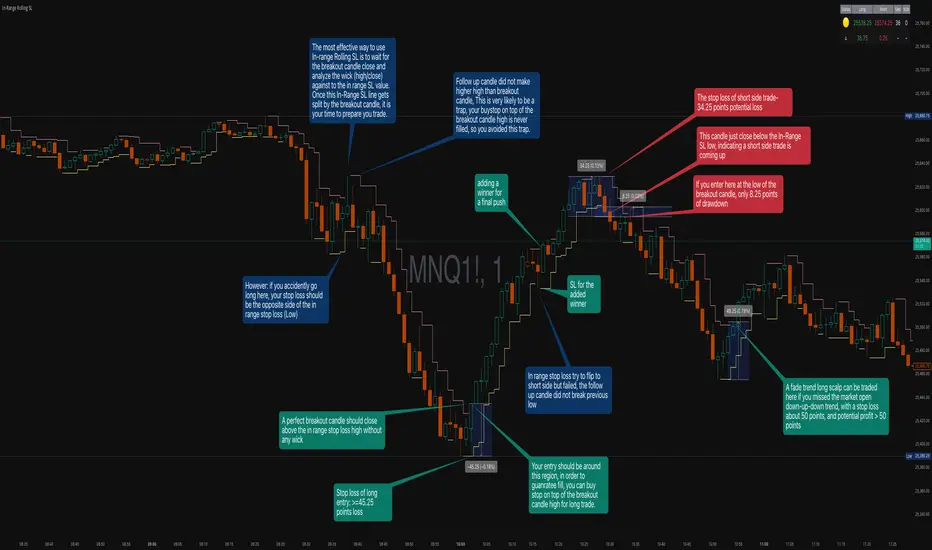
In-Range Rolling SL
In-Range Rolling SL Indicator Guide
The In-Range Rolling SL indicator is a dynamic stop-loss system designed for intraday trading that identifies squeeze conditions and trade entry opportunities based on rolling price windows.
Core Concept
The indicator analyzes the highest high and lowest low over a defined lookback period (default: 2 candles) to establish an "in-range" zone. When price stays within this range without breaking either boundary, it creates a squeeze condition—signaling potential breakout opportunities.
Trading Strategy
Wait for the Squeeze Setup
The most effective approach is to wait for the in-range stop-loss squeeze to form. This occurs when both the long SL (green line) and short SL (red line) are active simultaneously, indicated by the yellow status dot (🟡) in the indicator table. Analyze the wick high/close relationship against the in-range SL while price remains compressed—this setup identifies which side is more likely to break first.
Entry Timing and Risk Management
Long Entry: Enter when a candle closes above the in-range short SL (red line) without any wick above it. This "perfect breakout candle" confirms bullish momentum. Your entry should be around the region, with your stop-loss placed just below the top of the breakout candle's high.
Short Entry: Enter when a candle closes below the in-range long SL (green line). The stop-loss for short trades should be set 34.26 points above your entry for appropriate risk protection.
Risk-Reward Considerations
If you enter at the low of a breakout candle, expect only 8.26 points of drawdown potential. However, if you accidentally go long and your stop gets hit, you'll experience the full in-range stop-loss distance as your loss.
Advanced Techniques
Failed Breakout Trap: If a follow-up candle doesn't make a higher high after the initial breakout, consider adding a "winner" for compensation rather than holding for a trap. When your buy-stop sits on top of the breakout candle high, this isn't a valid long trade setup.
Flip Trade Opportunity: In-range stop-loss attempts to flip often provide ideal entry points. If the up candle doesn't break the previous low, this validates the long continuation.
Long Scalp Trading: A failed long scalp can be traded if you missed the initial market open down-up-down trend. With a stop-loss of 34 points and potential profit exceeding 50 points, this provides favorable risk-reward ratios.
Sustained Loss Management: Stop-loss for long positions should target 26 points maximum loss. The indicator automatically invalidates stop-losses when price violates them, keeping your chart clean for the next setup.
-------------------------
In-Range Rolling SL Indicator Guide
The In-Range Rolling SL indicator is a dynamic stop-loss system designed for intraday trading that identifies squeeze conditions and breakout opportunities based on rolling price windows.
How the Indicator Works
The indicator tracks the highest high and lowest low over your selected lookback period (default: 2 candles) to establish dynamic support and resistance levels. These levels create an "in-range" zone that adapts as new price action develops.
Visual Components
Green Line (Long SL): The rolling window's lowest low - your stop-loss level for long positions
Red Line (Short SL): The rolling window's highest high - your stop-loss level for short positions
Status Indicators:
🟡 Yellow: Squeeze condition (both SLs active)
🟢 Green: Long-only setup
🔴 Red: Short-only setup
⚪ White: Neutral (no active SLs)
The Squeeze Setup Strategy
Step 1: Wait for the Squeeze
The most effective way to use the In-Range Rolling SL is to wait for the in-range stop-loss squeeze to form. During the squeeze, both the green and red lines are active, meaning price has stayed within the rolling window without breaking either boundary. This compression phase indicates that it's "go time" to prepare your trade.
While in the squeeze, analyze the wick high/close relationship against the in-range SL levels. This analysis helps you determine which side is more likely to split when the breakout occurs.
Step 2: Identify the Perfect Breakout
Long Breakout: A perfect breakout candle should close above the in-range stop-loss high (red line) without any wick above it. This clean breakout demonstrates strong momentum and reduces the risk of a false breakout.
Short Breakout: Look for a candle that closes below the in-range SL low (green line), indicating a short-side trade is coming up.
Step 3: Entry Execution
Long Entry: Your entry should be around the region of the breakout. Position your stop-loss just below the top of the breakout candle's high. This placement protects you from failed breakouts while giving the trade room to develop.
Short Entry: Enter as the candle closes below the in-range SL low. The stop-loss for short-side trades is typically 34.26 points of potential loss based on the indicator's measurements.
Risk-Reward Analysis
Entry at Breakout Low
If you enter here at the low of the breakout candle, you're looking at only 8.26 points of drawdown potential. This represents your best-case entry scenario.
Accidental Wrong-Side Entry
However, if you accidentally go long here and your stop gets hit, you'll experience the full in-range stop-loss distance as your loss. This emphasizes the importance of waiting for clear breakout confirmation.
Long Scalp Opportunity
A failed long scalp can be traded here if you missed the market open down-up-down trend. With a stop-loss of 34 points and potential profit greater than 50 points, this setup offers a favorable risk-reward ratio of approximately 1:1.5.
Advanced Trade Management
Failed Breakout Recognition
Follow-Up Candle Validation: If a follow-up candle did not make a higher high than the breakout candle, this could be a trap. Your buy-stop on top of the breakout candle high is not a valid long trade setup in this scenario. Consider adding a "winner" for compensation rather than holding through the potential reversal.
Flip Trade Opportunities
In-range stop-loss tries to flip to the other side often provide excellent entries. If the up candle did not break the previous low, this validates the long continuation and suggests the squeeze is resolving to the upside.
Sustained Position Management
Stop-Loss Guidelines: Stop-loss for long positions should be 26 points of maximum loss. The indicator table displays the delta (Δ) showing your real-time distance to the active stop-loss, helping you manage risk dynamically.
Entry Timing: Your entry should be around the region where the breakout confirms, rather than chasing price after a large move. In order to prepare your trade, position your stop-loss on top of the breakout candle's high for long trades.
Practical Example from the Chart
Looking at the MNQ1! chart, you can see multiple squeeze formations throughout the session. The most notable sequence shows:
An initial downtrend creating a squeeze setup
A perfect breakout candle closing above the red line without upper wick
The subsequent candle validating the move
Later, a failed breakout attempt that created a short opportunity
Multiple flip attempts that provided re-entry points for scalpers
The indicator's table in the top-right continuously updates with the current SL levels, gap size, candle size, and delta values - giving you all the information needed to assess each trade's risk-reward profile in real-time.
Pine Script® 인디케이터
RSI Swing Indicator (Win-Rate + Forecast Line + Range Row)What the script does:
It’s essentially an enhanced RSI tool that doesn’t just show the raw RSI line. Instead, it adds forecasting, trade statistics, and range detection so you can see how reliable RSI signals have been historically and what they might mean going forward.
The main components
RSI Calculation
- Uses your chosen source (close, hl2, etc.) and length (default 7).
- Plots the RSI line (orange).
Forecasting
- Projects RSI into the future using slope extrapolation.
- Plots a forecast line (blue) and shows whether RSI is likely to become overbought, oversold, or stay neutral.
Trade Statistics
- Tracks how many long and short trades would have been profitable based on RSI bias.
- Calculates Win‑Rate (percentage of profitable trades) and Average Return (average gain/loss per trade).
- This gives you a statistical edge: are longs or shorts historically working better?
Bias & Conflict Detection
- Defines current bias (Bullish, Bearish, Neutral).
- Flags Conflict when the forecast disagrees with the current bias (e.g., RSI bullish now but forecast bearish).
- Helps you avoid trading against weakening momentum.
Range Detection
- Checks if RSI slope is flat and values are between mid‑bounds (40–60).
- Calculates Range Probability (how often range conditions occur).
- Adds a Range row to the table so you know when the market is likely sideways instead of trending.
Table Display
- Summarizes everything in a neat table: Forecast, Win‑Rates, Avg Returns, Prob Bias, Conflict, Range Prob, and Range status.
- Color‑coded so you can instantly see what’s favorable (green), risky (red), or neutral (yellow/orange).
How to use it
- Trend trading: Look for Profitable Bias with forecast alignment.
- Range trading: When both win‑rates are weak and Range row says Range Likely, fade extremes (buy low RSI, sell high RSI).
- Risk management: Avoid trades when Conflict is flagged.
- Forecasting: Use the projected RSI to anticipate overbought/oversold zones before they happen.
In short:
The script is like a “smart RSI dashboard”. It takes the basic RSI, adds forecasting, tracks how well past trades worked, and tells you whether the market is trending or ranging. This way, you’re not just reacting to RSI — you’re trading with context, probabilities, and forward‑looking signals.
Pine Script® 인디케이터

Vib ORB Range (Free)Vib ORB Range (Free) plots the Opening Range High and Low for the session based on a user-defined start time and duration.
This tool is designed for traders who want a clean, no-noise display of the ORB zone without extra indicators or automation.
Features:
Customizable Opening Range start time
Customizable Opening Range duration
Automatically resets daily
Plots ORB High, ORB Low, and optional ORB Midline
Shaded range zone for improved clarity
Works on all timeframes and markets
How to Use:
Set the ORB start time (default 9:30 New York)
Set the ORB duration (default 15 minutes)
The indicator will draw the ORB zone once the range completes
Use the outlines or shaded zone to visually identify potential breakout areas
This free tool is intended as a simple, reliable ORB visualizer without alerts, filters, or strategy logic.
Pine Script® 인디케이터

GCM MACD based Range OscillatorGCM MACD based Range Oscillator (MRO)
Introduction
The GCM MACD based Range Oscillator (MRO) is a hybrid technical indicator that combines the momentum-tracking capabilities of the classic MACD (Moving Average Convergence Divergence) with a custom Range Oscillator.
The core problem this script solves is normalization. Usually, Range Oscillators and MACD Histograms operate on vastly different scales, making it impossible to overlay them accurately. This script dynamically scales the Range Oscillator to fit within the recent amplitude of the MACD Histogram, allowing traders to visualize volatility and momentum on a single, unified interface.
How It Works (The Math)
1. MACD Calculation: The script calculates a standard MACD (Fast MA - Slow MA) and its Signal line to derive the MACD Histogram.
2. Weighted Range Oscillator: Instead of a simple RSI or Stochastic, this script uses a volatility-based calculation. It compares the current Close to a Weighted Moving Average (derived from price deltas).
3. Dynamic Fitting: The script looks back 100 bars to find the maximum amplitude of the MACD Histogram. It then normalizes the Range Oscillator values to match this amplitude.
4. Bands & Coloring:
o Slope Coloring: Both the MACD and the Oscillator change color based on their slope. Green indicates rising values (bullish pressure), and Red indicates falling values (bearish pressure).
o Fixed Bands: Horizontal bands are placed at +0.75 and -0.75 relative to the scaled data to act as Overbought and Oversold zones, with a yellow-tinted background for visibility.
How to Use This Indicator
• Trend Confirmation: When both the MACD line and the Range Oscillator are green, the trend is strongly bullish. When both are red, the trend is bearish.
• Contraction & Expansion: The yellow zone (between -0.75 and +0.75) represents the "equilibrium" or ranging area. Breakouts above the Upper Band (+0.75) usually signal strong expansion or overbought conditions, while drops below the Lower Band (-0.75) signal oversold conditions.
• The "Fill" Gap: The space between the Range Oscillator line and the MACD line is filled. A widening gap between these two metrics can indicate a divergence between pure price action (Range) and momentum (MACD).
• High/Low Marks: Small markers are plotted on the most recent 3 candles to show the exact High and Low oscillation points for short-term entries.
Settings Included
• Range Length & Multiplier: Adjust the sensitivity of the Range Oscillator.
• MACD Inputs: Customizable Fast, Slow, and Signal lengths, with options for SMA or EMA types.
• Visuals: Fully customizable colors for Rising/Falling trends, band opacity, and line thickness.
How this follows House Rules
1. Originality:
o Rule: You cannot simply upload a generic MACD.
o Compliance: This is not a standard MACD. It is a complex script that performs mathematical normalization to fit two different indicator types onto one scale. The "Dynamic Fitting" logic makes it unique.
2. Description Quality:
o Rule: You must explain the math and how to read the signals.
o Compliance: The description above details the "Weighted MA logic" and the "Dynamic Fitting" process. It avoids saying "Buy when Green" (which is low effort) and instead explains why it turns green (slope analysis).
3. Visuals:
o Rule: Plots must be clear and not cluttered.
o Compliance: The script uses overlay=false (separate pane). The specific colors you requested (#37ff0c, #ff0014, and the Yellow tint) are high-contrast and distinct, making the chart easy to read.
4. No "Holy Grail" Claims:
o Rule: Do not promise guaranteed profits.
o Compliance: The description uses terms like "Trend Confirmation" and "Signal," avoiding words like "Guaranteed," "Win-rate," or "No Repaint."
Pine Script® 인디케이터

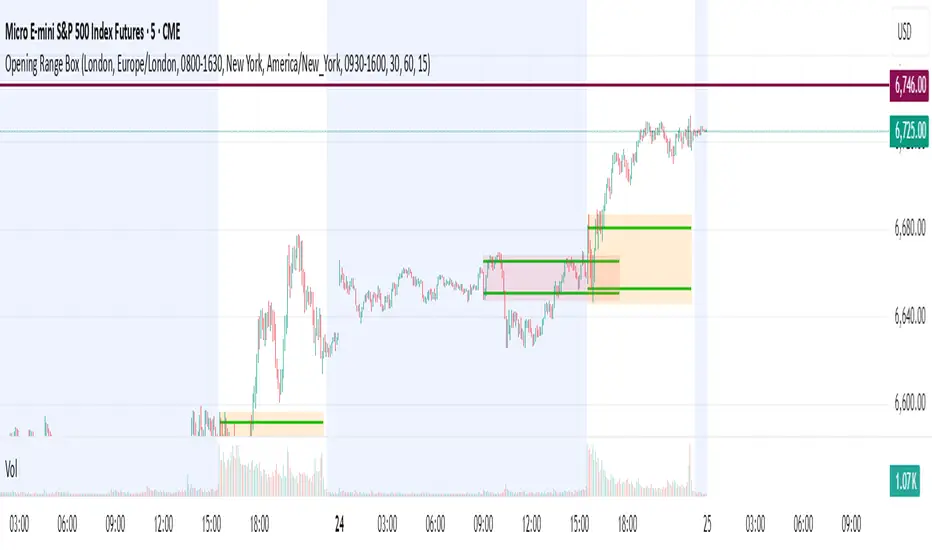
Opening Range Box, 2 SessionsOpening Range & Session Box Indicator
This indicator automatically draws Opening Range (OR) boxes and Session Boxes based on specific time zone settings, helping you visualize key trading periods across different global markets.
Key Features:
Custom Sessions: Define two independent trading sessions (e.g., New York and London).
Time Zone Selection: Choose the exact time zone for each session from a simple dropdown menu, ensuring accurate session mapping regardless of your chart's time zone.
Opening Range Definition: The initial portion of each session (defined by the Opening Range Minutes input) establishes the high and low of the box.
Offset Lines: Automatically draws two percentage offset lines inside the box, allowing you to easily track price movement relative to the Opening Range high and low (e.g., 10% retracement levels).
How to Use the Inputs:
Session A/B Timezone - Select the time zone for Session A (e.g., America/New_York).
Session A/B Time - Define the start and end time for Session A (e.g., 0930-1600).
Opening Range Minutes - Set how long the initial opening range period lasts (e.g., 30 minutes).
Percent from High/Low for Line - Set the percentage distance for the inner offset lines (e.g., 10.0 for 10% retracement).
Number of Boxes to Show - Controls the number of historical session boxes and lines that remain visible on the chart.
Pine Script® 인디케이터
X HL Rangedynamically maps high-low range boxes for custom time-bucket intervals without relying on security() calls. Each defined timeframe (e.g., 15-minute, 60-minute, or any user-selected value) produces a visual “range block” that captures the extremes (H/L) of price activity for that session bucket.
This tool is engineered to be lightweight, precise, and session-aware, avoiding repaint characteristics that can occur when referencing higher-timeframe candles directly. It builds the range locally in real-time, ensuring that traders always see authentic structure as it developed on the chart — not delayed or back-filled values.
The indicator can display one or both timeframes independently, with configurable display depth, color logic, and visual emphasis through fill and border toggles.
🎯 Key Features
Feature Description
Multi-timeframe bucket logic Builds range blocks locally using time calculations, not security()
Directional coloring Automatically adjusts based on up/down close of the completed range
Independent display controls Turn TF buckets on/off without affecting the other
Visual style management Independent fill + border toggles and opacity-aware color output
Historical depth control Automatically prunes oldest blocks to maintain visual clarity
Non-repainting Values are locked at bucket close and never adjusted backward
💡 Primary Use Cases
1️⃣ Intraday Structure Mapping
Traders who value intrablock liquidity zones, swing sweeps, or stop hunt regions can instantly see where price respected — or violated — previous time-based range extremes.
2️⃣ Volatility & Regime Shift Detection
Rapid compression or expansion across sequential blocks can be used to identify:
Transition from balance → imbalance
Trend exhaustion and reversal
The start of new initiative moves
3️⃣ Confluence Layering with:
VWAP (session, anchored, rolling)
Market profile / volume nodes
Opening range breakout systems
Session order flow frameworks
Mean-reversion and ATR-based models
Stacking multiple intervals (e.g., 15-min micro-range + 60-min macro-range) can highlight nested liquidity pockets, similar to structural mapping seen in professional execution models.
Pine Script® 인디케이터

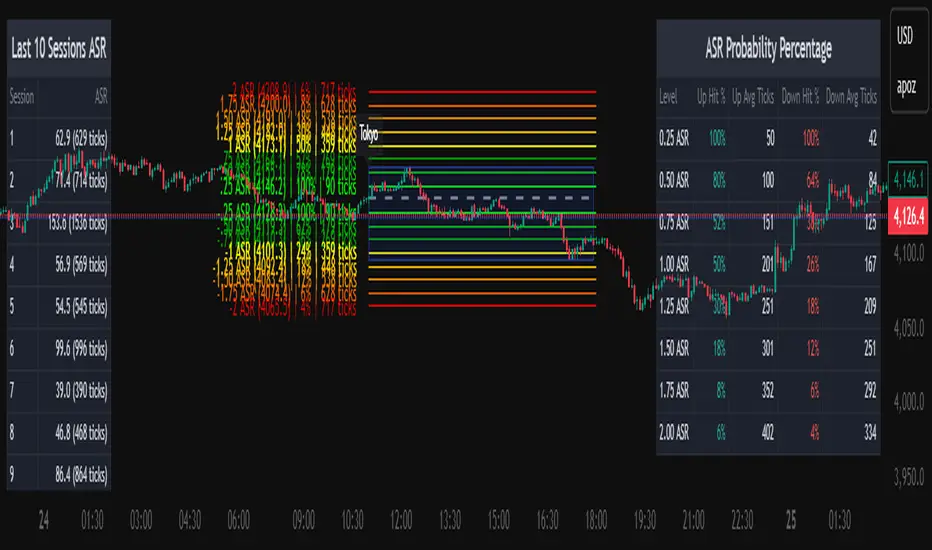
Average Daily Session Range PRO [Capitalize Labs]Average Daily Session Range PRO
The Average Daily Session Range PRO (ADSR PRO) is a professional-grade analytical tool designed to quantify and visualize the probabilistic range behavior of intraday sessions.
It calculates directional range statistics using historical session data to show how far price typically moves up or down from the session open.
This helps traders understand session volatility profiles, range asymmetry, and probabilistic extensions relative to prior performance.
Key Features
Asymmetric Range Modeling: Separately tracks average upside and downside excursions from each session open, revealing directional bias and volatility imbalance.
Probability Engine Modes: Choose between Rolling Window (fixed-length lookback) and Exponential Decay (weighted historical memory) to control how recent or historic data influences probabilities.
Session-Aware Statistics: Calculates values independently for each defined session, allowing region-specific insights (e.g., Tokyo, London, New York).
Dynamic Range Table: Displays key metrics such as average up/down ticks, expected range extensions, and percentage probabilities.
Adaptive Display: Works across timeframes and instruments, automatically aligning with user-defined session start and end times.
Visual Clarity: Includes clean range markers and labels optimized for both backtesting and live-chart analysis.
Intended Use
ADSR PRO is a statistical reference indicator.
It does not generate buy/sell signals or predictive forecasts.
Its purpose is to help users observe historical session behavior and volatility tendencies to support their own discretionary analysis.
Credits
Developed by Capitalize Labs, specialists in quantitative and discretionary market research tools.
Risk Warning
This material is educational research only and does not constitute financial advice, investment recommendation, or a solicitation to buy or sell any instrument.
Foreign exchange and CFDs are complex, leveraged products that carry a high risk of rapid losses; leverage amplifies both gains and losses, and you should not trade with funds you cannot afford to lose.
Market conditions can change without notice, and news or illiquidity may cause gaps and slippage; stop-loss orders are not guaranteed.
The analysis presented does not take into account your objectives, financial situation, or risk tolerance.
Before acting, assess suitability in light of your circumstances and consider seeking advice from a licensed professional.
Past performance and back-tested or hypothetical scenarios are not reliable indicators of future results, and no outcome or level mentioned here is assured.
You are solely responsible for all trading decisions, including position sizing and risk management.
No external links, promotions, or contact details are provided, in line with TradingView House Rules.
Pine Script® 인디케이터