Algo ۞ Halo 7MAs WonderA complete trend following and important MA crossing tool. The indicator is self-explanatory. You decide where you want the triggers to go. Enjoy!Pine Script® 인디케이터inspyr24의25
Equal Highs/Lows Multi-Pivot [Julio]Equal Highs/Lows Multi-Pivot Description A sophisticated multi-timeframe pivot analysis tool that detects and highlights equal highs and equal lows across four different pivot lengths simultaneously. This indicator identifies price levels where the market creates identical extremes, a powerful signal of institutional support/resistance and potential reversal or breakout zones. How It Works Four Independent Pivot Streams Pivot 1 (Intraday - 2 bars): Ultra-fast level detection for scalpers Pivot 2 (Session - 4 bars): Short-term swing levels Pivot 3 (Daily - 6 bars): Medium-term structural levels Pivot 4 (Weekly - 9 bars): Long-term institutional levels Equal High (EQH) Detection Compares consecutive swing highs and draws a line when two highs are nearly identical within a defined threshold. The indicator uses ATR-based confluence to determine "equality," filtering out noise while catching true market structure. Equal Low (EQL) Detection Same logic applied to swing lows, identifying support zones where price repeatedly fails to break below previous lows. Key Features Four Simultaneous Timeframes: Analyze intraday, session, daily, and weekly structures all on one chart ATR-Based Confluence Threshold: Automatically adjusts sensitivity based on current volatility (no fake signals) Color-Coded Levels: Each pivot length has distinct colors for instant visual identification Highs: Red, Orange, Yellow, Fuchsia Lows: Green, Blue, Aqua, Purple Confirmation Mode: Optional setting to wait for full pivot confirmation before marking levels Customizable Alert Zones: Toggle individual pivot lengths on/off to reduce clutter Smart Label Positioning: Labels auto-center between the two equal pivots for clarity Ideal For Swing traders tracking support/resistance across multiple timeframes Scalpers identifying micro-structure for quick entries and exits Market structure analysts studying institutional price action patterns Multi-timeframe traders needing confluence from intraday to weekly levels Anyone trading 1-minute to 4-hour charts Trading Applications Identify strong support/resistance zones: Equal levels = confirmed institutional levels Confirm trend reversals: Multiple equal lows = strong accumulation zone; multiple equal highs = distribution Plan entries with precision: Enter near equal levels for higher probability setups Detect liquidity concentration: Where price repeatedly tests the same level Multi-timeframe confluence: Look for equal levels across multiple pivot lengths for ultra-strong zones How to Use Identify the equal levels: Color-coded lines instantly show where price creates matching extremes Check for confluence: Strong setups occur where multiple pivot lengths align Wait for price action: Watch for breakouts through equal levels or reversals at these zones Enter with structure: Use equal levels as entry/exit triggers combined with your trading methodology Manage with confidence: These levels mark institutional decision points Customization Options Adjust pivot lengths to match your preferred timeframe structure Set ATR threshold sensitivity (lower = stricter equality, higher = more signals) Toggle confirmation mode for additional filter Enable/disable individual pivot streams to reduce visual clutter Customize colors to match your chart theme Default Settings Optimized For NASDAQ futures and liquid forex pairs Intraday and swing trading (1-minute to 4-hour charts) Smart Money / ICT trading methodologies Volatility-adjusted confluence detectionPine Script® 인디케이터julioperez75955의33
Clean Industry DataClean Industry Data – Overview Clean Industry Data is a utility tool designed to give traders an instant, structured view of key fundamental and volatility metrics directly on the chart. The script displays a compact, customizable information panel containing: Industry & Sector Market Cap and Free-Float Market Cap Free-Float Percentage Average Daily Rupee Volume Relative Volume (R.Vol) based on daily volume % from 10 / 21 / 50 EMAs (calculated on daily closes) ADR (14-day) with threshold-based indicators ATR (current timeframe) with colour-coded risk cues All volume-based statistics are anchored to daily data, ensuring the values remain consistent across all timeframes. The display table supports flexible positioning, custom background/text colours, and adjustable text size. This script is ideal for traders who want a quick, accurate snapshot of a stock’s liquidity, volatility, and broader classification — without digging through multiple menus or external sources.Pine Script® 인디케이터jigz11의4428
SYMBOL NOTES - UNCORRELATED TRADING GROUPSWrite symbol-specific notes that only appear on that chart. Organized into 6 uncorrelated groups for safe multi-pair trading. 📝 SYMBOL NOTES - UNCORRELATED TRADING GROUPS This indicator solves two problems every serious trader faces: 1. Keeping Track of Your Analysis Write notes for each trading pair and they'll only appear when you view that specific chart. No more forgetting your key levels, trade ideas, or analysis! 2. Avoiding Correlated Risk The symbols are organized into 6 groups where ALL pairs within each group are completely UNCORRELATED. Trade any combination from the same group without worrying about double exposure. ━━━━━━━━━━━━━━━━━━━━━━━━━━━━━━━━━━━━━━━━━━━━━ 🎯 THE PROBLEM THIS SOLVES Have you ever: - Opened XAUUSD and EURUSD at the same time, then Fed news hit and BOTH positions went against you? - Traded GBPUSD and GBPJPY together, then BOE announcement stopped out both trades? - Forgotten what levels you were watching on a pair? This indicator helps you avoid these costly mistakes! ━━━━━━━━━━━━━━━━━━━━━━━━━━━━━━━━━━━━━━━━━━━━━ 📁 THE 6 UNCORRELATED GROUPS Each group contains pairs that share NO common currency: ``` GRUP 1: XAUUSD • EURGBP • NZDJPY • AUDCHF • NATGAS GRUP 2: EURUSD • GBPJPY • AUDNZD • CADCHF GRUP 3: GBPUSD • EURJPY • AUDCAD • NZDCHF GRUP 4: USDJPY • EURCHF • GBPAUD • NZDCAD GRUP 5: USDCAD • EURAUD • GBPCHF GRUP 6: NAS100 • DAX40 • UK100 • JPN225 ``` **Example - GRUP 1:** - XAUUSD → Uses USD + Gold - EURGBP → Uses EUR + GBP - NZDJPY → Uses NZD + JPY - AUDCHF → Uses AUD + CHF - NATGAS → Commodity (independent) = 7 different currencies, ZERO overlap! ━━━━━━━━━━━━━━━━━━━━━━━━━━━━━━━━━━━━━━━━━━━━━ **✅ HOW TO USE** 1. Add indicator to any chart 2. Open Settings (gear icon ⚙️) 3. Find your symbol's group and input field 4. Write your note (support levels, trade ideas, etc.) 5. Switch charts - your note appears only on that symbol! ━━━━━━━━━━━━━━━━━━━━━━━━━━━━━━━━━━━━━━━━━━━━━ ⚙️ SETTINGS - Note Position: Choose where the note box appears (6 positions) - Text Size: Tiny, Small, Normal, or Large - Show Group Name: Display which correlation group - Show Symbol Name: Display current symbol - Colors: Customize background, text, group label, and border colors ━━━━━━━━━━━━━━━━━━━━━━━━━━━━━━━━━━━━━━━━━━━━━ 💡 TRADING STRATEGY TIPS Safe Multi-Pair Trading: 1. Pick ONE group for the day 2. Look for setups on ANY symbol in that group 3. Open positions freely - they won't correlate! 4. Even if major news hits, only ONE position is affected ━━━━━━━━━━━━━━━━━━━━━━━━━━━━━━━━━━━━━━━━━━━━━ 🔧 COMPATIBLE WITH - All major forex brokers - Prop firms (FTMO, Alpha Capital, etc.) - Works on any timeframe - Futures symbols supported (MGC, M6E, etc.) ━━━━━━━━━━━━━━━━━━━━━━━━━━━━━━━━━━━━━━━━━━━━━ Pine Script® 인디케이터Saeid21의업데이트됨 13
ICT Fair Value Gap (FVG) Detector │ Auto-Mitigated │ 2025Accurate ICT / Smart Money Concepts Fair Value Gap (FVG) detector Features: • Detects both Bullish (-FVG) and Bearish (+FVG) using strict 3-candle rule • Boxes automatically extend right until price mitigates them • Boxes auto-delete when price closes inside the gap (true mitigation) • No repainting – 100% reliable • Clean, lightweight, and works on all markets & timeframes • Fully customizable colors and transparency How to use: – Bullish FVG (green) = potential support / buy zone in uptrend – Bearish FVG (red) = potential resistance / sell zone in downtrend Exactly matches The Inner Circle Trader (ICT) methodology used by thousands of SMC traders in 2024–2025. Enjoy and trade safe!Pine Script® 인디케이터keerthanamurugesan의업데이트됨 1165
Minervini VCP Pattern -Indian ContextThis script implements Mark Minervini's Trend Template and VCP (Volatility Contraction Pattern) pattern, specifically adapted for Indian stock markets (NSE). It helps identify stocks that are in strong uptrends and ready to break out. Core Concepts Explained 1. What is the Minervini Trend Template? Mark Minervini's method identifies stocks in Stage 2 uptrends - the sweet spot where institutional money is accumulating and stocks show the strongest momentum. Think of it as finding stocks that are "leaders" rather than "laggards." 2. What is VCP (Volatility Contraction Pattern)? A VCP occurs when: Stock price consolidates (moves sideways) after an uptrend Price swings get tighter and tighter (like a coiled spring) Volume dries up (fewer people trading) Then it breaks out with force. You can customize the strategy settings without editing code. Key Settings: Minimum Price (₹50): Filters out penny stocks that are too volatile Min Distance from 52W Low (30%): Stock should be at least 30% above its yearly low Max Distance from 52W High (25%): Stock should be within 25% of its yearly high (showing strength) Moving Average Periods: 10, 50, 150, 200 days (industry standard) Minimum Volume (100,000 shares): Ensures the stock is liquid enough to trade Indian Market Adaptation: The default values (₹50 minimum, volume thresholds) are adjusted for NSE stocks, which behave differently than US markets. The script pulls weekly chart data even when you're viewing daily charts. Why it matters: Weekly trends are more reliable than daily noise. Professional traders use weekly charts to confirm the bigger picture. What are Moving Averages (MAs)? Simple averages of closing prices over X days They smooth out price action to show trends Think of them as the "average cost" of buyers over different time periods The 4 Key MAs: 10 MA (Fast): Very short-term trend 50 MA: Short to medium-term trend 150 MA: Medium to long-term trend 200 MA: Long-term trend (the "grandfather" of all MAs) Why Weekly MAs? The script also calculates 10 and 50 MAs on weekly data for additional confirmation of the bigger trend. The script Finds the highest and lowest prices over the past 52 weeks (1 year). Why it matters: Stocks near 52-week highs are showing strength (institutions buying) Stocks far from 52-week lows have "room to run" upward This is a psychological level that influences trader behaviour. What is Volume here ? The number of shares traded each day High volume = many traders interested (conviction) Low volume = lack of interest (weakness or consolidation) Volume in VCP: During consolidation (sideways movement), volume should dry up - this shows sellers are exhausted and buyers are holding. When volume spikes on a breakout, it confirms the move. NSE Context: Indian stocks often have different volume patterns than US stocks, so the 50-day average is used as a baseline. Relative Strength vs Nifty: Example: If your stock is up 20% and Nifty is up 10%, your stock has strong RS If your stock is up 5% and Nifty is up 15%, your stock has weak RS (avoid it!) Why it matters: The best performing stocks almost always have strong relative strength before major moves. The 13 Minervini Conditions:- Condition 1: Price > 50/150/200 MA Meaning: Current price must be above ALL three major moving averages. Why: This confirms the stock is in a clear uptrend. If price is below these MAs, the stock is weak or in a downtrend. Condition 2: MA 50 > 150 > 200 Meaning: The moving averages themselves must be in proper order. Analogy: Think of this like layers in a cake - short-term on top, long-term at bottom. If they're tangled, the trend is unclear. Condition 3: 200 MA Rising (1 Month) Meaning: The 200 MA today must be higher than it was 20 days ago. Why: This confirms the long-term trend is UP, not flat or down. The means "20 bars ago." Condition 4: 50 MA Rising Meaning: The 50 MA today must be higher than 5 days ago. Why: Confirms short-term momentum is accelerating upward. Condition 5: Within 25% of 52-Week High Meaning: Current price should be within 25% of its 1-year high. Example: 52-week high = ₹1000 Current price must be above ₹750 (within 25%) Why: Strong stocks stay near their highs. Weak stocks fall far from highs. Condition 6: 30%+ Above 52-Week Low (OPTIONAL) Meaning: Stock should be at least 30% above its yearly low. Note: The script marks this as "SECONDARY - Optional" because the other conditions are more important. However, it's still a good confirmation. Condition 7: Price > 10 MA Meaning: Very short-term strength - price above the 10-day moving average. Why: Ensures the stock hasn't just rolled over in the immediate term. Condition 8: Price >= ₹50 Meaning: Filters out stocks below ₹50. Why: In Indian markets, stocks below ₹50 tend to be penny stocks with poor liquidity and higher manipulation risk. Condition 9: Weekly Uptrend Meaning: On the weekly chart, price must be above both weekly MAs, and they must be properly aligned. Why: Confirms the bigger picture trend, not just daily fluctuations. Condition 10: 150 MA Rising Meaning: The 150 MA is trending upward over the past 10 days. Why: Another confirmation of medium-term trend health. Condition 11: Sufficient Volume Meaning: Average volume must exceed 100,000 shares (or your custom setting). Why: Ensures you can actually buy/sell the stock without moving the price too much (liquidity). Condition 12: RS vs Nifty Strong Meaning: The stock's relative strength vs Nifty must be improving. Why: You want stocks that are outperforming the market, not underperforming. Condition 13: Nifty in Uptrend Meaning: The Nifty 50 index itself must be above its 50 MA. Why: "A rising tide lifts all boats." It's easier to make money in individual stocks when the overall market is bullish. VCP Requirements: Volatility Contracting: Price swings getting tighter (coiling spring) Volume Drying Up: Fewer shares trading + trending lower The Setup: When volatility contracts and volume dries up WHILE all 13 trend conditions are met, you have a VCP setup ready to explode. What You See on Chart: Colored Lines: 10 MA (green), 50 MA (blue), 150 MA (orange), 200 MA (red) Blue Background: Trend template conditions met (watch zone) Green Background: Full VCP setup detected (buy zone) ↟ Symbol Below Price: New VCP buy signal just triggered Information Table: What it does: Creates a checklist table on your chart showing the status of all conditions. Table Structure: Column 1: Condition name Column 2: Status (✓ green = met, ✗ red = not met) Final Row: Shows "BUY" (green) or "WAIT" (red) based on full VCP setup status. Dos: Example: Account size: ₹5,00,000 Risk per trade: 1% = ₹5,000 Entry: ₹1000 Stop loss: ₹920 (8% below) Distance to stop: ₹80 Shares to buy: ₹5,000 / ₹80 = 62 shares Exit Strategy: Sell 1/3 at +20% profit Sell another 1/3 at +40% profit Let the final 1/3 run with a trailing stop Always exit if price closes below 10 MA on heavy volume What This Script Does NOT Do: Guarantee profits - No strategy works 100% of the time Account for news events - Earnings, regulatory changes, etc. Consider fundamentals - Company financials, debt, management quality Adapt to market crashes - Works best in bull markets Best Market Conditions: ✅ Nifty in uptrend (above 50 MA) ✅ Market breadth positive (more stocks advancing) ✅ Sector rotation happening ❌ Avoid in bear markets or high volatility periods References: Trade Like a Stock Market Wizard by Mark Minervini Think & Trade Like a Champion by Mark Minervini Chart attached: AU Small Finance Bank as on EoD dated 28/11/25 This script is a powerful tool for educational purpose only, remember: It's a tool, not a crystal ball. Use it to find high-probability setups, then apply proper risk management and patience. Good luck! Pine Script® 인디케이터kingshukghosh71의66118
VaCs Pro Max by CS (Final Version - V9)VaCs Pro Max by CS (Final Version - V9) – TradingView Indicator Overview Introduction: The VaCs Pro Max indicator is a comprehensive, all-in-one technical analysis tool designed for traders who seek a clear, visual, and flexible overview of market trends, levels, sessions, and key signals. This advanced TradingView script integrates multiple technical indicators, market level trackers, session visualizations, and the innovative AlphaTrend module to provide actionable insights across any timeframe. 1. Technical Indicators: This module combines essential trend-following and market momentum tools: VWAP (Volume Weighted Average Price): Shows the average price weighted by volume, helping traders identify key support/resistance levels. Customizable color allows easy chart visibility. EMAs (Exponential Moving Averages): Two EMAs (fast and long) track short-term and long-term price trends. Traders can adjust lengths and colors for personalized analysis. Parabolic SAR: Highlights potential trend reversals with dots above/below candles. Step and maximum settings allow fine-tuning for sensitivity. S2F Bands (Stock-to-Flow): A dynamic band system representing mid, upper, and lower levels derived from EMA. Useful for identifying overbought/oversold zones. Logarithmic Growth Channel (LGC): Provides logarithmic regression channels, highlighting long-term price structure and growth trends. Adjustable length and band colors. Linear Regressions: Two regression lines (short and long) detect trend directions and deviations over customizable periods. Liquidity Zones: Highlights recent highs/lows over a defined lookback period, showing potential support/resistance clusters. SMC Markers (Swing Market Context): Marks pivot highs and lows using visual labels, helping identify swing points and trend continuation patterns. 2. Market Levels: Track weekly and Monday high/low levels for precise intraday and swing trading decisions: Weekly Levels: Highlight the previous week’s high and low for reference. Monday Levels: Focus on the day’s opening range, particularly useful for weekly breakout strategies. 3. Session Boxes (UTC): Visual boxes mark major trading sessions (London, New York) in UTC time: London Session Box: Highlights market activity between 08:00–16:30 UTC. New York Session Box: Highlights market activity between 13:30–20:00 UTC. Boxes automatically adjust to session highs and lows for clear intraday structure visualization. 4. Vertical Session Lines (Turkey Time – UTC+3): These vertical lines provide an easy-to-read visualization of key market opens and closes: US (NYSE), EU (LSE), JP (TSE), CN (SSE) lines: Color-coded and labeled, showing market opening and closing times in Turkish local time. Ideal for identifying session overlaps and liquidity spikes. 5. AlphaTrend Module: The AlphaTrend module is a dynamic trend-following system offering both visual guidance and trade signals: Trend Calculation: Uses ATR and RSI/MFI logic to determine dynamic trend levels. Signals: Generates BUY and SELL markers based on trend crossovers. Customizable Settings: Multiplier, period, source input, and volume data modes allow tailored sensitivity. Visuals: Filled areas between main and lag lines highlight trend direction, making it easy to interpret market bias at a glance. Alerts: Includes multiple alert conditions such as potential and confirmed BUY/SELL, and price crossovers, suitable for automated notifications. Usage & Benefits: All modules have on/off toggles in the input panel, allowing users to customize the chart view without losing performance. Color-coded visuals, session boxes, and trend channels improve readability, especially during high volatility. Suitable for day trading, swing trading, and long-term analysis due to multi-timeframe adaptability. The combination of trend indicators, liquidity zones, and session analysis provides a holistic view of market structure. Alerts enable traders to automate monitoring without constantly staring at the chart. Conclusion: VaCs Pro Max by CS (V9) is designed for both professional and semi-professional traders who want an all-inclusive, visually intuitive, and highly configurable TradingView indicator. It merges classical technical indicators with modern trend and session analysis tools, making it an indispensable tool for informed trading decisions.Pine Script® 인디케이터cdssvg의34
2-Year Real RateThe 2-year real rate is the inflation-adjusted yield on a 2-year U.S. Treasury—essentially the market’s expectation for short-term “true” interest rates after subtracting expected inflation (often approximated as nominal 2Y yield – breakeven inflation). It matters because it reflects the actual cost of capital and is one of the cleanest gauges of the Fed’s effective stance: rising real rates mean tightening financial conditions, falling real rates mean loosening. In trading, the 2Y real rate is a powerful macro risk-on/risk-off indicator—equities, long-duration tech, crypto, and EM FX generally weaken when real rates rise, while USD and front-end rate-sensitive trades tend to strengthen. Watching inflections in the 2Y real rate helps you time shifts in liquidity, gauge how aggressively the market is pricing Fed moves, and position for cross-asset trends driven by changes in real funding conditions.Pine Script® 인디케이터gman1023의9
Gold Master: Swing + Daily Scalp (Fixed & Working)How to use it correctly Daily chart → Focus only on big green/red triangles (Swing trades) 5m / 15m / 1H chart → Focus on small circles (Scalp trades) You can turn each system on/off independently in the settings Works perfectly on XAUUSD, GLD, GC futures, and even DXY (inverse signals).Pine Script® 인디케이터ela24의18
XAU/NASDAQ monthly with SMA 48XAU to NASDAQ composite ratio on a monthly period with SMA 48.Pine Script® 인디케이터Niddecoucous의3
BHUVANA Fib 50–61.8 • Turn Alerts when FIB directions change Detects step-up / step-down on both Fib 50 & 61.8 (your “stairs” logic). Triggers BUY/SELL on that slope change (optionally also requires price to be above/below the line).Spot volatility compression around the 50%–61.8% Fibonacci mid-band of the current swing, then trade the first expansion with clean, rules-based entries and auto SL references. Swing mapping: Finds the active high/low over a user-defined lookback and computes Fib 50% and Fib 61.8%. Squeeze detection: Measures the distance between 50% and 61.8%. If the band width is ≤ (ATR × multiplier), the zone is flagged as a Squeeze. Breakout entries (on close): Long when price crosses up through 50% while squeezed. Short when price crosses down through 61.8% while squeezed. Risk framework: Auto-plots stop lines from the signal bar: Long SL = swing low; Short SL = swing high. Visuals: Fib lines (50/61.8) + optional yellow zone highlight during squeeze. Signals evaluate on bar close (no forward-looking data). Works well on XAUUSD / US30 intraday (5–15m) during London/NY sessions. Add your own alertcondition() lines if you want push alerts on Long/Short entries.Pine Script® 인디케이터mankarnan의22
Thick WicksWant thicker wicks? Here you go! Adjust your wicks to the thickness you like. Pine Script® 인디케이터Willem-DVS의17
Dumb Money Flow - Retail Panic & FOMO# Dumb Money Flow (DMF) - Retail Panic & FOMO ## 🌊 Overview **Dumb Money Flow (DMF)** is a powerful **contrarian indicator** designed to track the emotional state of the retail "herd." It identifies moments of extreme **Panic** (irrational selling) and **FOMO** (irrational buying) by analyzing on-chain data, volume anomalies, and price velocity. In crypto markets, retail traders often buy the top (FOMO) and sell the bottom (Panic). This indicator helps you do the opposite: **Buy when the herd is fearful, and Sell when the herd is greedy.** --- ## 🧠 How It Works The indicator combines multiple data points into a single **Sentiment Index** (0-100), normalized over a 90-day period to ensure it always uses the full range of the chart. ### 1. Panic Index (Bearish Sentiment) Tracks signs of capitulation and fear. High values contribute to the **Panic Zone**. * **Exchange Inflows:** Spikes in funds moving to exchanges (preparing to sell). * **Volume Spikes:** High volume during price drops (panic selling). * **Price Crash (ROC):** Rapid, emotional price drops over 3 days. * **Volatility (ATR):** High market nervousness and instability. ### 2. FOMO Index (Bullish Sentiment) Tracks signs of euphoria and greed. High values contribute to the **FOMO Zone**. * **Exchange Outflows:** Funds moving to cold storage (HODLing/Greed). * **Profitable Addresses:** When >90% of holders are in profit, tops often form. * **Parabolic Rise:** Rapid, unsustainable price increases. --- ## 🎨 Visual Guide The indicator uses a distinct color scheme to highlight extremes: * **🟢 Dark Green Zone (> 80): Extreme FOMO** * **Meaning:** The crowd is euphoric. Risk of a correction is high. * **Action:** Consider taking profits or looking for short entries. * **🔴 Dark Burgundy Zone (< 20): Extreme Panic** * **Meaning:** The crowd is capitulating. Prices may be oversold. * **Action:** Look for buying opportunities (catching the knife with confirmation). * **🔵 Light Blue Line:** * The smoothed moving average of the sentiment, helpful for seeing the trend direction. --- ## 🛠️ How to Use (Trading Strategies) ### 1. Contrarian Reversals (The Primary Strategy) * **Buy Signal:** Wait for the line to drop deep into the **Burgundy Panic Zone (< 20)** and then start curling up. This indicates that the worst of the selling pressure is over. * **Sell Signal:** Wait for the line to spike into the **Green FOMO Zone (> 80)** and then start curling down. This suggests buying exhaustion. ### 2. Divergences * **Bullish Divergence:** Price makes a **Lower Low**, but the DMF Indicator makes a **Higher Low** (less panic on the second drop). This is a strong reversal signal. * **Bearish Divergence:** Price makes a **Higher High**, but the DMF Indicator makes a **Lower High** (less FOMO/buying power on the second peak). ### 3. Trend Confirmation (Midline Cross) * **Crossing 50 Up:** Sentiment is shifting from Fear to Greed (Bullish). * **Crossing 50 Down:** Sentiment is shifting from Greed to Fear (Bearish). --- ## ⚙️ Settings * **Data Source:** Defaults to `INTOTHEBLOCK` for on-chain data. * **Crypto Asset:** Auto-detects BTC/ETH, but can be forced. * **Normalization Period:** Default 90 days. Determines the "window" for defining what is considered "Extreme" relative to recent history. * **Weights:** You can customize how much each factor (Volume, Inflows, Price) contributes to the index. --- **Disclaimer:** This indicator is for educational purposes only. "Dumb Money" analysis is a probability tool, not a crystal ball. Always manage your risk. **Indicator by:** @iCD_creator **Version:** 1.0 **Pine Script™ Version:** 6 --- ## Updates & Support For questions, suggestions, or bug reports, please comment below or message the author. **Like this indicator? Leave a 👍 and share your feedback!** Pine Script® 인디케이터iCD_creator의업데이트됨 59
PIVOT BACKGROUND AND TABLE BY PRANOJIT DEYThis shows pivot trend in relation with the day open line. it makes the day bias easily understandable.Pine Script® 인디케이터mukherjee_debasri의8
Ichimoku Green BG by Pranojit DeyThis indicator shows ichimoku bulliush trend background so that the option buyers can understand bullish trend easily.Pine Script® 인디케이터mukherjee_debasri의5
PIVOT AND ICHIMOKU BACKGROUND BY PRANOJIT DEYIt shows pivot bias in relation to day open line and it also shows ichimoku bullish trend background. good for option buyers to understand market bias.Pine Script® 인디케이터mukherjee_debasri의5
Yit's Risk CalculatorIntroducing a risk a bulletproof risk calculator. I'm tired of sitting on my brokerage, messing with my shares to buy while price action leaves me in the dust. For my breakout strategy execution is everything i dont have time to stop and think. within the Indicator settings you have free reign to change account size and risk% *the stop loss is glued to the low of the day* Pine Script® 인디케이터Nolimityit의7
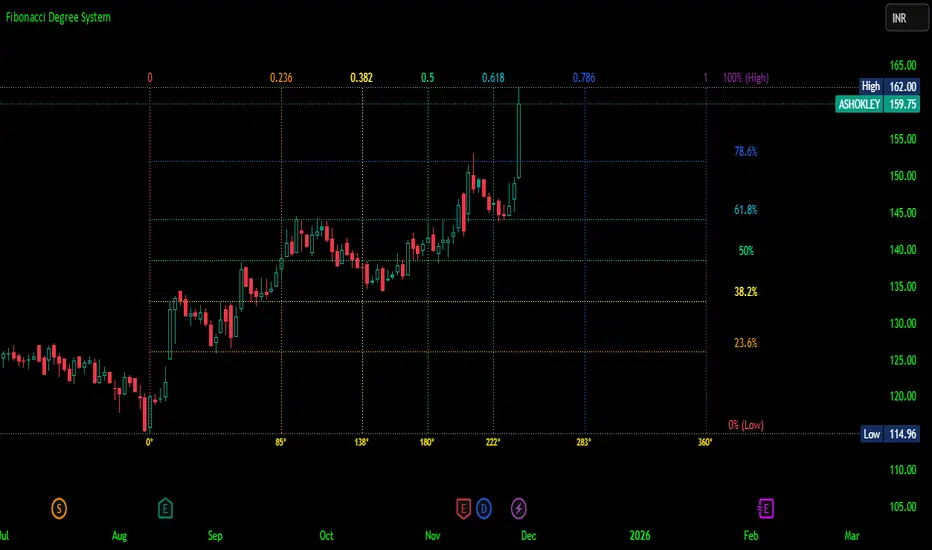
Fibonacci Degree System This Pine Script creates a sophisticated technical analysis tool that combines Fibonacci retracements with a degree-based cycle system. Here's a comprehensive breakdown: Core Concept The indicator maps price movements onto a 360-degree circular framework, treating market cycles like geometric angles. It creates a visual "mesh" where Fibonacci ratios intersect in both price (horizontal) and time (vertical) dimensions. How It Works 1. Finding Reference Points The script looks back over a specified period (default 100 bars) to identify: Highest High: The peak price point Lowest Low: The trough price point Time Locations: Exactly which bars these extremes occurred on These two points form the boundaries of your analysis window. 2. Creating the Fibonacci Grid Horizontal Lines (Price Levels): The script divides the price range between high and low into seven key Fibonacci ratios: 0% (Low) - Bottom boundary in red 23.6% - Minor retracement in orange 38.2% - Shallow retracement in yellow 50% - Midpoint in lime green 61.8% - Golden ratio in aqua (most significant) 78.6% - Deep retracement in blue 100% (High) - Top boundary in purple Each line represents a potential support/resistance level where price might react. Vertical Lines (Time Cycles): The same Fibonacci ratios are applied to the time dimension between the high and low bars. If your high and low are 50 bars apart, vertical lines appear at: Bar 0 (0%) Bar 12 (23.6%) Bar 19 (38.2%) Bar 25 (50%) Bar 31 (61.8%) Bar 39 (78.6%) Bar 50 (100%) These suggest when price might make significant moves. 3. The Degree Mapping System The innovative feature maps the time progression to degrees: 0° = Start point (0% time) 85° = 23.6% through the cycle 138° = 38.2% through the cycle 180° = Midpoint (50%) 222° = 61.8% through the cycle (golden angle) 283° = 78.6% through the cycle 360° = Complete cycle (100%) This treats market movements as circular patterns, similar to how planets orbit or pendulums swing. Visual Output When you apply this indicator, you'll see: A rectangular mesh extending beyond your high-low range (by 150% default) Color-coded horizontal lines showing price Fibonacci levels Matching vertical lines showing time Fibonacci intervals Price labels on the right showing percentage levels Degree labels at the bottom showing the angular position in the cycle Intersection points creating a grid of potentially significant price-time coordinates Trading Application Traders use this to identify: Support/Resistance Zones: Where horizontal and vertical lines intersect Time Targets: When price might reverse (at vertical Fibonacci times) Cycle Completion: When approaching 360°, a new cycle may begin Harmonic Patterns: Geometric relationships between price and time Customization Features The script offers extensive control: Lookback period: Adjust cycle length (10-500 bars) Mesh extension: How far to project the grid forward Visual toggles: Show/hide horizontal lines, vertical lines, labels Styling: Line thickness, style (solid/dashed/dotted), colors Label positioning: Fine-tune text placement for readability The intersection at 61.8% time and 61.8% price at 222° becomes a key target zone. This tool essentially converts the abstract concept of market cycles into a concrete, visual geometric framework that traders can analyze and act upon. DISCLAIMER: This information is provided for educational purposes only and should not be considered financial, investment, or trading advice. No guarantee of profits: Past performance and theoretical models do not guarantee future results. Trading and investing involve substantial risk of loss. Not a recommendation: This script illustration does not constitute a recommendation to buy, sell, or hold any financial instrument. Do your own research: Always conduct thorough independent research and consider consulting with a qualified financial advisor before making any trading decisions. Pine Script® 인디케이터kingshukghosh71의95
XAU/SPX with SMA 48Gold to SP 500 ratio monthly with 48 months moving average.Pine Script® 인디케이터Niddecoucous의4
Pure Wyckoff V50R [Region Based]Pure Wyckoff V50R — Regional Wyckoff Volume-Price Structure Scanner This script implements a semi-automatic Wyckoff volume–price analysis based purely on regional behaviour, not on single candles. Instead of trying to label every bar, it analyses the last N candles (default ≥ 50) and their volume distribution to estimate whether the market is in an accumulation, distribution or trend phase. Main features: 🔍 Region-based structure detection Scans the last regLen bars to find the trading range, then attempts to locate key Wyckoff points such as SC (Selling Climax), AR, ST, Spring, UT, LPSY, and draws the SC–AR band when a structure is active. ⚖️ Supply–demand balance Uses regional bullish vs bearish volume to show whether Demand > Supply, Supply > Demand, or Balanced for the current range. 🧠 Phase & decision panel For the current bar the panel summarises: overall structure (bullish / bearish / ranging), approximate Wyckoff phase (e.g. “A phase: SC→AR rally”, “B phase: top distribution zone”, “Bottom testing zone”), VSA-style bar reading (no supply, effort vs result, SOW, etc.), current key signal (Spring / UT / LPSY / ST / Trend), one-line short-term and long-term trading bias. 📊 Scoreboard Simple scores for structure, volume and trend to give a quick “bullish / bearish / neutral” overview. Recommended use: Designed mainly for higher timeframes (Daily / 4H) where Wyckoff structures are clearer. Parameters (window length, volume averages, multipliers) should be tuned to the instrument and timeframe. This is a structure helper, not an automatic signal provider – always combine it with your own discretion and risk management. Disclaimer: This script is for educational and analytical purposes only and does not constitute financial advice. Use at your own risk and feel free to share feedback or improvements.Pine Script® 인디케이터hello_zenshara의19
Dynamic Support & Resistance ZonesDynamic Support & Resistance Zones Overview This indicator automatically detects and visualizes dynamic support and resistance zones based on pivot point analysis. Unlike simple horizontal lines, these zones adapt to market volatility using ATR and track how many times price has respected each level—giving you a real-time strength score for every zone. How It Works The indicator identifies swing highs and lows using pivot detection, then creates zones around these price levels. Each zone is continuously monitored for: Touches: Every time price enters the zone and reverses, the touch count increases Strength: A 0-100% score based on touch count and recency (zones fade over time if untested) Breaks: When price closes beyond the zone for consecutive bars, it's marked as broken and removed Nearby zones of the same type automatically merge to reduce clutter, and only the strongest zones are displayed based on your settings. Features 🎯 Smart Zone Detection Pivot-based identification of key price levels ATR-adaptive zone width (adjusts to volatility) Automatic merging of overlapping zones 📊 Strength Scoring System Each zone rated 0-100% based on touches + time decay Stronger zones appear more opaque Weak/old zones automatically removed 🔔 Built-in Alerts Alert when price approaches a zone Alert when price breaks through a zone 📋 Info Panel Shows count of active resistance/support zones Displays nearest S/R levels above and below current price Settings Detection Settings Pivot Lookback Length - Higher values find stronger but fewer levels (default: 10) Zone Width (%) - Width of each zone as % of price (default: 0.5%) Max Zones to Display - Limits visual clutter (default: 8) Merge Distance (%) - Zones within this % are combined (default: 1.0%) Zone Strength Min Touches for Valid Zone - Zones need this many touches to display (default: 2) Strength Decay (bars) - How quickly zones lose strength over time (default: 100) Break Confirmation Bars - Consecutive closes needed to confirm a break (default: 2) Visual Settings Customize resistance/support colors Toggle labels and strength display Option to extend zones into the future How to Use For Entries: Look for confluence when price approaches a high-strength zone (70%+) Zones with 3+ touches have historically acted as strong reversal points Use the "approaching zone" alert to get notified before price reaches key levels For Exits/Targets: Set profit targets at the nearest resistance (for longs) or support (for shorts) The info panel shows these levels in real-time For Breakout Trading: Watch for breaks of high-touch zones—these often lead to momentum moves Use the "broke zone" alert to catch breakouts as they happen Best Practices On higher timeframes (4H, Daily): Use higher pivot lookback (15-20) for major levels On lower timeframes (5m, 15m): Use lower pivot lookback (5-8) for scalping levels For volatile assets: Increase zone width to 1-2% For ranging markets: Lower min touches to 1 to see more potential levels Notes Zones are drawn from the time they were created, extending right The indicator uses timestamps (not bar indices) so it works on any history length Broken zones are automatically cleaned up to keep your chart clear Tip: Combine with volume analysis or momentum indicators for confirmation before trading S/R levels. If you find this indicator useful, please leave a comment with your feedback or suggestions for improvements!Pine Script® 인디케이터DayTradingMD1992의34
1M XAU Cumulative Delta Volume with OB Breakouts ### Overview This is a **session-based CVD strategy** built around the **00:00–07:00 CEST range**. It finds the high/low of that session, turns them into **adaptive ATR-based support (yellow)** and **resistance (purple)** zones, and trades only **CVD-confirmed reversals** off those levels. --- ### How it Works * For each day, the script: * Builds a 00:00–07:00 CEST **profile high/low**. * Creates a **support zone** around the session low and a **resistance zone** around the session high. * Using lower timeframe data, it reconstructs **Cumulative Volume Delta (CVD)** and a **recent delta** filter. * It arms “pending” states when price **enters a zone from the correct side**, then confirms: * **BUY (long):** price reclaims above support and recent CVD is strongly positive. * **SELL (short):** price rejects below resistance and recent CVD is strongly negative. Only these two CVD signals (`buySignal` / `sellSignal`) open trades. --- ### Strategy Logic * **Entries** * `buySignal` → open **long** (if flat). * `sellSignal` → open **short** (if flat). * No pyramiding; one position at a time. * **Exits (only TP & SL)** * Long: TP at `avg_price * (0.5 + TP%)`, SL at `avg_price * (1 – SL%)`. * Short: TP at `avg_price * (0.5 – TP%)`, SL at `avg_price * (1 + SL%)`. * No opposite-signal exits. --- ### Extras * **Reversal markers** on yellow/purple zones and **breakout/retest markers** are plotted for context and alerts but **do not trigger entries**. * Zone width and “thickening” are ATR-based so important touches and near-touches are easy to see. * Only suited for **1m intraday scalping** (e.g. XAU/USD), but can be tested on other markets/timeframes. Pine Script™ 전략FredAstaire의1151
Red to Green / Green to Red Tracker# Red to Green / Green to Red Tracker - Quick Reference ## Core Concept ``` PRIOR CLOSE = Yesterday's closing price = The "zero line" for today Above Prior Close = 🟢 GREEN (profitable for yesterday's buyers) Below Prior Close = 🔴 RED (losing for yesterday's buyers) ``` --- ## The Two Key Moves ### 🟢 Red to Green (R2G) ``` OPEN: Below prior close (RED) ↓ CROSS: Price moves above prior close ↓ RESULT: Now GREEN - Bullish signal ``` **Why it matters:** - Bears who shorted get squeezed - Creates FOMO buying - Momentum often continues --- ### 🔴 Green to Red (G2R) ``` OPEN: Above prior close (GREEN) ↓ CROSS: Price moves below prior close ↓ RESULT: Now RED - Bearish signal ``` **Why it matters:** - Longs who bought get trapped - Triggers stop losses - Panic selling follows --- ## Signals Explained | Signal | Shape | Location | Meaning | |--------|-------|----------|---------| | R2G | ▲ Green Triangle | Below bar | Crossed to green | | G2R | ▼ Red Triangle | Above bar | Crossed to red | --- ## Level Lines | Line | Color | Style | What It Is | |------|-------|-------|------------| | Prior Close | Orange | Solid | KEY R2G/G2R level | | Prior High | Green | Dashed | Yesterday's high | | Prior Low | Red | Dashed | Yesterday's low | | Today Open | White | Dotted | Gap reference | --- ## Info Table Reference | Field | What It Shows | |-------|---------------| | Status | 🟢 GREEN / 🔴 RED / ⚪ FLAT | | Day Change | % change from prior close | | Prior Close | The key level price | | Distance | How far from prior close | | Opened | Did today open green or red | | R2G | R2G status + price if triggered | | G2R | G2R status + price if triggered | | Rel Vol | Current relative volume | | Prior High | Yesterday's high + distance | | Prior Low | Yesterday's low + distance | --- ## Trading R2G (Long Setup) ### Entry Checklist - Stock opened RED (below prior close) - R2G cross signal triggered (green triangle) - Volume confirmation (1.5x+ preferred, 2x+ ideal) - Price holding above prior close - Overall market not tanking ### Entry Method 1. **Aggressive:** Enter immediately on R2G cross 2. **Conservative:** Wait for pullback to prior close (now support) ### Stop Loss - Below the R2G cross candle low - OR below prior close (tighter) ### Target - Prior day high (first target) - 2:1 risk-reward minimum --- ## Trading G2R (Short Setup) ### Entry Checklist - Stock opened GREEN (above prior close) - G2R cross signal triggered (red triangle) - Volume confirmation - Price staying below prior close - Overall market not ripping ### Entry Method 1. **Aggressive:** Enter immediately on G2R cross 2. **Conservative:** Wait for bounce to prior close (now resistance) ### Stop Loss - Above the G2R cross candle high - OR above prior close (tighter) ### Target - Prior day low (first target) - Gap fill (if gapped up) --- ## Signal Quality ### High Quality R2G ✓ - Opened significantly red (-2% or more) - Strong volume on cross (2x+) - First R2G of the day - Market trending up - News catalyst present ### Low Quality R2G ✗ - Opened barely red (-0.5%) - Low volume cross - Multiple R2G/G2R already today (choppy) - Fighting market direction - No clear catalyst --- ## Common Patterns ### Clean R2G (Best) ``` Open red → Steady climb → Cross prior close → Continue higher ``` ### Failed R2G (Avoid/Exit) ``` Open red → Cross to green → Immediately fail back to red ``` ### Choppy R2G/G2R (Avoid) ``` Multiple crosses back and forth = Indecision, no clear direction ``` --- ## First Cross Rule **The FIRST R2G or G2R of the day is usually the most significant.** Why? - Catches traders off guard - Largest reaction from market - Sets tone for rest of day If you miss the first cross, be more selective on subsequent crosses. --- ## Volume Guide | Rel Volume | Quality | Action | |------------|---------|--------| | < 1.0x | Weak | Skip or small size | | 1.0-1.5x | Average | Standard position | | 1.5-2.0x | Good | Full position | | 2.0x+ | Strong | High conviction | --- ## Settings Recommendations ### Default (Balanced) ``` Require Opposite Open: ON Require Volume: ON (1.5x) Candle Close Confirm: OFF Min Cross %: 0 ``` ### Conservative (Fewer, Better Signals) ``` Require Opposite Open: ON Require Volume: ON (2.0x) Candle Close Confirm: ON Min Cross %: 0.5 ``` ### Aggressive (More Signals) ``` Require Opposite Open: OFF Require Volume: OFF Candle Close Confirm: OFF Min Cross %: 0 ``` --- ## Alert Setup ### Essential Alerts 1. **First R2G of Day** - Highest value alert 2. **R2G with Strong Volume** - High conviction ### How to Set 1. Right-click chart → Add Alert 2. Condition: R2G/G2R Tracker 3. Select alert type 4. Set notification method --- ## Combining with Other Indicators | Indicator | How to Use | |-----------|------------| | **Gap & Go** | R2G on gap-down stock = strong reversal | | **Bull Flag** | Look for bull flag after R2G confirmation | | **Float Rotation** | R2G + high rotation = explosive potential | | **VWAP** | R2G above VWAP = strongest setup | --- ## Common Mistakes ❌ **Chasing late R2G** - If price is already 3-5% green, you missed the move - Wait for pullback or next setup ❌ **Ignoring volume** - Low volume R2G often fails - Always check relative volume ❌ **Fighting the market** - R2G in a tanking market often fails - G2R in a ripping market often fails ❌ **No stop loss** - Failed R2G can reverse hard - Always have a defined stop ❌ **Overtrading choppy stocks** - Multiple R2G/G2R = no clear direction - Skip stocks that keep crossing back and forth --- ## Quick Decision Framework ``` 1. Did it open opposite color? (Red for R2G, Green for G2R) - NO → Lower probability, be cautious - YES → Continue 2. Is volume confirming? (1.5x+ relative volume) - NO → Skip or small size - YES → Continue 3. Is this the first cross of the day? - YES → Higher probability - NO → Be more selective 4. Is market direction supportive? - NO → Skip - YES → Take the trade 5. Can you define risk? (Clear stop level) - NO → Skip - YES → Execute ``` --- ## Key Takeaways 1. **Prior close is THE key level** - everyone watches it 2. **First cross matters most** - sets daily tone 3. **Volume confirms** - low volume crosses often fail 4. **Failed crosses reverse hard** - always use stops 5. **Don't overtrade choppy action** - multiple crosses = stay out --- Happy Trading! 🟢🔴Pine Script® 인디케이터DayTradingMD1992의10